Home / Guides / Women's jeans: category planning for buyers
Women's jeans: category planning for buyers
Category planning for women's jeans: how to split a denim budget across silhouettes, rises and washes, and how to set depth before breadth.
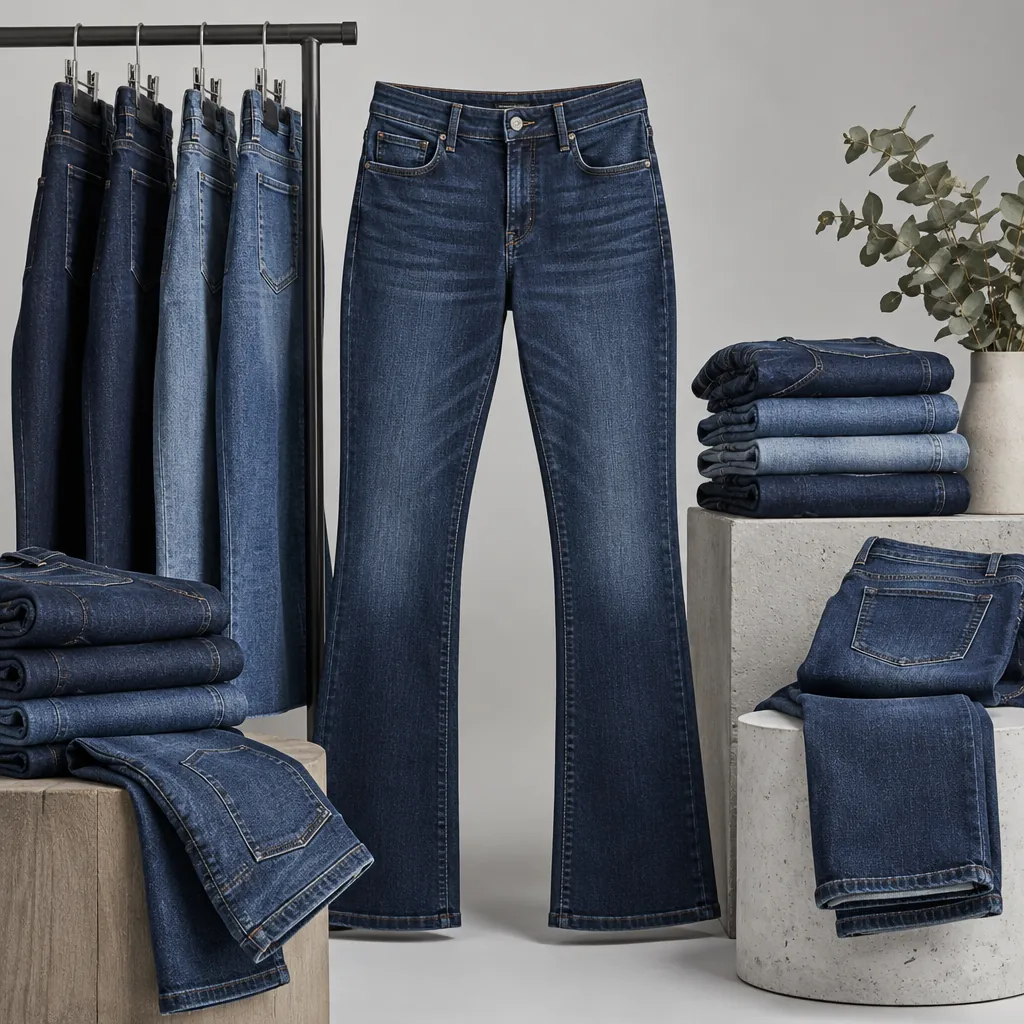
Women's jeans are the widest category on most denim floors, and also the easiest to overbuy. Search demand for womens jeans is broad rather than concentrated, which means the category rewards a planned structure more than a bold bet on a single silhouette. The questions a buyer faces are the same every season: how many silhouettes to carry, how deep to go in each, how to split the budget between core and seasonal product, and where the extended size range fits. This article walks through those decisions in the order they should be made, from sales history to size curve to reorder rhythm. The plan assumes a store buying wholesale for a mixed customer base; an online-first seller applies the same structure with its own data sources.
Start from the store's own sales history
Trend coverage and search rankings describe the market; the store's own sales record describes its customer. Before any new season is planned, three cuts of the history are worth making: sell-through by silhouette, return reasons by style, and the size distribution of what actually sold after exchanges. The first cut shows which shapes the customer accepts. The second shows which fits were specified badly. The third shows where depth was missing. A buyer who plans from this record can disagree with the trend feed with confidence, and a buyer who plans without it is guessing with the whole open-to-buy.
Splitting the budget across three layers
A workable women's range has three layers, and the split between them should be written down before ordering starts.
- Core layer. The silhouettes and washes that reorder reliably, planned as replenishment with standing reorder points.
- Seasonal layer. Light washes, seasonal colors and fashion finishes, bought in a defined window with a fixed markdown date.
- Test layer. One or two unproven silhouettes in limited depth, judged on real sell-through before a second buy.
The core should hold the largest share of the budget because it is the only layer with predictable cash flow. The seasonal layer earns its place by bringing traffic between core deliveries, and the test layer is the price of learning what the customer will accept next year. When a trend silhouette such as baggy takes over the coverage, the discipline is to place it in the test or seasonal layer first and promote it into the core only after the store's own data supports it.
Width before depth, or depth before width
The most common planning error in women's denim is breadth bought at the cost of depth. Five silhouettes in three washes and a thin size run produce a floor that looks full in the opening week and broken by the middle of the season. Two or three silhouettes in full depth produce steady sales and clean reorders. A useful rule is to fix the size depth first, then the wash count, then the silhouette count, in that order. The size depth comes from the fitting room and return data; the wash count from the customer's color habits; the silhouette count from whatever budget remains. A catalog review of the available silhouettes helps at this stage, but the count should be set by the capacity to hold depth, not by the length of the supplier list.
The rise and wash structure
Within each silhouette, the rise and wash decisions multiply quickly. Three rises and four washes are twelve products before sizes are counted. Most stores do better with one anchor rise per silhouette and a maximum of three washes in the core, led by a dark indigo that styles easily. The second wash should earn its place in a prior season before a third is added. Seasonal washes live in the seasonal layer with their own dates. This structure also simplifies communication with the supplier, because a range built on repeated rise-and-wash combinations across silhouettes can share fabric bookings and wash development, which shortens lead times and holds consistency across the wall.
The extended size range as its own plan
Plus sizes are not a share of the standard range and should not be planned as one. The customer base is distinct, the grading has to be independent, and the size curve is planned from its own sales history. A store that extends the standard run by a size or two and stops there usually ends up with edge sizes that never sell and a gap where real demand sat. Building the range properly starts with grading discipline, which the article on plus size grading covers in detail, and continues with a depth decision made from the store's own numbers rather than as a fixed share of the main buy.
Season structure and the reorder rhythm
Women's denim sells in waves, but the waves are predictable enough to plan around. A simple season has four moments: the core reset at the start, a seasonal delivery in the middle, a trend capsule where the test layer sits, and a clearance point with a date fixed in advance. Each delivery is planned backward from its selling window, because development time for new washes and fits is longer than most buying calendars assume. Between deliveries, the reorder rhythm on the core does the real work: styles that hold their sell-through reorder on schedule, and styles that slip are marked down early rather than carried. Lead times for each layer are confirmed in writing before the calendar is fixed, since fabric and wash development move on different schedules. A calendar with named moments also gives the supplier a forecast it can plan fabric against, which shortens development on the next season.
Signals that the plan needs correcting
- Edge sizes that sell long after center sizes have gone, which means the curve was too thin where it mattered.
- A silhouette with strong traffic and weak conversion, which usually points at fit rather than demand.
- Markdowns concentrated in one wash, which means the wash plan duplicated the colors the customer already owned.
- Reorders that arrive after the selling window, which means the lead time in the plan was optimistic.
Each of these signals maps to a decision made earlier in the season, which is the argument for writing the plan down: corrections are only as good as the structure they amend. The article on baggy jeans demand shows the same planning logic applied to a single trend silhouette.
Working with jeans
Quotations, minimum order quantities and lead times for a women's denim program are confirmed in writing for each order, because each silhouette, wash and size run carries its own terms. To plan a season against real capacity, request a quote with your target silhouette list, size runs and wash plan, and the response will set out the terms that apply.
Specification fields
| Field | Value |
|---|---|
| Fabric composition | Pending |
| Fabric weight | Pending |
| Wash options | Pending |
| Rise and fit | Pending |
| Leg opening | Pending |
| Stitching and finish | Pending |
| Hardware and trims | Pending |
| Labels and packaging | Pending |
Size chart fields
Measurements are taken flat, in centimeters or inches, and confirmed per size run.
| Field | Value |
|---|---|
| Waist | Pending |
| Hip | Pending |
| Rise | Pending |
| Inseam | Pending |
| Leg opening | Pending |
Pricing
| Tier | Quantity per style | Unit price (USD, FOB) | Lead time |
|---|---|---|---|
| Tier 1 | 300-499 pcs | Pending | approx. 30 days* |
| Tier 2 | 500-999 pcs | Pending | approx. 30 days* |
| Tier 3 | 1,000+ pcs | Pending | approx. 30 days* |
*Typical industry reference ranges for custom denim programs. Final MOQ, quantity tiers, unit prices and lead times are confirmed in writing for each program.
Private label options
Private label options for this style, including labels, trims, pocket detail and wash development, are listed on the custom and private label page and confirmed in writing.