Home / Denim Washes and Finishing: A Buying Guide
Denim Washes and Finishing: A Buying Guide
How stone, enzyme, acid, raw, laser and garment dye finishes set the look, hand feel, cost and lead time of denim. Standards confirmed in writing.
What a wash decides
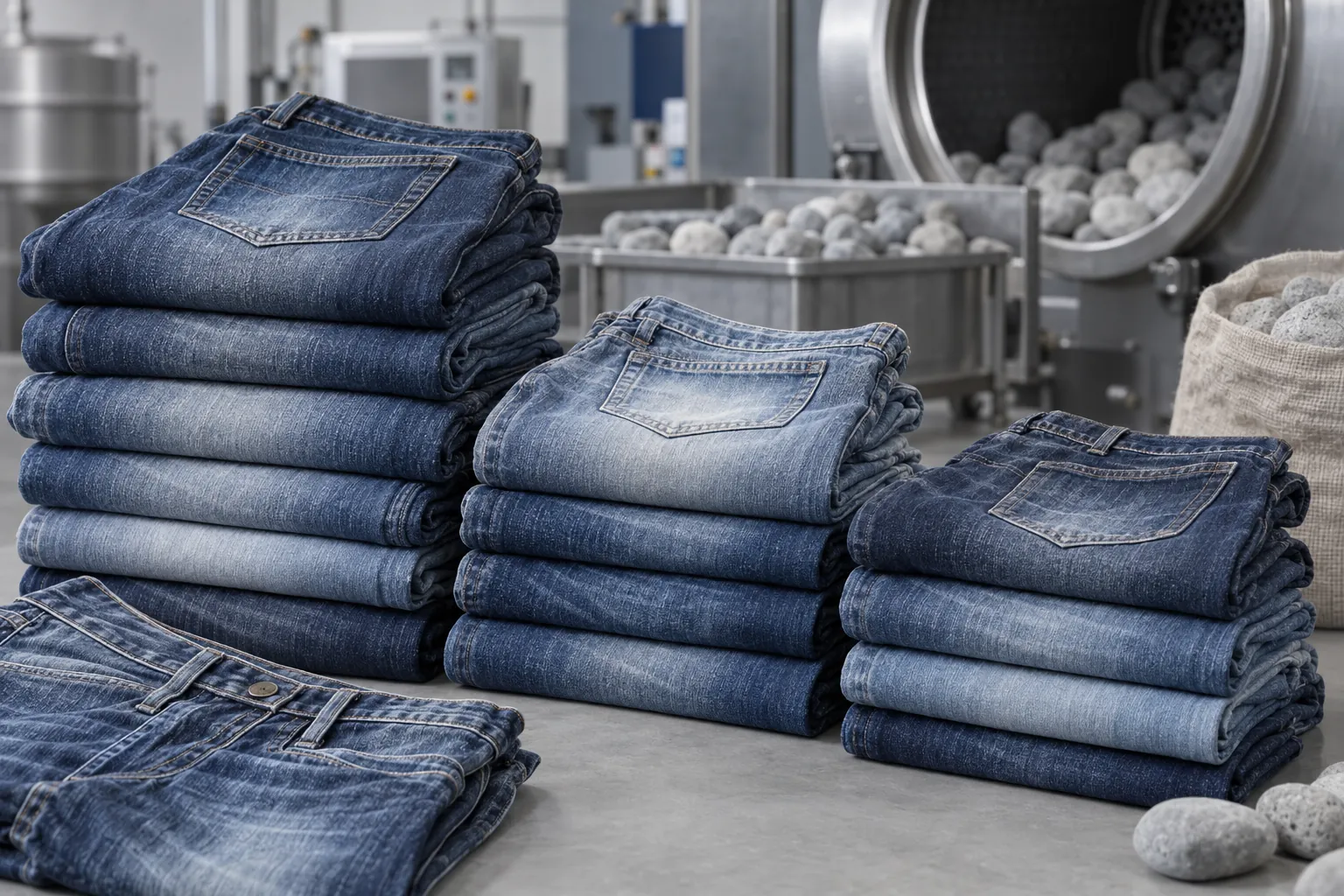
Jeans leave the sewing line as an unfinished garment in dark, rigid indigo. Everything a shopper recognizes as the look of denim is added afterward: mechanical abrasion, enzymes, chemical finishes, laser, dye, or deliberately none of these. For a retail buyer the wash is therefore not a detail to settle at the end. It is a program decision that belongs at the same table as fabric and fit, because the same silhouette in three washes is three separate products with three approval paths.
A wash moves four levers at once. Appearance: where indigo lifts, where it stays dark, and how much contrast the garment carries on a hanger. Hand feel: washed denim is softer and more relaxed out of the box, while unwashed denim is crisper and breaks in over months of wear. Cost and minimum order: every processing step adds cost per garment, and specialized finishes can change the quantity a facility will accept, so both are quoted per program. Lead time: washing, drying and inspection add days after sewing, and finishes with tight visual standards add checking time on top. The figures for any given program are Pending until quoted in writing.
The six processes in this section
Each sub-page in this section describes one process in the depth needed to write a specification. In one line each:
| Process | What it does to the garment | Main buyer risk |
|---|---|---|
| Stone wash | Pumice abrades the surface and lightens folds, seams and hems. | Uneven abrasion and strength loss when the standard is not written down. |
| Enzyme wash | Enzymes replace most pumice for a more even fade and a softer hand. | Back-staining and over-processing if the recipe is not controlled. |
| Acid wash | Treated stones create a high-contrast, mottled snow pattern. | Visible variation between production batches. |
| Raw denim | No wash after make; the garment keeps its loom-state indigo. | Residual shrinkage and care communication at the shelf. |
| Laser finishing | A digital file places whiskers, scraping and distress in fixed positions. | Parameter approval and facility capability per program. |
| Garment dye | Color is applied after cut and make, over fabric, thread and trims. | Shade variation between dye lots. |
The common thread is that every one of these processes is controllable, but only in writing. A washed sample that both sides keep as the sealed standard, a written description of where abrasion belongs, and an agreed tolerance for shade and contrast are what turn a good development sample into a repeatable order. The pages on stone wash and enzyme wash show what those written standards look like in practice.
Choosing a wash by customer and price band
Wash choice follows the customer first and the price band second. For entry-price basics aimed at broad, value-driven shoppers, a clean rinse or a light stone wash covers most of the demand and keeps the cost structure simple. In the middle of the range, enzyme wash gives a cleaner surface and a softer hand, which suits stores selling comfort first. Fashion-led assortments use contrast: acid wash and laser-placed distress carry trend risk, so they belong in capsule depth rather than core stock. At the premium end, raw denim serves customers who buy into the unwashed story and accept the care it requires.
Two cross-checks are worth running before committing. First, compare the candidates directly: the raw versus washed comparison sets out what changes for fit, care and display. Second, look at the process behind the quote, because wash complexity is one of the cost drivers; the laser finishing page explains why a digitally controlled finish can be more predictable than it first appears, and what to confirm before relying on it.
What to agree before the order
- A sealed washed sample, approved and retained by both sides as the visual standard.
- A written description of where fading or abrasion belongs, by area, not by photograph alone.
- Hand feel and shade checked on the washed garment, not on the fabric roll it was cut from.
- Shrinkage expectations and care label wording agreed before bulk, especially for raw programs.
- A repeat-order rule: repeats are compared against the sealed standard, not against a fresh sample.
Questions buyers ask
Does a heavier wash always cost more?
Usually, but not mechanically: each processing step adds cost per garment, and specialized finishes can change the minimum quantity a facility accepts. The reliable answer is the written quote for your specific fabric, wash and order mix, not a general rule.
Can I get the same style in several washes?
Yes, and it is a common way to build a range. Treat each wash as its own program with its own sealed sample and approval, because the same style washes differently depending on fabric weight and construction.
Which wash should I start a new program with?
For a first season, a clean rinse or a light stone wash is the safer choice for reading sell-through. Add contrast washes once the fit and size mix are proven, so a fashion wash is not carrying fit risk at the same time.
How are wash standards checked in production?
Against the sealed sample both sides retained at approval. Production garments are compared for shade, contrast and abrasion placement under an agreed light source, and any deviation is raised before packing, not after.
Are the washes described here available for small orders?
Availability depends on the washing facility, the finish and the season. Quantities and lead times for each finish are Pending until confirmed in writing for your program.