Home / Guides / Denim wash types: a buyer's reference
Denim wash types: a buyer's reference
A buyer's reference to denim wash types: rinse, mid and light washes, stone, enzyme, acid, garment dye and raw denim, and how to choose among them.
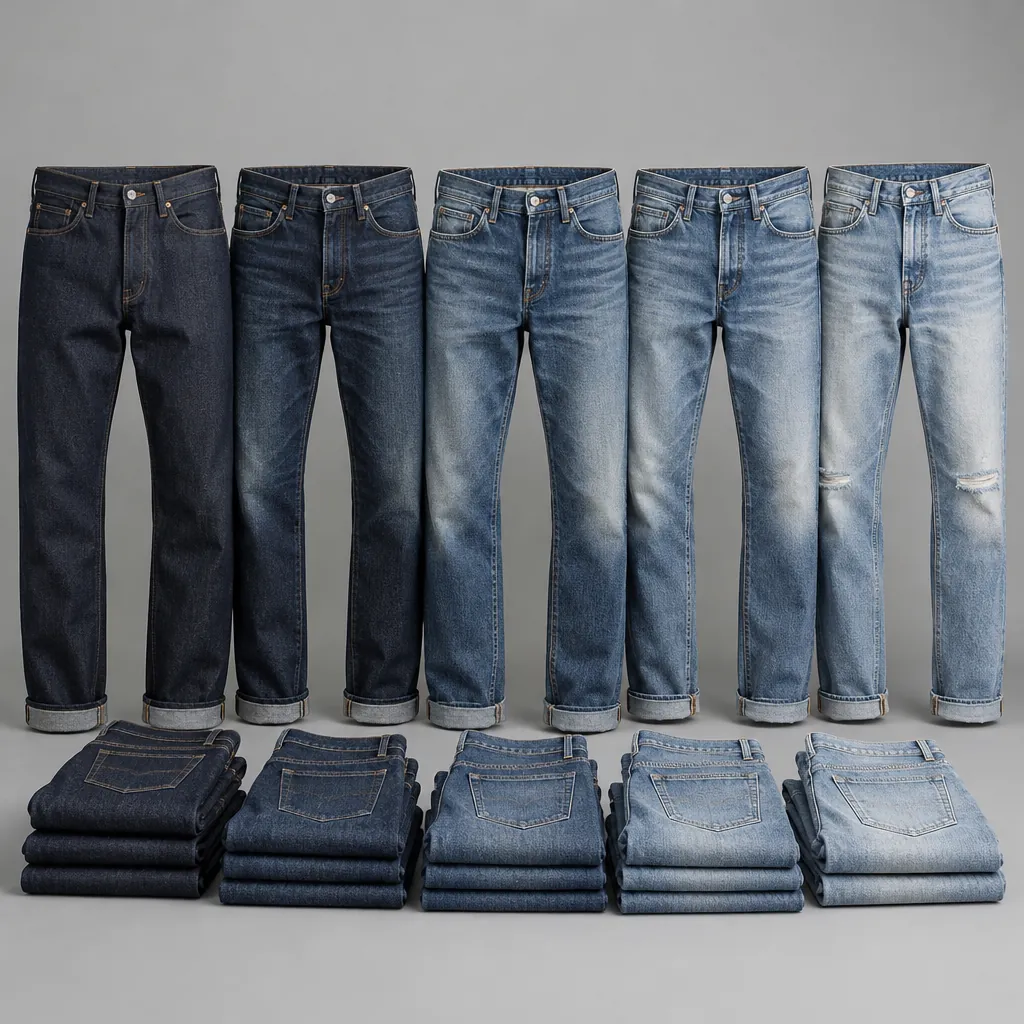
Every jean on a retail wall is the product of two decisions: the garment that was cut and sewn, and the wash that was applied to it afterward. The wash decides the color a customer sees from across the store, the softness of the hand, how the garment ages, and a meaningful share of the price and lead time behind it. Yet wash is often the least specified part of a buying brief. A buyer who writes medium blue into an order will receive a medium blue, but not necessarily the one imagined, and not necessarily the same one twice. This article is a working reference to the main wash types, what each does to the garment, and how to choose among them for a retail program.
Why wash is a production decision, not a styling note
A wash is a series of wet and mechanical processes applied to a finished garment. Each step changes the color, the hand feel and the dimensions of the piece, and some steps change the strength of the fabric as well. The same silhouette in three washes can behave like three different products after a few weeks on the floor and a few cycles in the customer's machine. For that reason, wash choices belong in the specification sheet next to the measurements, supported by an approved sample and a stated tolerance range, rather than in a styling mood board alone. A wash that is not specified is a wash that cannot be repeated.
The main wash families
Most retail assortments draw on a small set of families. Each has a distinct production route, a distinct look, and a distinct set of things the buyer must control.
- Rinse. A minimal wet treatment that cleans the garment and softens the hand slightly while keeping the deep indigo of the dyed yarn. The base for dark wash programs.
- Mid and light wash. Wash-down treatments that remove progressively more surface color, moving the garment from deep blue toward pale blue, usually with a softer hand at each step.
- Stone wash. Tumbling with pumice stones so abrasion lifts color at seams, hems and stress points, producing a naturally uneven, worn look.
- Enzyme wash. Uses enzymes rather than stones to release surface fibers and the indigo held in them, reaching a similar family of looks with less mechanical force.
- Acid wash. A high-contrast treatment that removes color in irregular pale patches against a darker ground, historically with pumice and an oxidizing chemistry.
- Garment dye. Dyeing the finished garment rather than the fabric, which colors seams and trims uniformly and opens a palette well beyond indigo.
- Raw, or unwashed. No treatment after dyeing. Deep uniform color, a firm hand, and first-wash behavior that the retailer must communicate.
Three of these families carry buying risks distinct enough to warrant their own articles: the mechanics and wear limits of the abraded look are covered in the article on stone wash, the reorder discipline for the high-contrast look in the article on acid wash trend reorders, and each treatment is also described for buyers on the finishing pages under washing.
How the families compare in production
| Wash family | Effect on the garment | What the buyer must control |
|---|---|---|
| Rinse | Keeps deep color, softens slightly | Color fastness and crocking results against a sealed standard |
| Mid and light | Progressive color removal, softer hand | Shade match across lots within a stated band |
| Stone wash | Abraded highlights at seams and stress points | Effect consistency and fabric strength after washing |
| Enzyme wash | Clean color removal with limited mechanical damage | Complete neutralization and shade repeat between lots |
| Acid wash | High-contrast mottled surface | Batch-to-batch match and an agreed intensity range |
| Garment dye | Uniform color across shell, seams and trims | Shade band, lot marking and dimensional change after dyeing |
| Raw | No treatment; the garment as woven and dyed | Shrinkage disclosure and first-wash guidance to the customer |
Choosing washes for a retail program
A workable assortment usually leans on one dark anchor, one or two mid washes, and a limited seasonal layer. Dark rinse denim is the most flexible position: it works for office settings and evenings, it pairs with the widest range of tops, and it reorders predictably. Mid washes carry the everyday volume in most stores. Light washes, stone, enzyme and acid effects are where a store expresses the season, and they deserve a shorter buying window and a tighter reorder plan than the core. Raw denim is a specialist position that rewards a retailer willing to explain it, and it can lift the story of the wall around it.
For e-commerce sellers the calculus shifts slightly. Washes with strong visual character photograph well but raise expectations, so the delivered garment must match the product photography closely, which makes the approved sample and the tolerance range more important rather than less. Washes that change noticeably in the first weeks of wear should be described on the product page, so the customer's expectation matches the garment's life and returns stay attributable to fit rather than to surprise.
Cost and lead time implications
Wash families differ in how much work they add after sewing. A rinse is the shortest route from finished garment to packed carton. Wash-down treatments add steps, and effects such as stone, enzyme and acid add recipe control, drying time and re-runs when a lot drifts. Garment dye requires dye capacity and adds a shade-approval stage ahead of production. Effects produced by machine, where used, depend on capacity that is often booked ahead. None of these differences reduce to a rule of thumb that survives contact with a specific laundry, so the practical method is to have each wash program quoted per style, with minimum quantities and lead times confirmed in writing before the development calendar is fixed.
Approving a wash before bulk
- Approve the shade direction on a lab dip or a washed swatch, in daylight and under store lighting.
- Approve the garment-level effect on a full sample in the intended silhouette, not on a swatch alone.
- Run a wash test on the approved sample, then check color, dimensions and hand after laundering.
- Seal the approved sample as the standard, dated and signed by both parties.
- Compare a pre-production sample from the bulk lot against the sealed standard before shipment.
One habit ties the whole range together. A buyer who can show a laundry a sealed standard from a previous order has a different conversation about a new wash than a buyer who arrives with adjectives. Standards accumulate across programs, and each later program starts further ahead because the vocabulary between buyer and laundry is already agreed.
Working with jeans
Wash options, minimum quantities, development time and lead times differ by program and are quoted per style. Every statement in this article is descriptive rather than contractual, and final pricing, MOQ and delivery schedules are to be confirmed in writing. To discuss a wash program for your range, request a quote and our team will respond with written terms.