Home / Wholesale Denim Programs by Application
Wholesale Denim Programs by Application
How retail stores, online brands, workwear programs and boutiques structure wholesale denim orders differently, with program notes for US buyers.
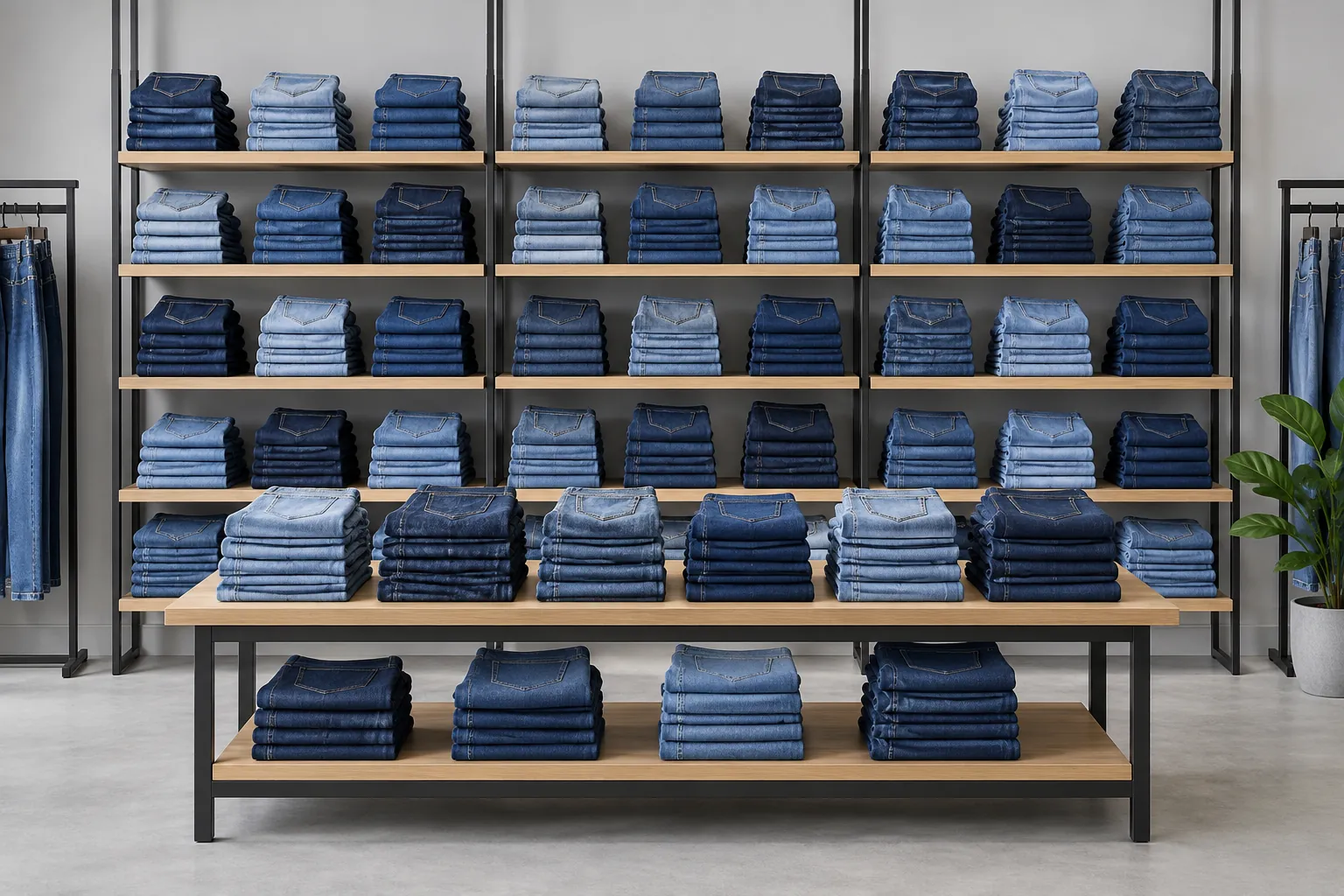
Four buyer profiles, four program structures
Denim is bought differently depending on who sells it and where it is sold. A single-store apparel retailer replenishing a denim wall, an online brand testing silhouettes against platform data, a company clothing coordinator dressing a workforce and a boutique owner building a seasonal capsule all place wholesale orders with different assortment logic, different size curves and different tolerance for risk. The buying structure follows the selling model, and the pages in this section describe what that means in practice for each profile.
Retail store denim wall programs
Physical retailers buy for a floor. The assortment is built depth-first: a limited number of silhouettes, each carried in a full size run and replenished as units sell. The buyer's working tools are the size curve, the replenishment cadence and the display plan, and fit consistency between deliveries matters more than novelty, because a returning customer expects the second pair to fit like the first. The retail store denim wall program page covers assortment depth, size curves and floor presentation.
Online denim brands
Online sellers trade floor depth for width. They carry more styles in smaller quantities, use early data to decide which styles to scale, and manage return rates through product content and size guidance rather than through fitting rooms. The ordering structure is deliberately stepped: small test batches, a read on sell-through and returns, then repeat orders on the styles that earned them. The online denim brand page sets out the testing logic and the stepped order structure.
Workwear and uniform programs
Company clothing buyers optimize for durability, size coverage and repeatable supply across years rather than seasons. Fabric moves in the heavyweight and rigid direction, size allocation is planned from the workforce and its roles instead of from a sales curve, and the commercial relationship usually takes the form of a framework agreement with call-off orders. The workwear program page covers the fabric direction and the agreement structure.
Boutique capsule collections
Boutiques buy narrow and deep within one concept: a few styles that share a wash language, delivered in quantities sized to one door or a small group of doors, inside a seasonal window that cannot slip far. Quantities are small, and minimum order quantities for developed washes and custom trims are set per program and confirmed in writing. The boutique capsule page covers selection logic, wash development and timing.
What changes between programs
| Program dimension | Retail store | Online brand | Workwear | Boutique capsule |
|---|---|---|---|---|
| Assortment logic | Depth over width | Width with test batches | Fixed range per role | Narrow capsule |
| Size planning | Store size curve | Platform returns data | Role-based allocation | Full run per style |
| Order rhythm | Scheduled replenishment | Test, read, scale | Framework and call-off | Seasonal drop |
| Fabric direction | Mixed weights | Trend-led, mixed | Heavyweight, rigid | Distinctive washes |
| Minimum order quantity | Pending | Pending | Pending | Pending |
Where every program is the same
Across all four profiles the working method is identical in one respect: nothing is fixed until it is written down. Silhouette specifications, size charts, wash standards, minimum order quantities, prices and lead times are confirmed in writing for each program before an order is placed, and approved samples are sealed as the reference for every delivery that follows. Buyers can treat that as the common denominator of this section: the profile changes the structure of the order, never the discipline around it.
Questions buyers ask
Which program type is the fastest to start with?
Retail replenishment programs on established silhouettes usually move fastest, because they run on existing patterns and standard washes. Developed washes, custom trims and framework agreements add development steps before the first bulk order. Exact timelines are confirmed in writing for each program.
Can one supplier serve several of these programs at once?
Yes, provided the programs are specified separately. A retail wall, a workwear range and a capsule carry different size matrices, fabric standards and order rhythms, and each keeps its own specification sheet and sealed samples.
Do minimum order quantities differ between the four profiles?
They can, because minimums follow from fabric runs, wash batches and packing rules rather than from the buyer type. The applicable level and value for each program are confirmed in writing before an order is placed.
Which profile carries the highest fit risk?
Online programs carry the highest measured fit risk, because returns make every fit miss visible as data. Store programs see fit misses as rack copies and slow sellers. Workwear sees them as issue complaints. Each profile controls fit through specification sheets and fit-approved samples.
How does a buyer move from one profile to another?
By respecifying rather than copying. A store buyer adding an online channel needs content-grade size documentation and a test-batch order structure; an online brand opening a floor needs depth planning and a size curve. The specification sheet is rebuilt for the new selling model.