Home / Guides / Acid wash jeans: managing a trend reorder
Acid wash jeans: managing a trend reorder
Acid wash jeans sell in fashion waves. How a buyer manages batch consistency, writes reorder terms and decides when a trend run has run its course.
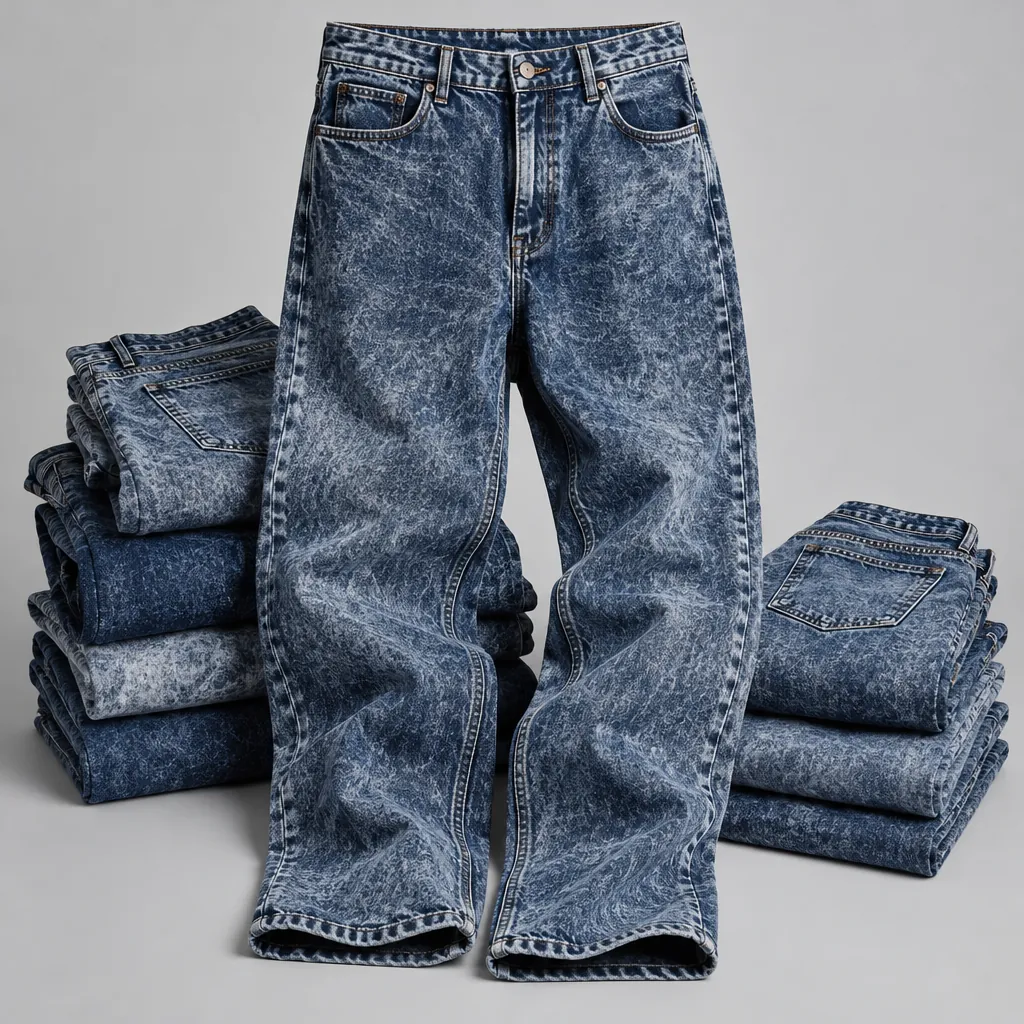
Acid wash returns to retail in cycles. The look, with its irregular pale clouds against a darker ground, is unmistakable, and when it is in demand it sells with little explanation. That same recognizability makes it a trend-managed product rather than a core one: demand arrives quickly, batch consistency is harder to hold than in conventional washes, and the buyer who reorders late pays twice, once in lost sales and once in markdowns when the wave has passed. This article is about managing an acid wash run from the first order through the reorder decision and the exit.
What the treatment is
Acid wash, sometimes called snow wash, is a wash-down treatment that removes color in irregular patches rather than evenly. Classically it is done by tumbling garments with pumice stones soaked in an oxidizing chemistry, which lightens the areas the stones contact; modern variants achieve related effects with different media or with machine methods that reduce the handling of soaked stones. The chemistry involved is hazardous to handle and is tightly controlled inside professional laundries. For the buyer, two facts follow. First, this is work for an equipped laundry, not a modification to request casually mid-production. Second, the oxidizing step and the rinsing that follows it interact with chemical compliance requirements, which is why test reports for the finished garment belong in the order documents. For where this treatment sits among the other wash families, the buyer's reference to denim wash types gives the overview.
What it asks of the fabric
The oxidizing step is among the more aggressive treatments a denim garment can meet in a laundry. Elastic yarns are more sensitive to it than cotton, so stretch programs need recovery checks after wash; plated or coated hardware can dull; and sewing threads chosen without the process in mind can lighten at the seams. None of these is a reason to avoid the treatment. All of them are reasons the fit sample for an acid wash program should be a washed sample, judged after the process rather than before it, and the fabric's strength and the garment's recovery after washing should be part of the test scope agreed in the order.
Why batch consistency is the central risk
The acid look is statistical by nature. Each stone applies chemistry to a small area, and the final pattern is the sum of many random contacts. Change the stone batch, the load size or the dwell of any step, and the pattern changes with it. Compared with an enzyme wash-down, where the shade drifts gradually, an acid run can drift in character: patch size, contrast and coverage move independently, and a lot can be the right shade overall while reading wrong in pattern. Buyers should therefore define the acceptable look as a band, not a point.
A related trap is approving from images. A photograph of one garment, taken in one light, is not a standard; it is an example. Standards in this category are physical: sealed samples at the agreed extremes of the variation band, compared under the agreed light source. The extra cost of sealing two or three reference samples is trivial against the cost of a disputed lot arriving at the warehouse.
Writing the first order so a reorder is possible
- Seal the approved sample and agree that bulk must fall inside a stated variation band around it.
- Record the recipe reference the laundry assigned, so a reorder reaches the same process, not a similar one.
- Agree a pre-production sample from the reorder lot, compared against the sealed standard before shipment.
- Ask for the color fastness and chemical test reports for the finished garment with the shipment documents.
- State the inspection point and the light source used to judge conformity, so both sides measure the same way.
Where the capsule pairs the acid look with abraded or damaged effects, those effects carry their own specification discipline, covered in the article on distressed denim specs, and the two sets of standards should be sealed separately so each can be judged on its own.
Deciding when to reorder
Trend washes deserve a harder test than core washes before money is committed again. A workable discipline is to set, at the time of the first order, the sell-through level and the calendar date at which the reorder decision will be made, and to require both. A style selling steadily week after week early in its window is a reorder candidate; a style whose early sales came from one promotion or one channel often is not. The buyer should also watch the wider market. When the look appears broadly across price points, the wave is already mature, and the remaining demand is usually shallower than the sales report suggests.
Timing interacts with production reality. An acid wash reorder is not an instant product: fabric, garments, laundry capacity and the approval cycle all sit between the decision and the shelf. The reorder point should be calculated from the supplier's confirmed lead time, not from hope, and the lead time should be confirmed in writing for the reorder specifically, because laundry slots change with the season and a figure quoted for the first order may not stand for the second.
Managing the exit
Every trend run needs an exit plan. A buyer who decides in advance what happens to residual stock at the end of the window, whether a planned markdown date, a channel for clearance or a cap on the final buy, protects margin and avoids the slow discounting that ties up open-to-buy. The acid wash is a category where this discipline earns its keep, because the look dates quickly once the wave has passed, and residual stock held past the window tends to sell only at prices the first-order margin never assumed.
Compliance notes that belong in the file
Because the treatment uses oxidizing chemistry, the finished garment's chemical test reports are part of the order, not an optional extra. Buyers serving markets with chemical restrictions should name the required test scope in the purchase documents and receive the reports before shipment. An overview of the common test items and the documents to request is in the chemical compliance guide, and the treatment itself is described for buyers on the acid wash finishing page of this site.
Working with jeans
Acid wash capability, minimum quantities and lead times vary by laundry and season, and every figure for a specific program is to be confirmed in writing. This article describes process and buying discipline, not a quotation. To discuss an acid wash run or a trend capsule, request a quote and we will respond with written terms.