Home / Guides / Stone wash: process, look and wear limits
Stone wash: process, look and wear limits
How stone wash creates its worn look, what pumice abrasion does to fabric strength, and how a buyer seals the standard before bulk.
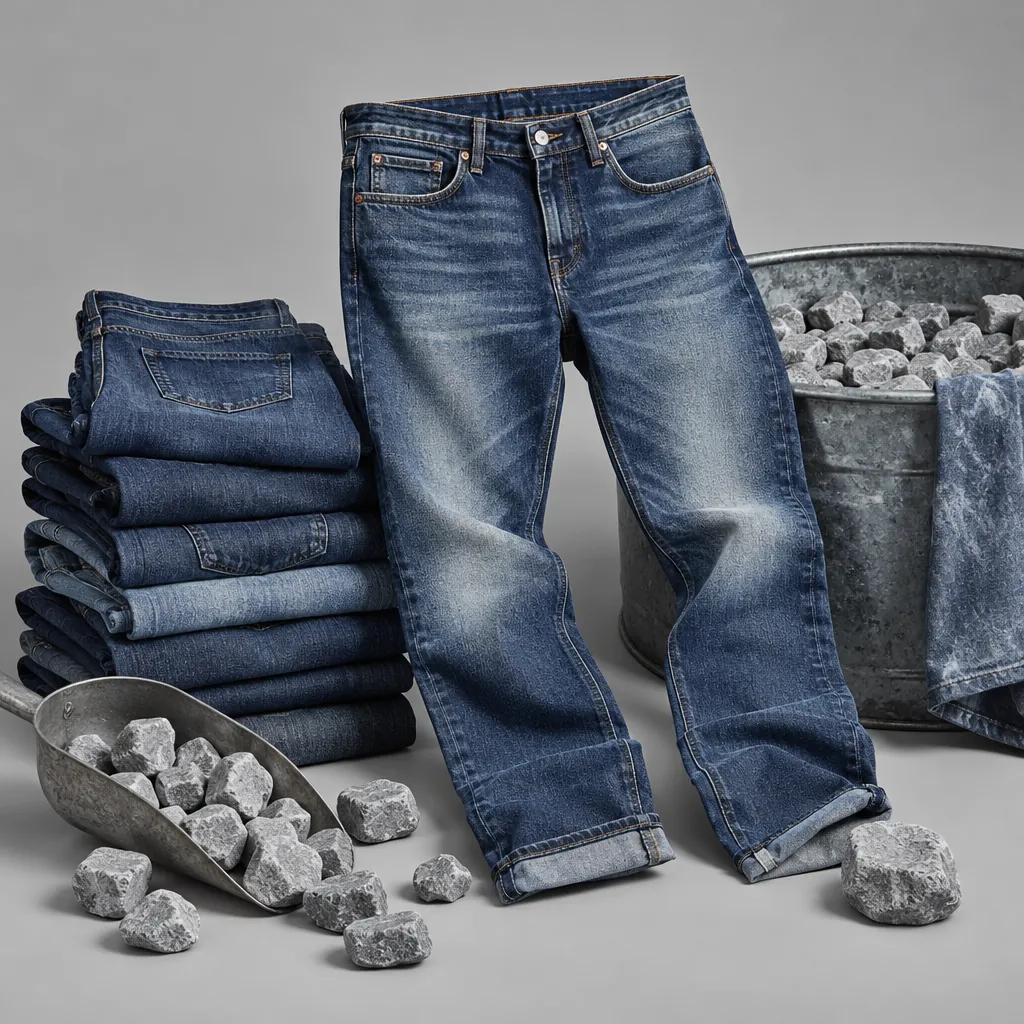
Stone wash is the treatment most customers picture when they think of worn-in denim: pale highlights across the seams and hems, a softened hand, and an unevenness that reads as use rather than as a printing error. It is also one of the oldest mechanical wash-down treatments in the industry, and one of the easiest to get wrong in bulk, because its defining ingredient, abrasion, is by nature difficult to meter precisely. This article explains what the process does to a garment, where its limits are, and how a retail buyer can pin the look down with a sealed standard before a bulk order runs.
What the process does
In a stone wash, finished garments are tumbled with pumice stones in a machine sized for garment work. The stones rub against the fabric as the drum turns, and the friction lifts indigo from the surface yarns, most visibly where the fabric is raised or stitched: waistband edges, pocket openings, hems, belt loops and the seams themselves. The garment emerges with color removed unevenly, which is the point. After tumbling, the stones are separated from the garments, which are then rinsed, often softened, and dried. Recipes vary by mill and by laundry, and every parameter inside them, including stone-to-garment ratios, cycle length and liquor level, is set by the laundry rather than published. Buyers should treat those parameters as the supplier's process knowledge and specify outcomes, not recipes.
Why the look is hard to repeat exactly
- Pumice is a natural material. Stones vary in size, density and wear rate between deliveries, and they break down as they work.
- The result depends on the load. A drum filled differently produces different contact between stones and fabric.
- Garment construction matters. A heavier seam or a double-turned hem takes more abrasion than a flat panel, so the same recipe reads differently on two styles.
- The fabric itself varies. Indigo shade, yarn twist and finishing agents on the cloth all change how readily color lifts.
None of these factors is a defect; together they explain why two lots washed to the same recipe can differ visibly. The control a buyer has is not the recipe but the standard: an approved sample that defines how much variation is acceptable, and an agreement that the bulk is judged against it.
The wear-limit question
Abrasion removes color by removing fiber, and fiber that is removed no longer contributes to strength. A heavily stone-washed garment is, at the abraded points, a thinner garment than it was before washing. In normal use this shows up as earlier failure at hems and seam allowances, or, in extreme washes, as thinning across the seat and thighs long before the rest of the garment has aged. The effect scales with intensity: a light stone wash barely touches garment life, while an aggressive wash that thins the fabric visibly will shorten it. Buyers should ask for the fabric's strength test results after washing rather than before, because pre-wash numbers describe a garment that no longer exists once the wash has run.
Stretch denim deserves a separate look
Stretch denim reacts to abrasion differently from rigid cloth. The elastic yarns that give the fabric its recovery are more vulnerable to mechanical damage than the cotton around them, and a wash plan tuned on rigid fabric can over-soften a stretch garment or reduce its recovery at the knee and seat, where recovery matters most in wear. A buyer ordering stone-washed stretch jeans should request recovery and strength checks on the washed garment, and should confirm in writing how the results will be judged before the order is placed rather than after it ships.
Specifying a stone wash in an order
- A sealed, dated sample of the approved effect, in the actual fabric and silhouette.
- A stated tolerance for variation between pieces within a lot.
- The fabric strength and color fastness results required after washing, by named test method.
- The care label wording, which should match the wash's actual behavior.
- The inspection point at which the effect is checked: after wash, before packing.
Quantity matters in a different way. Because the look depends on physical contact between stones and garments, very small runs can wash differently from production-scale loads, so the sample should be washed at a load size the laundry considers representative. Where that is not possible, the buyer should treat the first bulk lot as the final approval stage and hold shipment until it has been checked against the sealed standard. Both arrangements are ordinary commercial practice, and the one that applies is to be confirmed in writing with the laundry.
Sealing the standard
The sealed sample is the single most useful document in a wash program. It is a physical sample, signed and dated by both sides, kept in two copies so that buyer and laundry compare against identical references. When a bulk lot is compared against the sealed standard under the agreed light source, a dispute about whether a lot is too light becomes a measurement instead of an argument. For a fuller description of how the approval stages fit together, the article on wash sampling walks each stage from lab dip to bulk. Sealing standards, tolerances and inspection points are to be confirmed in writing for every order.
Where stone wash fits in a range
Stone wash suits programs that want an authentic, irregular worn look and can accept piece-to-piece variation inside an agreed band. Where a range needs a cleaner, more repeatable wash-down at scale, the same family of looks is often reached with enzymes instead, at a different cost structure; the comparison is set out in the article on enzyme wash versus stone wash. The treatment is also described for buyers on the stone wash finishing page, which pairs with this article when briefing a team.
Working with jeans
Stone wash recipes, minimum quantities and lead times are set per program and vary between laundries. Nothing in this article is a quotation; prices, MOQ and delivery dates are to be confirmed in writing before an order is placed. To start a stone wash program, request a quote with your target styles and washes.