Home / Guides / Enzyme wash vs stone wash: cost and handfeel
Enzyme wash vs stone wash: cost and handfeel
Enzyme wash and stone wash reach similar looks by different routes. A comparison of handfeel, garment life, cost structure and fit for retail programs.
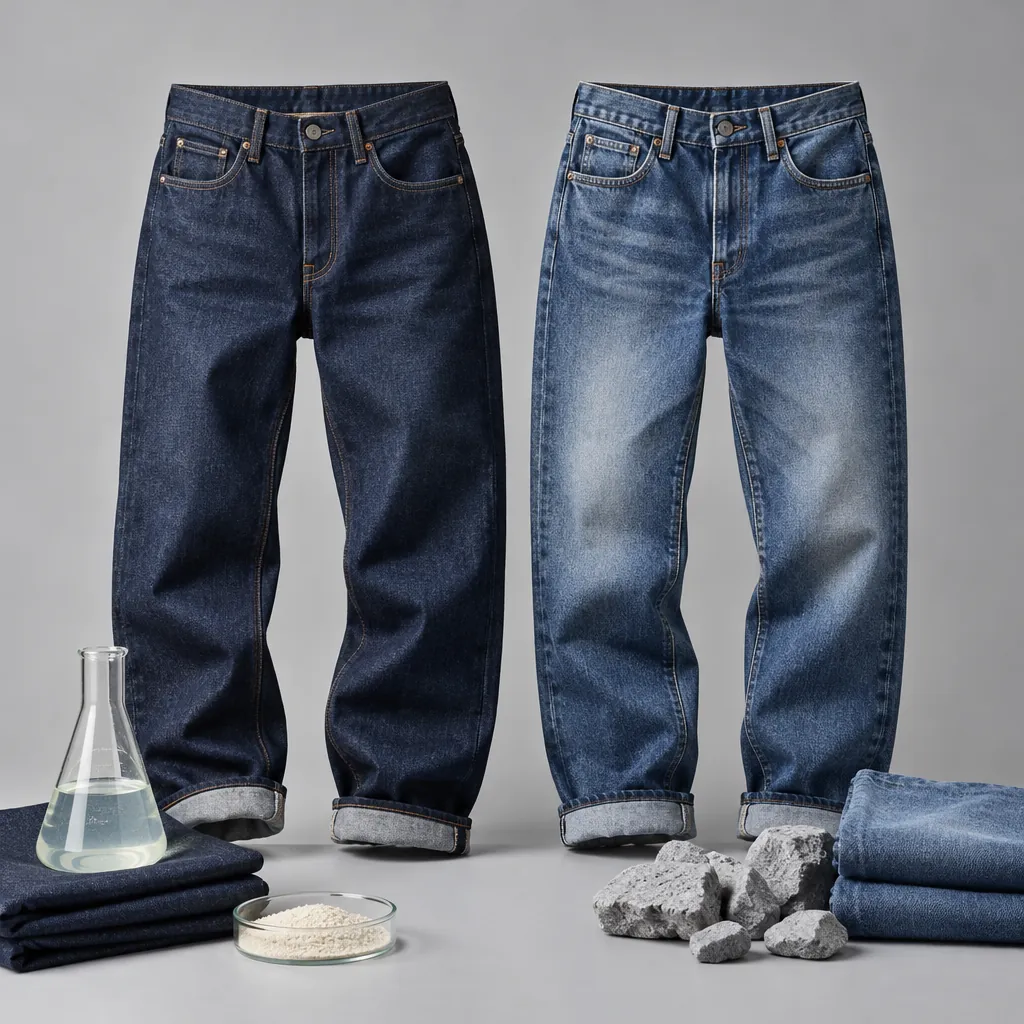
Enzyme wash and stone wash are two routes to the same family of looks: softened fabric, lifted color at seams and stress points, and a garment that feels broken in from the first wear. They differ in mechanism, in what they do to the garment over its life, and in cost structure. For a buyer choosing between them for a program, the decision is less about which looks better on a single sample and more about which set of trade-offs fits the price point, the fabric and the repeatability the program needs. This article compares the two on those terms.
Two mechanisms, similar destinations
Stone wash removes surface color mechanically. Pumice stones abrade the fabric as garments tumble, scraping indigo off the raised parts of the cloth and leaving naturally uneven highlights. Enzyme wash removes surface color biochemically. Enzymes that target cellulose are used to break down the tiny surface fibers that hold loose indigo; when those fibers are removed in the wash bath, the color lifted with them, and the surface that remains is cleaner and smoother. Both routes take a dark garment toward a washed-down shade. They differ in how uniformly they get there and in what they leave behind.
Handfeel and garment life
Enzyme-treated garments generally emerge with a smoother surface and a softer, more even hand. Because little mechanical force is involved, the fabric's structure is largely intact, and hardware and embroidery are not battered by stones. Stone-washed garments carry the marks of their process: a slightly rougher surface texture, more pronounced contrasts, and genuine thinning at the points of heaviest contact. Over the life of the garment this difference matters. Aggressive abrasion removes fiber, and removed fiber no longer carries load, so heavily stone-washed fabric fails earlier at hems and seams than the same fabric treated enzymatically to a similar shade. A buyer should weigh the visual authenticity of stone against the retention of fabric strength.
Handfeel also ages differently. An enzyme-washed garment tends to stay smooth through repeated laundering because the surface fibers that cause pilling have already been removed; a stone-washed garment can soften further in the customer's machine, which some customers read as the garment improving with age. Neither direction is wrong, but they suit different positions: the cleaner, more stable surface supports a program selling on consistency, while the evolving surface supports a program selling on character. Buyers can see the difference by laundering sample garments through several cycles and comparing the results side by side.
Cost structure compared
The two processes cost money in different places, which is why a per-garment comparison taken from a single quote can mislead.
| Dimension | Enzyme wash | Stone wash |
|---|---|---|
| Materials | Enzyme product plus neutralization steps; cost follows the market for enzyme products | Pumice, a natural material with its own price cycles, plus stone handling and sludge removal |
| Labor and machine time | Cycle lengths are generally comparable; neutralization adds a stage | Loading and unloading stones adds labor; stone removal from garments adds a step |
| Rework risk | Shade drift is gradual and easier to correct within a lot | Effect drift can be more abrupt; re-runs are costlier once a lot is off-standard |
| Garment life impact | Minimal structural loss at an equal shade | Thinning in proportion to intensity |
| Best fit | Clean, repeatable wash-downs at scale; stretch fabrics | Authentic irregular looks; rigid fabrics; heritage positions |
The cells describe tendencies, not quotations. Actual wash costs per garment are to be confirmed in writing for each style and each laundry, because the same treatment prices differently at different scales and seasons.
Repeatability across lots
Enzyme processes tend to drift in shade, which is a manageable failure mode: the laundry adjusts dwell or concentration within its process knowledge and brings the lot back toward the standard. Stone processes drift in character, because stone size and wear change the contact pattern. For a program where the same wash runs repeatedly across many months, enzyme routes usually hold a tighter repeat. For a program built on visual irregularity, the stone route's variance is part of the product, and the specification should embrace a variation band rather than fight it.
Stretch fabrics and special constructions
Stretch denim deserves specific mention. The elastic yarns that give the fabric its recovery are sensitive to mechanical damage, and stone contact can degrade them at the very points, knee and seat, where recovery matters most in wear. Enzyme routes treat the surface with less force, which is why stretch programs often specify them. Garments with heavy embroidery, patchwork or delicate trims face the same logic: anything that stones would batter, enzymes treat more gently. Residual enzyme activity is the counterweight to watch. A wash that is not properly neutralized can continue to weaken fibers after the garment leaves the laundry, so buyers should require neutralization and post-wash strength testing as part of the specification rather than as a favor.
Choosing for a program
- Choose enzyme where repeat consistency, fabric strength retention and stretch content dominate the decision.
- Choose stone where the irregular, physical character of the effect is the product and the fabric is robust.
- Consider a combined approach where a light stone pass sets the pattern and enzymes clean and soften the surface; this is common in practice and should be specified by outcome.
- In all cases, judge both routes on washed, tested garments rather than on unwashed samples.
Whichever route is chosen, the approval mechanics are identical: lab dip for shade direction, full garment sample for the effect, a sealed standard, and a pre-production check from the bulk lot. The stone washing and enzyme wash finishing guides describe each process for buyers, and the article on the stone wash process covers its wear limits in detail. Where effects must repeat exactly across many pieces, the article on laser finishing describes the digital route.
Working with jeans
Wash costs, minimum quantities and lead times differ between laundries and are quoted per program. Nothing here is a price; final figures are to be confirmed in writing before commitment. To compare enzyme and stone routes on your own styles, request a quote with the washes you have in mind.