Home / Guides / Laser finishing: consistent vintage effects
Laser finishing: consistent vintage effects
Laser finishing turns vintage effects into a digital file. How sampling to bulk works, where laser fits, and what it changes for cost and consistency.
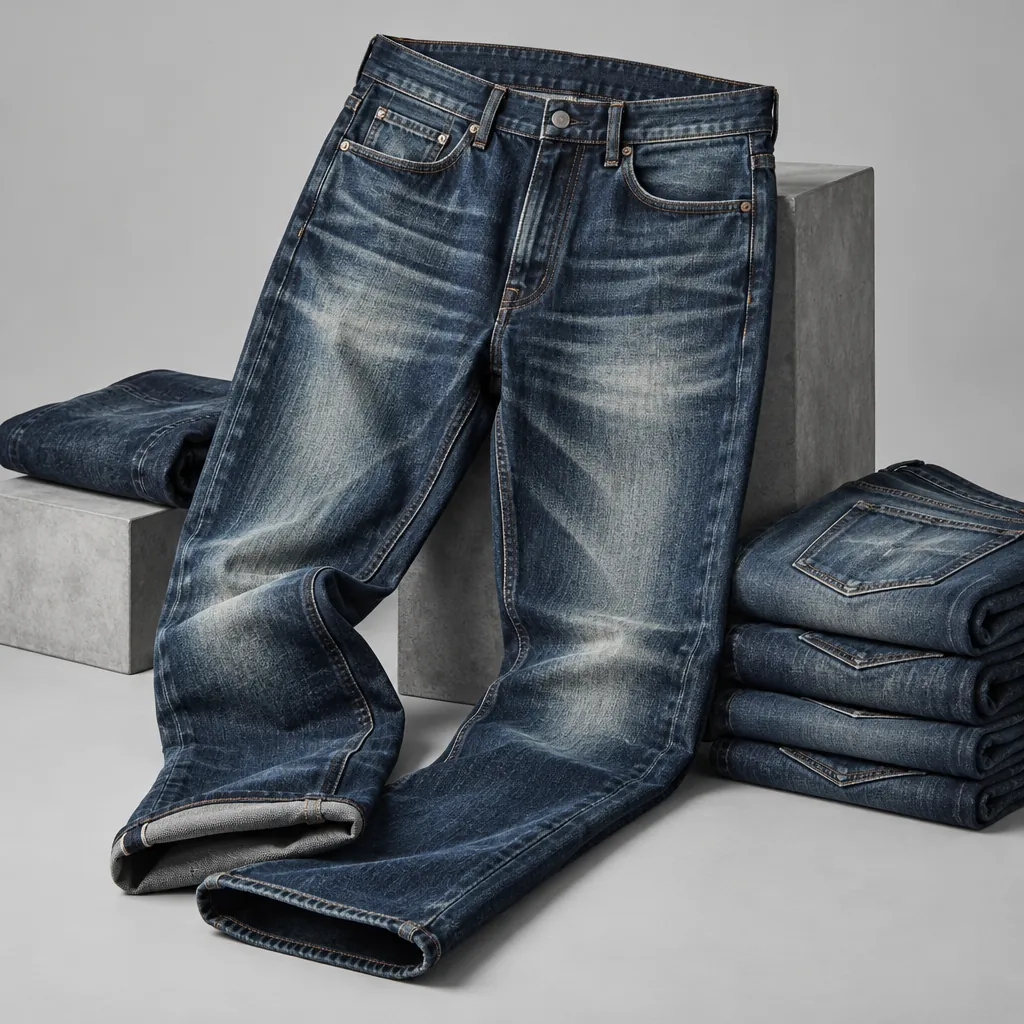
Vintage effects used to be made by hand and by stone: operators sanding whiskers line by line, tumbling garments until the abrasion read right. Laser finishing changed the mechanics. A digitally controlled beam removes surface indigo according to a graphics file, producing whiskers, abrasion marks and overall wash-down with a repeatability that hand work cannot match. For a buyer, laser finishing is less a mystery than a discipline: the file is the specification, the fabric and the intensity settings are the variables, and the approval process decides whether the bulk looks like the sample. This article follows the treatment from design file to bulk approval.
What laser finishing does
The machine directs a beam across the garment surface in patterns defined by a digital file. Where the beam meets indigo-dyed fabric, it removes the surface fibers and the color sitting in them, leaving the paler beneath. Effects that once required hand sanding, whisker patterns at the hip and knee, abrasion at pocket edges and hems, can be produced from the file, and the same file applies to every piece in a lot. The beam acts on the surface; it does not wash the garment. Overall tint, softness and the wet-process part of the look still happen in laundry baths, which is why laser programs are usually a combination: digital effects plus a conventional wash around them. The treatment is also described for buyers on the laser finishing page of this site.
Why consistency improves
- The pattern is a file. Once approved, the file applies identically to piece after piece, independent of operator fatigue or skill.
- Placement is controlled. Whiskers land at the same height relative to the pocket on every garment, which matters when the fit is graded across a size run.
- Variables shrink. Hand work varies with the operator and the day; laser work varies mainly with the fabric, the focus and the intensity settings the laundry assigns.
- Records are portable. The approved file, stored and versioned, becomes part of the specification and travels with the order to any laundry equipped to run it.
None of this removes the wet chemistry from denim, and it is worth being precise about what the machine replaces: the hand work and, in some recipes, part of the stone load, not the rinse or the softening that follow. A buyer briefing a brand team should describe laser finishing as a way of making effects repeatable and position-critical, which is where its value sits, rather than as a change to what the garment fundamentally is.
From sampling to bulk
The approval ladder for laser effects has one extra rung: the file. A workable sequence runs design file, then a struck sample on the actual fabric, then the full garment sample with its wash, then the sealed standard, then a pre-production check from the bulk lot. The struck sample is where surprises surface. The same file cuts differently on fabrics that differ in weight, indigo depth or surface finishing, so the file must be approved on the fabric that will run in bulk, not on a convenient substitute. Buyers should also confirm who owns the file and whether it is retained for reorders; a lost file is a re-development, not a reprint.
Fabric changes reopen the file. A program that runs the same design across two fabric lots, or adds a second fabric weight to the style, should treat the file as unproven on the new substrate until a struck sample says otherwise, because intensity that reads correctly on one cloth can under- or over-cut on another. Buyers who manage multi-fabric programs usually fold this check into the pre-production stage: the file is approved once as a design, and re-verified per fabric in writing before each bulk run. The small delay is cheaper than a lot of garments whose whiskers sit at the wrong depth.
Where laser fits, and where it does not
Laser excels at precise, position-critical effects: whiskers, local abrasion, logo-area wear and mended-look details that hand work renders inconsistently. It is less a complete answer where the look depends on overall softness and three-dimensional abrasion, which still come from washing and tumbling. Open holes and heavy destruction are a separate craft, and the specifications that hold up in inspection for those effects are covered in the article on distressed denim specs. Most production programs use laser as one layer inside a wash recipe rather than as the whole recipe, and the buyer's specification should describe the finished garment, not the machine.
Cost and capacity realities
Laser capacity is machine time, and machine time is scheduled. Laundries equipped for laser work book it ahead, and effects that run long per piece raise both cost and lead time in proportion to their complexity. Against that, laser replaces labor: the hand-sanding hours it absorbs are the costlier and less consistent input in conventional finishing. Which side of the trade a program lands on depends on the effect, the volume and the laundry, so the practical method is to quote the finishing per style rather than assume laser is cheap or dear. Finishing costs, minimum quantities and lead times are to be confirmed in writing for each program.
There is also an environmental ledger that buyers increasingly ask about. Laser work can reduce the water, pumice and chemical burden of the steps it replaces, though the size of the reduction depends on the whole recipe, not on the laser alone. Buyers who need to make claims about such reductions should rely on supplier documentation rather than on the presence of a machine; the article on sustainable washing claims sets out what can be verified and how.
Working with jeans
Laser finishing is quoted per style and depends on laundry capacity, so minimum quantities and lead times are to be confirmed in writing for every program. This article describes the process, not an offer. To test laser effects on your own fabrics and fits, request a quote and we will coordinate samples and written terms.