Home / Guides / Baggy jeans: demand signals and sizing risks
Baggy jeans: demand signals and sizing risks
Baggy jeans demand signals and the sizing risks behind them: fit ambiguity, waist grading, return exposure and a phase-out plan for trend stock.
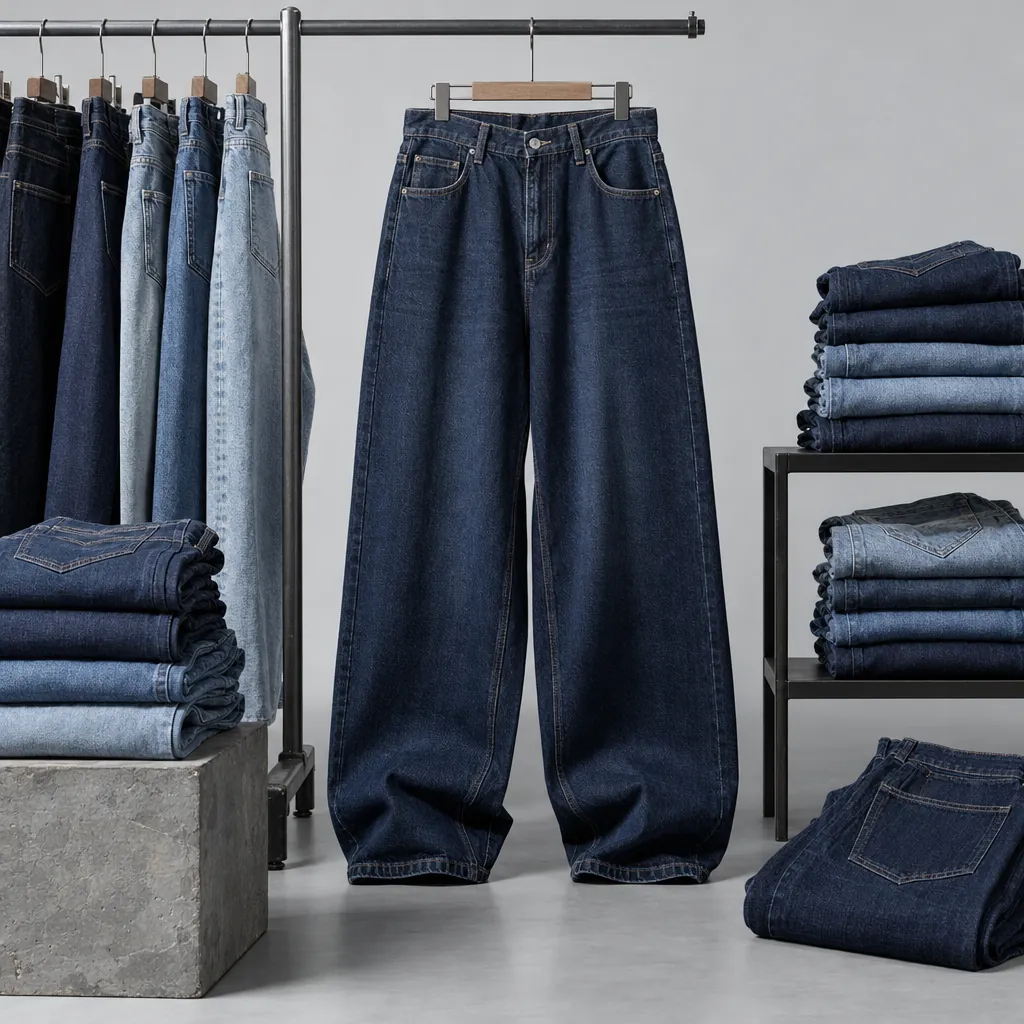
Baggy jeans are the silhouette where trend enthusiasm and operational risk meet most sharply. Search interest for baggy jeans is high and still climbing in the United States, social feeds push the style constantly, and the customer response on the floor can be immediate. The same properties that make the style exciting also make it fragile: the fit is loosely defined, the sizing behaves differently from fitted cuts, and demand that arrives quickly can leave just as quickly. None of what follows argues against the style; it argues for entering it with the same paperwork a core style would get. This article reads the demand signals honestly, sets out the sizing risks that drive returns, and gives a structure for the first order and the exit.
What the demand signals do and do not tell you
| Signal | What it supports | What it does not prove |
|---|---|---|
| High and rising search interest | A real shift in shopper attention toward relaxed volumes | That a specific store's customer will buy the style in depth |
| Strong social media presence | That the style photographs well and travels between platforms | That the shoppers posting are in your size range or price band |
| Fast sellouts at trend retailers | That early stock can clear quickly | That a reorder will clear at the same speed |
Read together, the signals justify a test position, not a core position. The style belongs in the trend layer of the assortment until the store's own sell-through, at its own sizes and price points, says otherwise. A buyer who skips this read often discovers that the demand was real but lived in sizes or a price band the store does not serve.
Why baggy sizing behaves differently
A baggy leg hides the body, so the customer cannot read the size from the mirror the way she does with a fitted cut. Fit satisfaction shifts to the waist, the rise and the length, and those are exactly the points where baggy patterns vary most between factories. Three issues dominate returns in this silhouette: waistbands that run large relative to the label size, rises that are dropped so far that the garment sizes differently from everything else on the floor, and inseams that pool because the wide hem has no natural break point. None of these is visible on a hanger, and all of them surface after purchase, which is where the cost lands.
The fit points to pin down before ordering
- Waist measured and stated flat against the label size, with the tolerance in writing.
- Front and back rise recorded separately, so the drop is a decision rather than an accident.
- Inseam planned against the intended break, since a wide hem shows extra length more than a narrow one.
- Leg opening and knee width recorded, so the volume is distributed rather than dumped at the hem.
Who is actually buying the style
Baggy demand is not one customer. A younger, streetwear-adjacent shopper buys the silhouette as a look and tolerates a loose size match. An older or more mainstream shopper tries the style for comfort and abandons it the moment the fit feels sloppy. The same garment serves both poorly or both well depending on specification. A cleaner waistband, a moderate drop and a controlled leg opening keep the mainstream customer in the style; a full drop and extreme volume serve the trend customer but narrow the base. The store's existing customer profile should decide which version of baggy the buyer specifies, and the sizing page should say plainly how the style fits relative to the rest of the range, because the customer cannot infer it from the rail.
Details that date the style quickly
Baggy is a volume story more than a detailing story, and the details are where the style shows its age fastest. Extreme distressing, heavy graphic hardware and exaggerated pocket treatments tie the garment to a narrow moment, while clean indigo and mid washes keep it wearable after the peak passes. For a buyer managing trend risk, the quieter version of the style is also the more liquid one: it clears at the end of the season with shallower markdowns, and it can carry over into a relaxed program if the trend cools. This is a buying argument rather than a styling one. The specification sheet should treat loud details as a deliberate decision with a shorter selling window attached, priced and depth-planned accordingly.
Structuring the first order
The first buy should be sized to learn from, not to win the season. A limited run in the most central sizes, in one or two washes, gives a clean read on demand without committing the budget. The reorder trigger should be written into the plan: a sell-through level and a decision date, agreed before the stock lands. Because relaxed volumes use more fabric per garment, the cost gap between a small and a large reorder is wider than in fitted styles, which makes the staged approach cheaper as well as safer. Fabric bookings also move faster in trend moments, so the reorder window should be planned with the supplier rather than assumed. The planning logic follows the same pattern set out in the women's category planning article: a trend layer position with a written promotion path into the core.
Planning the exit before the entrance
Trend silhouettes end, and the end is cheaper when it is scheduled. Three controls make the exit survivable. First, a markdown date fixed at the start of the season, moved earlier if sell-through lags the plan. Second, a size-priority clearance that clears the edge sizes before the center, because edge sizes are the hardest to place later. Third, a carryover decision: relaxed fits as a family outlive the extreme version of the trend, so the reorder can shift volume from extreme baggy into a moderated relaxed or wide leg cut without changing the customer's mental shelf. A store that plans the exit holds its margin; a store that improvises it donates the season to the clearance rack. When returns do spike, the article on high return rates sets out how to separate fit causes from page causes before reordering.
Working with jeans
Quotations, minimum order quantities and lead times for a baggy program are confirmed in writing for each order, and the relaxed volume changes both fabric consumption and finishing terms. To test the silhouette against a controlled first run, request a quote with your target measurements and size plan, and the response will state the terms that apply.
Specification fields
| Field | Value |
|---|---|
| Fabric composition | Pending |
| Fabric weight | Pending |
| Wash options | Pending |
| Rise and fit | Pending |
| Leg opening | Pending |
| Stitching and finish | Pending |
| Hardware and trims | Pending |
| Labels and packaging | Pending |
Size chart fields
Measurements are taken flat, in centimeters or inches, and confirmed per size run.
| Field | Value |
|---|---|
| Waist | Pending |
| Hip | Pending |
| Rise | Pending |
| Inseam | Pending |
| Leg opening | Pending |
Pricing
| Tier | Quantity per style | Unit price (USD, FOB) | Lead time |
|---|---|---|---|
| Tier 1 | 300-499 pcs | Pending | approx. 30 days* |
| Tier 2 | 500-999 pcs | Pending | approx. 30 days* |
| Tier 3 | 1,000+ pcs | Pending | approx. 30 days* |
*Typical industry reference ranges for custom denim programs. Final MOQ, quantity tiers, unit prices and lead times are confirmed in writing for each program.
Private label options
Private label options for this style, including labels, trims, pocket detail and wash development, are listed on the custom and private label page and confirmed in writing.