Home / Guides / Flare jeans for retail: fit and wash choices
Flare jeans for retail: fit and wash choices
How retail buyers specify flare jeans: flare start point and knee width, inseam and hem choices, and the size curve details that prevent returns.
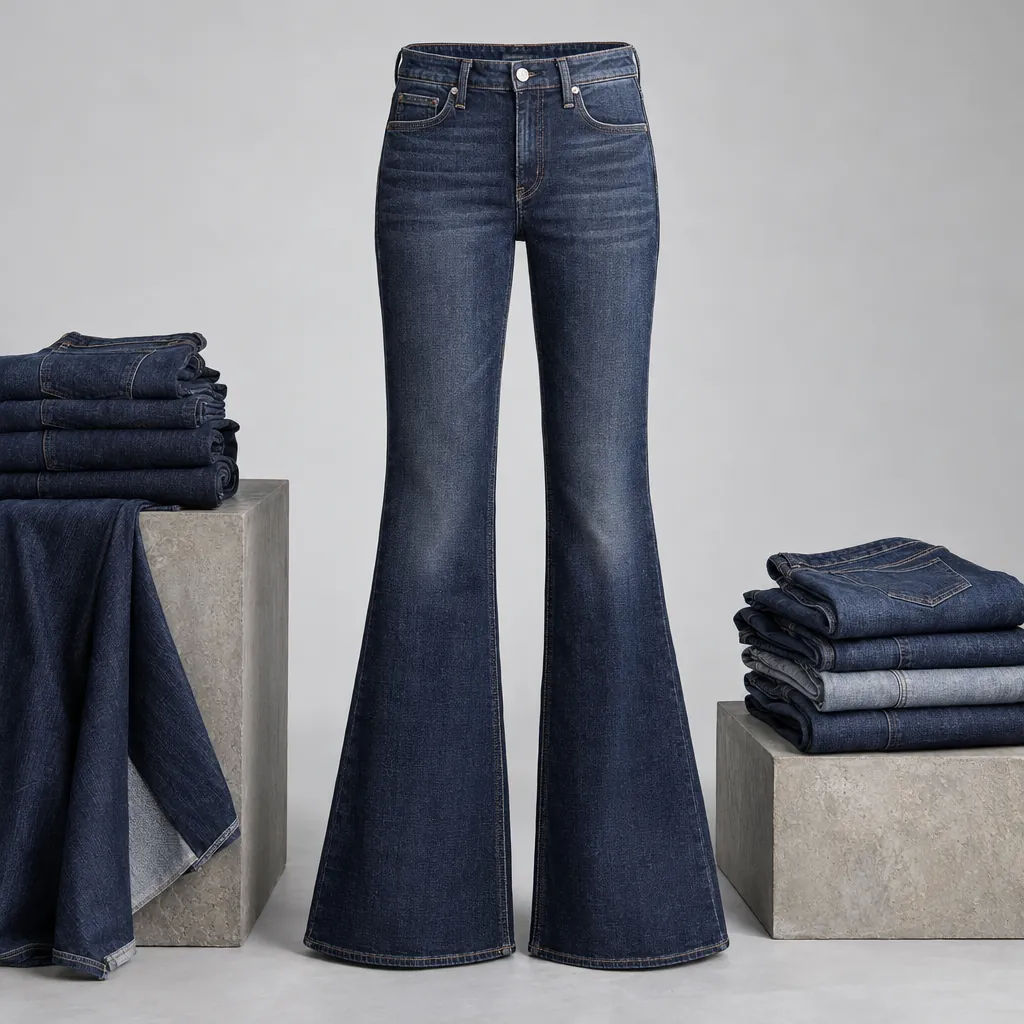
Flare jeans hold a specific position in a denim assortment: fitted where the body is shaped, generous where the shoe needs room. Search interest for flare jeans remains among the strongest silhouette terms in the United States, but the style is specified poorly more often than any other fitted cut, because the flare itself can start anywhere from above the knee to the floor and each choice produces a different garment. This guide covers the decisions that define a flare program: where the flare begins, how the hem meets the shoe, and how the size curve has to change to keep the fit honest across body shapes.
A flare is not a wide leg
The two silhouettes are often grouped together in trend coverage, and buyers who treat them as one style end up with a range that serves neither customer. A wide leg runs generous from the hip down. A flare is fitted through the hip and thigh, holds the shape through the knee, and only then opens toward the hem. The customer who wants a flare is buying the contrast between the fitted top block and the swinging hem, and a pattern that adds width too early destroys that contrast. When the two styles share a line sheet, the specification sheets should keep them strictly apart, with the knee width as the point that separates them.
The wide leg buying guide covers the neighboring silhouette in its own terms; the sections below deal only with the fitted version.
Where the flare starts
- Flare from above the knee. The most dramatic read and the most sensitive to body shape; works for a young, trend-led customer and sells on the fitting room mirror.
- Flare from the knee. The balanced default for most programs; keeps the thigh clean while giving a clear swing at the hem.
- Flare from below the knee. The subtlest version, close to a bootcut; easier to fit, easier to size, and the safest choice for a first order.
The start point should be written as a measurement from the waistband down to where the leg begins to widen, with the value confirmed on the fit sample rather than named in words. Two factories given the same sketch will place the flare differently, and the difference is invisible until the garment is on a body.
The knee measurement that decides the look
Knee width is the control point of the whole silhouette. Too narrow and the flare becomes a costume; too wide and the style drifts toward a wide leg and loses the contrast the customer came for. The knee width should be recorded flat, in the specification, with the agreed tolerance, and it should be checked at both ends of the size run, because grading a knee too conservatively makes the flare vanish on larger sizes while the hem stays wide, which changes the entire proportion of the garment for that customer. The hem opening then follows: it is judged against the knee, not as a standalone number, and the ratio between the two is what the eye actually reads.
Inseam, hem and the shoe
Flare hems are judged against footwear, and this is where the style earns or loses its sales. A hem that breaks against the floor in flats looks entirely different on a heeled boot, and a hem that clears the shoe entirely reads as too short even when the measurement is correct. The practical decisions are these:
- Offer the core inseam that matches the store's customer height profile, and decide before ordering whether a second length will be stocked or offered as an in-store hemming service.
- Check the hem on a fit model with both flat shoes and boots, and photograph both, because the photos become the size guidance on the product page.
- Decide the hem finish early: a raw or frayed edge reads casual, a clean chain-stitch hem reads tailored, and changing it after wash approval restarts the finishing approval.
Because the hem is the signature of the style, inseam and hem decisions belong in the first specification, not in a later revision. A hem revision after fabric is cut is one of the most expensive changes a denim order can absorb.
Rise, seat and the size curve
Flare fits live or die in the seat. A fitted thigh means the pattern has nowhere to hide: a shallow back rise pulls, a deep one bags, and both show immediately because the fabric is held close to the body. The rise ladder should be planned with the same discipline as the wash ladder. A high rise suits the current market lead and pairs with the fitted waistband the style usually carries; a mid rise serves customers who find a high front rise uncomfortable when seated. Where the customer base includes fuller hips relative to the waist, a curvy grade is not an optional extra but a separate pattern decision, and it changes the hip, seat and thigh rules rather than only the waist measurement. The store's general sizing resources cover how rise and grade interact; the flare-specific point is that the fitted top block punishes a generic grade faster than any relaxed silhouette does.
Wash choices that flatter the line
Dark indigo supports the vertical line of a flare better than any other finish, because dark colors elongate and the clean surface shows the hem swing clearly. Mid and vintage washes work, but the abrasion pattern should be placed with the flare's geometry in mind: whiskering across a fitted thigh is prominent, and heavy abrasion at a wide hem draws the eye to the floor rather than the leg line. Light washes and heavy distressing narrow the customer base for a fitted silhouette, and they belong in a tested follow-up rather than the opening order. A practical opening plan is one dark wash at depth and one mid wash at supporting depth, with the wash program reviewed against sell-through before a third finish is added. The flare catalog page lists the rises and washes typically quoted for this silhouette.
Ordering discipline for a statement silhouette
A flare program should be bought like a trend style even when the search numbers look established, because the style's fit demands make returns more expensive than they are for relaxed cuts. The disciplines that matter: approve the fit on the smallest and largest size, not only the center; fix the inseam strategy before the order; and write the reorder trigger into the season plan so that a strong seller is replenished rather than admired. Size depth deserves more care than usual, because a fitted silhouette that is out of stock in the customer's size sends her to the next store, while a relaxed cut can absorb a size flex. Returns should also be read carefully in this silhouette: a flare return is more often a seat or rise failure than a style rejection, and the distinction decides whether the next order changes the pattern or the buy.
Working with jeans
Quotations, minimum order quantities and lead times for a flare program are confirmed in writing for each order, since the fitted top block and the finishing plan both change the production terms. To take a specification into pricing, request a quote with your rise, knee and hem targets, and the response will state the terms that apply to your brief.
Specification fields
| Field | Value |
|---|---|
| Fabric composition | Pending |
| Fabric weight | Pending |
| Wash options | Pending |
| Rise and fit | Pending |
| Leg opening | Pending |
| Stitching and finish | Pending |
| Hardware and trims | Pending |
| Labels and packaging | Pending |
Size chart fields
Measurements are taken flat, in centimeters or inches, and confirmed per size run.
| Field | Value |
|---|---|
| Waist | Pending |
| Hip | Pending |
| Rise | Pending |
| Inseam | Pending |
| Leg opening | Pending |
Pricing
| Tier | Quantity per style | Unit price (USD, FOB) | Lead time |
|---|---|---|---|
| Tier 1 | Pending | Pending | Pending |
| Tier 2 | Pending | Pending | Pending |
| Tier 3 | Pending | Pending | Pending |
Private label options
Private label options for this style, including labels, trims, pocket detail and wash development, are listed on the custom and private label page and confirmed in writing.