Home / Guides / Wide leg jeans: a wholesale buying guide
Wide leg jeans: a wholesale buying guide
A wholesale buying guide to wide leg jeans: measurements that define the shape, wash pairing, size curve planning and order controls that protect margin.
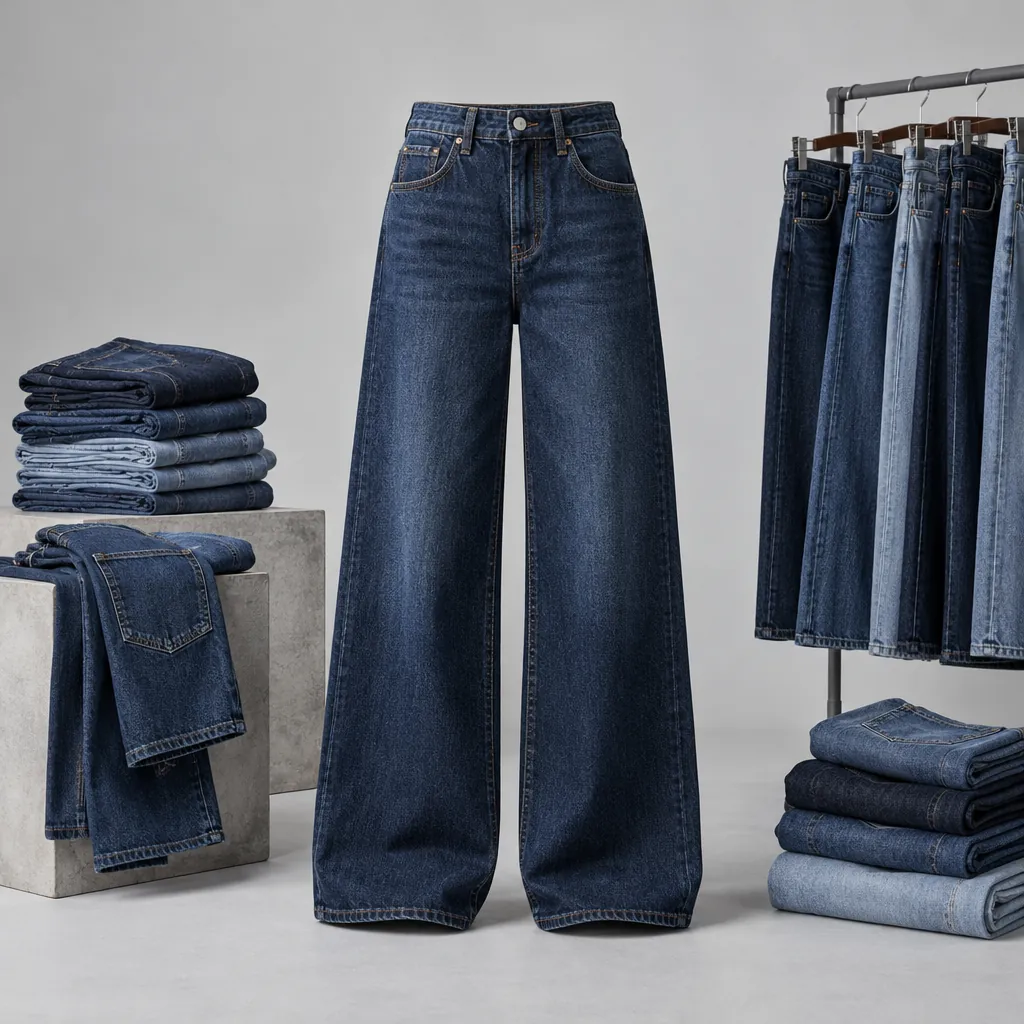
Wide leg jeans have moved from a niche revival to the loudest silhouette signal in the United States denim market, and search interest for wide leg jeans now leads the silhouette terms. For a wholesale buyer the style is attractive because it reads clearly on the floor and photographs well online. It is also unforgiving at the specification stage: a leg that is cut wide without control reads as sloppy rather than intentional, and a hem that drifts out of proportion ages the garment quickly. This guide covers the measurements that define the shape, the fabric and wash pairings that support it, and the order controls that keep a wide leg program sellable from first sample to final markdown.
What actually defines a wide leg
The name describes the leg opening, but the silhouette is judged by the relationship between three widths: the hip, the knee and the hem. A true wide leg runs wide from the hip down, with a knee width that is already generous and a leg opening wider than the knee. Styles that are fitted through the thigh and flare only from the knee belong to the flare family, and customers notice the difference. When a buyer writes a wide leg into a line sheet without measurement points, the factory decides the proportions, and two suppliers can return two very different garments under the same name.
The most common failure in bulk is not the hem width itself but the balance around it. A wide hem on a short inseam pools on the floor for shorter customers and looks accidentally cropped on taller ones. A wide hem with too much hip ease loses the waist definition that makes the style wearable. The specification should therefore treat the leg opening as one point in a system, not as the headline number.
The measurement points to put in writing
A wide leg specification should list every point that moves the silhouette, with the agreed tolerance beside each one. The table below is a working template; the values themselves are confirmed on the approved fit sample and stay recorded as Pending until then.
| Measurement point | Why it matters for a wide leg | Value |
|---|---|---|
| Front and back rise | Sets where the volume starts; a low rise changes the whole balance of the leg | Pending |
| Hip ease | Controls whether the width reads as intentional or as a size up | Pending |
| Knee width | Decides whether the leg runs wide from the hip or flares from the knee | Pending |
| Leg opening | The headline measure; judged against the knee width, never on its own | Pending |
| Inseam | Determines how the hem meets the shoe at each height in the size curve | Pending |
Each of these points should also be measured on the smallest and largest size of the run, because grading that works at the center of the range can distort the proportions at the ends, where the customer has the fewest alternatives.
Fabric weight and drape
Wide legs live or die on drape. A fabric that is too crisp holds the leg away from the body and exaggerates every unevenness in the cutting; a fabric that is too soft collapses at the knee and loses the line. Midweight and heavier constructions generally hold the column shape the silhouette promises, while lighter weights suit warm-weather programs where the customer expects movement. The choice should be made against the store's climate and season, and the hand feel should be approved on a full garment rather than a swatch, because washing changes the way the leg hangs. Stretch content is a separate decision: a small amount of elastane can improve comfort through the hip without changing the line, but it also affects recovery, and a wide leg that bags at the knee after a day of wear generates fitting room complaints and returns.
Pairing the wash program
Wide legs carry wash differently from fitted silhouettes because the eye travels down a larger surface. Dark indigo gives the strongest column line and pairs with the widest set of tops, which makes it the natural lead for a first order. Mid and vintage washes show whiskering and abrasion across the thigh, and on a wide leg those effects sit on a bigger canvas, so the placement of the finishing matters more than it does on a skinny. Light washes work for seasonal capsules but show every seam and pressing mark, which raises the stakes on finishing quality. A practical plan is to lead with one dark wash in depth, add one mid wash for the second delivery, and hold lighter washes for a tested follow-up rather than the opening buy. The wide leg catalog page lists the wash and rise options typically quoted for this silhouette.
Rise choices and the size curve
Most current wide leg programs lead with a high rise, and the front and back rise measurements should be recorded separately because they rarely move together. A high front rise with a shallow back rise is a common cause of gapping at the waist, and it shows up in returns rather than in the fitting room. The rise and fit guide sets out the measurement points to agree before sampling. The size curve deserves equal attention: the wide cut skews the perceived size of the garment, and customers who wear one size in a straight leg often need different guidance in a wide one. Publishing a per-silhouette size chart, rather than one chart for the whole denim section, is one of the least expensive ways to protect the return rate, and the chart should state the fit in plain words beside the numbers.
Order control for a trend-leaning style
Even at the top of the search rankings, wide leg should be treated as a trend-leaning silhouette rather than a permanent basic, and the order should be structured accordingly. A disciplined pattern is a first buy in limited depth, a written decision date for the reorder, and a sell-through threshold that triggers it. The reorder decision should be made on settled data rather than a single hot opening week, because early sales can reflect curiosity as much as demand. Planning the second buy in advance also protects the delivery window: fabric for a wide leg is booked by weight and width, and lead times move with the market. When the style cools, the exit should be just as planned, with a markdown date agreed before the season rather than improvised at the end of it.
Sample-stage checks specific to the silhouette
- Leg opening measured flat and compared with the knee width, not with the line sheet promise.
- Hem finish checked on the body at the intended inseam, with the shoe the customer will actually wear.
- Waistband behavior checked while seated, since a wide leg is often worn with a tucked top.
- Pressing and packing checked, because a folded wide leg creases at the knee and the crease ships to the customer.
Where a check fails, the fix belongs in the specification sheet before bulk, not in a note to the finishing line. The neighboring silhouette shares several of these checks but adds its own: the guide to flare jeans fit and wash choices covers them in detail.
Working with jeans
Quotations, minimum order quantities and lead times for a wide leg program are confirmed in writing for each order, and the terms that apply to one silhouette do not transfer automatically to another. To move from shortlist to order, request a quote with your target measurements, size run and wash plan, and the response will set out the terms that apply to your specific brief.
Specification fields
| Field | Value |
|---|---|
| Fabric composition | Pending |
| Fabric weight | Pending |
| Wash options | Pending |
| Rise and fit | Pending |
| Leg opening | Pending |
| Stitching and finish | Pending |
| Hardware and trims | Pending |
| Labels and packaging | Pending |
Size chart fields
Measurements are taken flat, in centimeters or inches, and confirmed per size run.
| Field | Value |
|---|---|
| Waist | Pending |
| Hip | Pending |
| Rise | Pending |
| Inseam | Pending |
| Leg opening | Pending |
Pricing
| Tier | Quantity per style | Unit price (USD, FOB) | Lead time |
|---|---|---|---|
| Tier 1 | Pending | Pending | Pending |
| Tier 2 | Pending | Pending | Pending |
| Tier 3 | Pending | Pending | Pending |
Private label options
Private label options for this style, including labels, trims, pocket detail and wash development, are listed on the custom and private label page and confirmed in writing.