Home / Guides / Plus size jeans: grading and fit discipline
Plus size jeans: grading and fit discipline
Plus size jeans built on grading discipline: independent grade rules, fit checks across the size range, and depth planned from real demand.
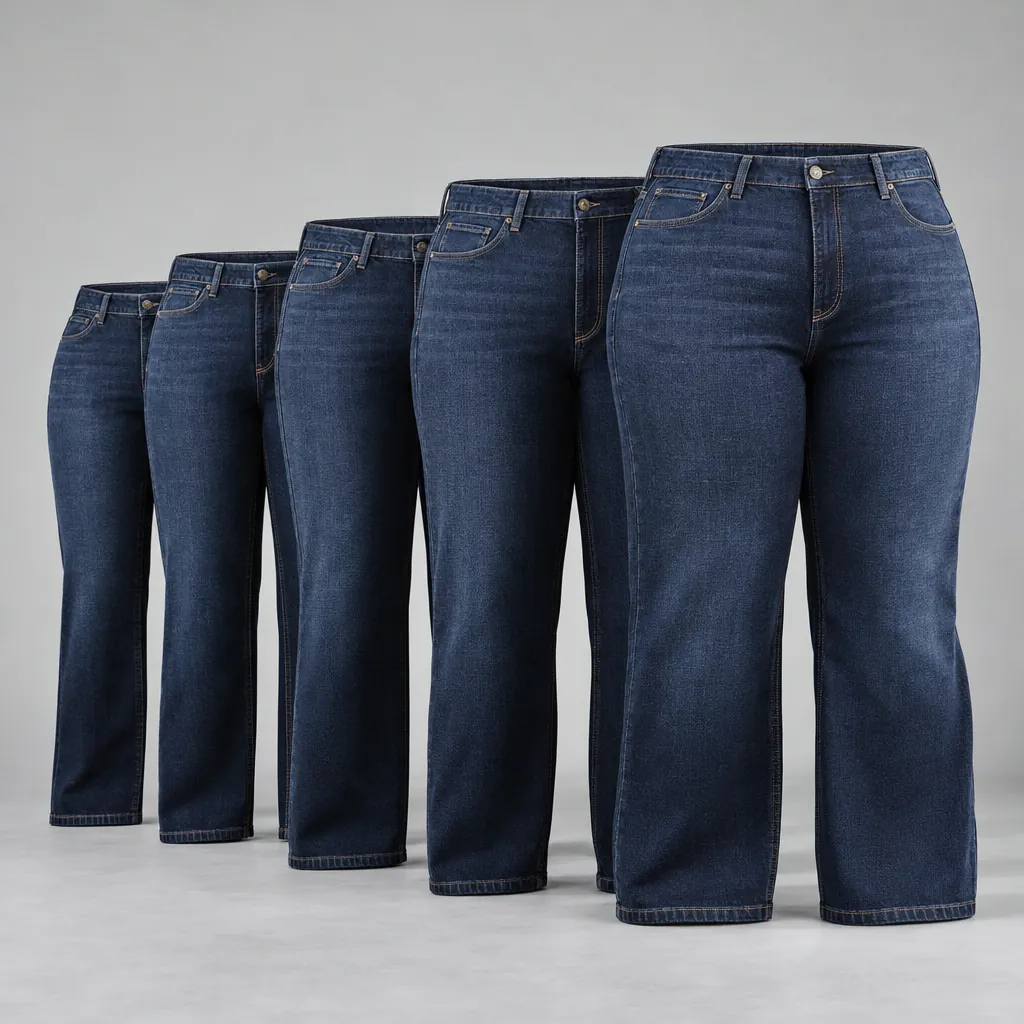
Plus size jeans fail in production for a specific and preventable reason: the pattern is often a scaled-up version of a straight-size block rather than a garment engineered on its own grading. The customer feels the difference immediately — a rise that sits wrong, a thigh that pulls, a waistband that gaps — and the return follows. Search interest for plus size jeans is substantial and steadier than most fashion terms, which makes the segment attractive to buyers who plan it properly and expensive for those who do not. This article covers what independent grading means, how to fit-test across the range, which fabric decisions matter most, and how to size the buy from real demand rather than habit.
Why scaling up a straight pattern fails
Body proportions do not scale linearly. As sizes go up, the relationship between waist, hip, seat and thigh changes, and the rise needed for a comfortable, gap-free fit changes with it. A pattern that simply adds equal steps to every measurement preserves none of those relationships; it produces jeans that are uniformly bigger rather than differently shaped. The failures concentrate where the relationship moves fastest: the back rise and seat, the thigh relative to the waist, and the balance between the front and back rise. A store that has returned plus size stock season after season for fit reasons is usually seeing this single root cause, and no amount of size-chart improvement downstream fixes it.
What independent grading means
Independent grading gives the plus range its own grade rules rather than extending the straight rules. Each measurement point is re-decided for the segment:
- Rise. Front and back rise graded by their own rules, so the seat stays covered and the waist stays level when seated.
- Seat and thigh. Graded in a relationship that keeps the close-fitting zones comfortable without widening the whole leg.
- Waistband. Height and curve reconsidered, since a straight waistband that gaps at straight sizes gaps worse as the back rise changes.
- Knee and hem. Proportioned against the new leg volume, so the silhouette the customer chose survives the grade.
The grade rules should be written as a document, point by point, and the document should be a required attachment to the fit approval. The general principles are covered in the guide to size grading; the plus range's difference is that its rules are not an extension of anything.
Fit testing across the range
A plus range is fit-approved across the run or it is not approved at all. The minimum discipline: fit sessions on the smallest size, a middle size and the largest size of the intended run, on fit models whose measurements are recorded, with the sitting, walking and bending checks that any denim approval should include. The largest size deserves particular attention, because that is where scaled-up patterns fail hardest and where the customer has the fewest alternatives; a program that fits beautifully in its center and fails at the top of the range has built a wall its most loyal customers cannot climb. Photographs from the sessions, front and back, seated and standing, become the reference for the bulk comparison and for the size guidance published on product pages.
Fabric and comfort decisions for the segment
Fabric choices should serve the segment's fit demands. Stretch content earns a careful role: it eases the close zones through the seat and thigh, but recovery matters even more than in straight sizing, because a seat that bags over a working day is a complaint the customer will not give a second season to correct. Rise depth generally runs deeper than in straight ranges, and the waistband construction — curve, height, closure — should be approved on the body rather than on the table. Dark indigo anchors the wash plan as it does elsewhere in denim, and the wash approval should be checked across the size range, since larger garments wash and abrade differently from the sample size the mill tested.
Sizing the buy from real demand
The plus buy should be planned from its own numbers. Where a store has carried the segment, the sales and return history by style and size is the plan's foundation; where the store is entering the segment, the first buy is a test sized to learn from, concentrated in the center of the demand curve with the edges covered. The common planning errors are symmetric: treating the segment as a fixed share of the main buy, which underbuys real demand and signals to customers that the range is decorative, or extending the range without the grading work above, which buys returns instead of sales. The plus size catalog page shows the silhouette coverage a program can offer once the fit base is sound.
Honesty on the page and the floor
Fit honesty is the segment's currency. A size chart that matches the approved specification, a page that states the rise and the fit in plain words, and staff guidance that says how the fit behaves when seated — these are the details that turn a trial customer into a repeat one, because plus size customers have been burned by inconsistent labeling often enough to reward the store that is precise. The reward compounds: a customer who trusts one fit in the range returns for the others, and the segment's repeat behavior is among the strongest in denim. The range-level planning around it — where the budget sits, how the segment joins the seasonal structure — follows the same logic as the women's category plan, with the segment treated as a first-class layer rather than an extension.
Signs the program is healthy
- Repeat purchases in the same fit across washes, the clearest signal the grade works.
- Returns concentrated in uncertainty reasons rather than fit reasons, which points at page guidance rather than the pattern.
- Sell-through spread across the size curve, without a dead zone at either end.
- Customers crossing from one silhouette to another within the segment, which shows the fit base is trusted.
Working with jeans
Quotations, minimum order quantities and lead times for a plus size program are confirmed in writing for each order, and the independent grading work shapes both sampling and production terms. To start the program on a sound fit base, request a quote with your size range, grade approach and target silhouettes, and the response will state the terms that apply.
Specification fields
| Field | Value |
|---|---|
| Fabric composition | Pending |
| Fabric weight | Pending |
| Wash options | Pending |
| Rise and fit | Pending |
| Leg opening | Pending |
| Stitching and finish | Pending |
| Hardware and trims | Pending |
| Labels and packaging | Pending |
Size chart fields
Measurements are taken flat, in centimeters or inches, and confirmed per size run.
| Field | Value |
|---|---|
| Waist | Pending |
| Hip | Pending |
| Rise | Pending |
| Inseam | Pending |
| Leg opening | Pending |
Pricing
| Tier | Quantity per style | Unit price (USD, FOB) | Lead time |
|---|---|---|---|
| Tier 1 | Pending | Pending | Pending |
| Tier 2 | Pending | Pending | Pending |
| Tier 3 | Pending | Pending | Pending |
Private label options
Private label options for this style, including labels, trims, pocket detail and wash development, are listed on the custom and private label page and confirmed in writing.