Home / Guides / Kids denim: safety testing overview
Kids denim: safety testing overview
A buyer's overview of safety questions in kids denim: small parts, drawcords, surface coatings and chemicals, and the documents to request from suppliers.
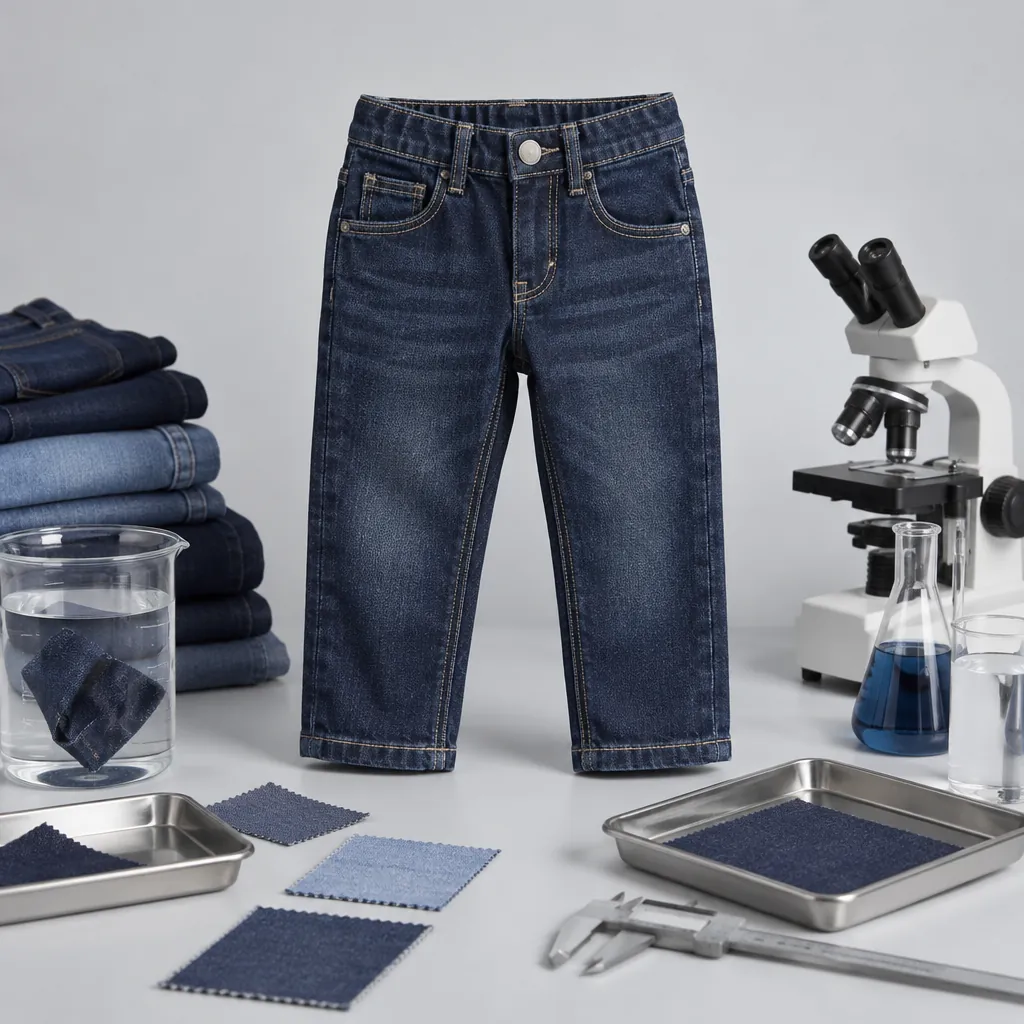
Children's denim carries a heavier compliance load than adult denim, and the difference is not mainly about fabric. A kid's jean is judged on the same fit and wash questions as an adult style, and then on a second layer of questions about parts that can come loose, cords that can catch, and substances that sit where children put their hands. Buyers moving from adult to kids programs are often surprised by how much of this second layer is settled before production even starts, in documents rather than in the workshop. This article gives an overview of the safety questions a United States retail buyer should expect for kids denim, in general terms, and the paperwork that supports each one.
Small parts and attachment strength
Jeans are fastened with hardware. Buttons, rivets, snaps, zips and decorative patches are exactly the components that children's safety programs watch, because a component that detaches becomes a small part with swallowing risk. The questions a buyer should expect are therefore about attachment: how each component is fixed, whether the fixing method is one the factory uses every day or a special operation, and how the fixing survives pulling, washing and wearing. On the sample, this is checked by hand and by observation; in bulk, it is checked through the inspection plan agreed in writing. The sample-stage checks overlap heavily with a standard denim inspection, and the guide to the denim sample inspection checklist shows how to fold hardware checks into the rounds the program already runs.
Decoration needs the same treatment as function. A printed motif, an embroidered patch or a glued-on badge is a component like a rivet, and it should appear in the specification with its attachment method, not arrive as a late styling addition that nobody tested.
Drawcords and garment construction
Drawstrings on children's upper outerwear are a recognized hazard area in United States guidance, and the same logic shapes how reviewers look at cords, belts and loops on kids bottoms. An adjustable waistband is a common and sensible feature on kids jeans; a free-hanging cord at the waist or hood is not. The buyer's task is to describe every cord, tie and loop in the specification, including its length and anchoring, so that the design intent is written rather than assumed. Where a styling idea conflicts with the guidance, it is cheaper to discover that on the sketch than on the finished sample.
Sharp edges and points belong in the same review. Hardware that is acceptable on an adult work jean can be questioned on a child's garment, and the review should cover rivet doming, zip pullers, belt buckle edges and any exposed fastener inside the waistband.
Surface coatings and substances
The chemical side of kids denim concentrates on what a child touches and mouths. Surface coatings, printed motifs, metal hardware and the dyes in the wash all come into scope, and the substances most often discussed in this context are lead in surface coatings, certain phthalates in flexible plastics and printed films, and the wider list of dye and finish chemistries covered in chemical screening. This article does not state limits, because limits change and sit with the current version of the applicable rules; the buyer's compliance adviser should confirm the scope and the numbers for the program, and the supplier should produce to them.
Children's products also carry identification expectations that adult garments do not, commonly described as tracking information that links the product to its production batch. The practical takeaway for a buyer is that the kids label set is larger than the adult set, and the artwork brief should plan for it from the start rather than squeeze it onto a proof late in development.
How the testing scope is built
A testing scope for a kids denim program is usually assembled from three inputs: the rules that apply in the destination market, the materials and components nominated in the specification, and the ages the garment is sized for. The buyer's adviser sets the scope; the supplier books the testing against that scope; the results come back as reports and declarations that the buyer files with the order. The scope should name the components it covers, because a report for one hardware item does not answer questions about a different finish on a different button.
- Component list from the specification: every button, rivet, snap, zip, patch and print, with its material and attachment method.
- Applicable rules for the destination market and age range, confirmed by the buyer's own adviser.
- Testing booked by the supplier against that scope, on samples tied to the bulk lot.
- Declarations for coatings, prints and hardware finishes, item by item.
- Label artwork that carries the required identification and content elements.
This site does not issue certifications or publish test reports; documents are obtained from suppliers on request and confirmed in writing. The standing requirements for this topic are summarized on the page covering kids denim testing.
Where kids programs go wrong
The pattern is familiar. A styling component is added after testing, and nobody re-checks it. A hardware finish changes because the nominated finish was unavailable, and the substitution travels no further than the purchasing team. The label set is finalized from the adult artwork and misses an identification element. Each of these is a paperwork failure with a product consequence, and each is preventable by treating the specification as the single source of truth and routing every change through a written amendment.
Chemical questions deserve their own reading list, because they extend well beyond kids styles. The companion article on chemical testing for denim walks through the test families an adult program meets most often, and the two articles together cover most of what a buyer will be asked in a first kids denim review.
Working with jeans
Quotations, minimum order quantities and lead times for jeans are confirmed in writing for each order, and the practices in this article are planning guidance rather than commitments. To open a kids denim program on a documented footing, request a quote and ask for the supplier's component and testing process in writing.