Home / Guides / Care labels: rules buyers must check
Care labels: rules buyers must check
What US retail buyers should check on jeans care labels: the care labeling rule in plain terms, who supplies what, and the documents to request.
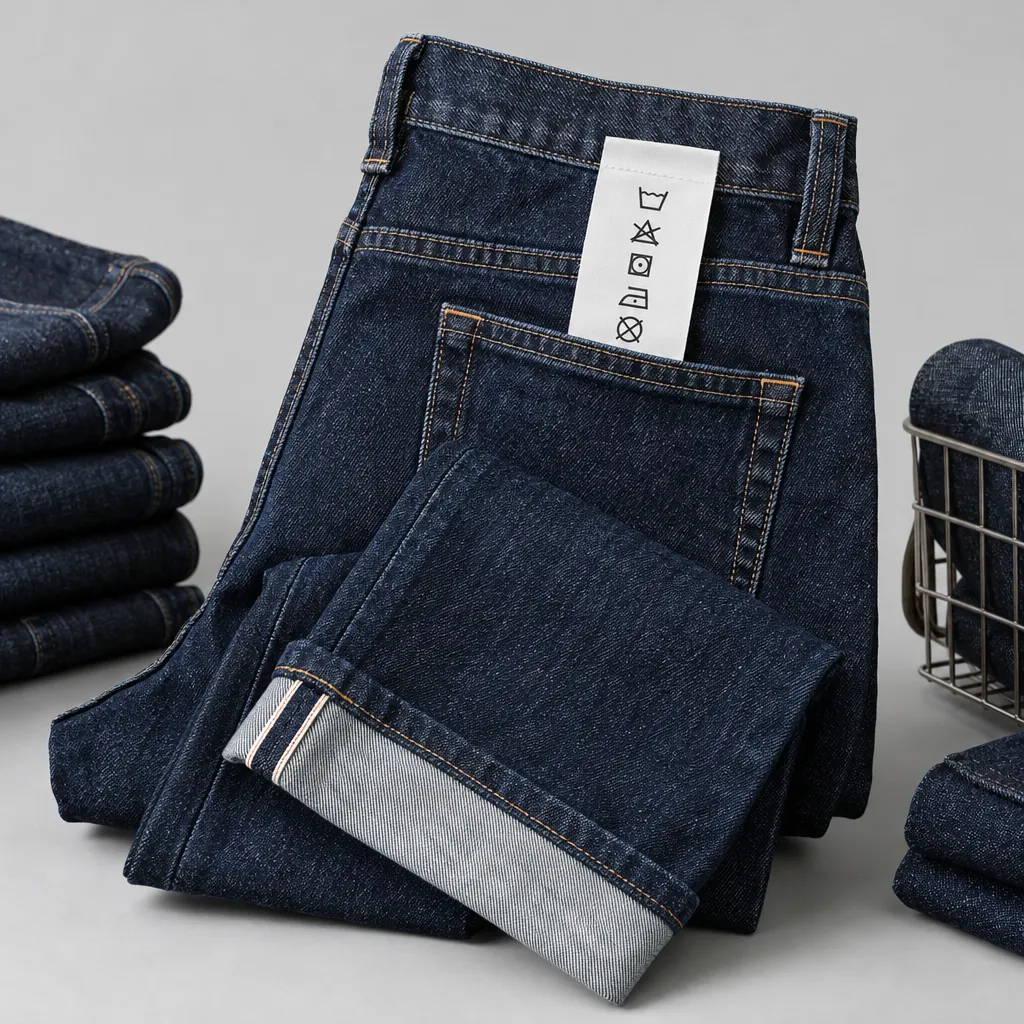
Care labels are among the least expensive components on a pair of jeans and among the most costly to get wrong. A care instruction that does not match how the garment actually behaves shows up later as complaints, returns and a slow loss of repeat customers. Yet on many orders the label is treated as a printing task for the final week, after the fabric and the wash are already fixed. This article explains what a United States buyer should check on jeans care labels, how responsibility for the content is usually divided, and which documents to request from a supplier before the labels are approved for bulk.
What the care labeling rule expects, in plain terms
The care labeling rule is a United States requirement for consumer textile garments, and jeans fall under it. In plain terms, a garment offered at retail is expected to carry permanent care instructions covering the regular care of the product, expressed either in words or through an approved symbol system. The instructions are expected to describe the ordinary care steps a customer would take, and where an ordinary step would harm the garment, a caution is expected so the customer can avoid it.
Two points matter for a buyer. First, the requirement attaches to the product as sold in the United States, so the label content is a market question, not a factory preference. Second, the obligation is enforced against the seller, which in practice means the importer or retailer of record. A supplier can propose the wording and print the label, but the buyer answers for whether the content is right for the market it sells into.
Build the instruction from the garment, not from habit
A care instruction is only correct if it reflects the fabric, the wash and the finishes of that specific garment. The same silhouette can need different instructions in a rigid all-cotton fabric and in a stretch fabric, because the elastic fiber, the dye and the finishing chemistry behave differently in the wash. Special finishes push this further: a garment-dyed jean, a heavily distressed jean, a jean with a coating or a laser-achieved vintage effect, each carries its own risks of color change, surface damage or shrinkage that a plain rinse does not.
The practical method is to derive the instruction from the wash behavior of the approved fabric and wash, then check that the printed wording matches what the testing showed. Where the supplier proposes an instruction, ask which observations support it. An instruction copied from a previous style is not evidence; it is a habit, and habits do not survive a change of fabric or finish.
Some programs resolve a difficult construction by specifying professional care instead of home washing. That choice should be deliberate. Professional care shifts cost and behavior onto the customer, and it should match how the target customer actually cares for jeans. An instruction that is technically defensible but ignored in practice protects no one.
Words, symbols and attachment
Care information may be presented in words or through an approved symbol system, and some programs use both. Words are simpler to approve and easier to revise late in development. Symbols save space on a small label, but they need a defined reference sheet so the printing team does not improvise. Whichever format the program chooses, it should be consistent across the range, because a customer who learns one label format on a first purchase expects the same format on the next style.
Attachment and durability deserve the same attention as content. A label that detaches or becomes illegible after the first wash fails its purpose, and the failure usually surfaces as a customer complaint rather than as an inspection finding. Check the label position, the attachment method and the legibility after a wash on the sample, and record all three in the specification sheet so the bulk lot is produced against something written.
Who is responsible for what
Responsibility is usually divided in three layers. The supplier proposes care instructions based on the construction and materials, then prints and attaches the label to the approved artwork. The buyer verifies that the proposal is supported by testing and that the content meets the requirements of the destination market, with advice where needed from its own compliance adviser. The seller of record carries the market-facing responsibility for the final content. The care label is one of several labels on the garment, and the fiber content label carries its own requirements, covered in the guide to fiber content labeling.
Put the division in the contract. The agreement should state who supplies the content, who approves it, what happens when the content changes after approval, and which documents evidence the change. A half-page label clause prevents most of the arguments that otherwise appear when the first customer complaint arrives.
Documents to request from the supplier
Before labels go to print, ask the supplier for a short and specific set of documents:
- The proposed care instruction text, with the reasoning that supports each step and each caution.
- Wash observations for the approved fabric and wash, tied to the sample or lot they came from.
- Label artwork proofs for the care label, the size label and any hangtag that repeats care claims.
- Confirmation of label material, attachment method and position, as they will be produced in bulk.
- Written confirmation of who approves any later change to the content.
This site does not issue certifications or publish test reports; documents are obtained from suppliers on request and confirmed in writing. The standing requirements for this topic are summarized on the page covering care labeling.
Where care labels go wrong in practice
The recurring failures are mundane. The instruction contradicts a claim printed on the hangtag. The label detaches after the first wash because the attachment was approved on paper but quietly changed on the line. The wording was carried over from a previous style with a different finish, so a coated jean gets washed as if it were a plain rinse. None of these are exotic, and all of them are found by reading the label against the approved sample before shipment rather than after the goods land.
When returns do arrive, care-related complaints should be sorted separately from fit complaints, because the remedies differ. A label fix is a printing and attachment question; a fit problem is a pattern question. The sorting method is set out in the guide to root-causing denim returns, and it works for compliance-driven returns just as it does for fit-driven ones.
Working with jeans
Quotations, minimum order quantities and lead times for jeans are confirmed in writing for each order, and the practices in this article are planning guidance rather than commitments. To move from reading to pricing, request a quote and ask for the label plan and the current terms in writing.