Home / Guides / Denim shrinkage: spec it before bulk
Denim shrinkage: spec it before bulk
Why denim shrinks, how to test shrinkage before bulk, and which written clauses keep post-wash measurements inside the fit you approved.
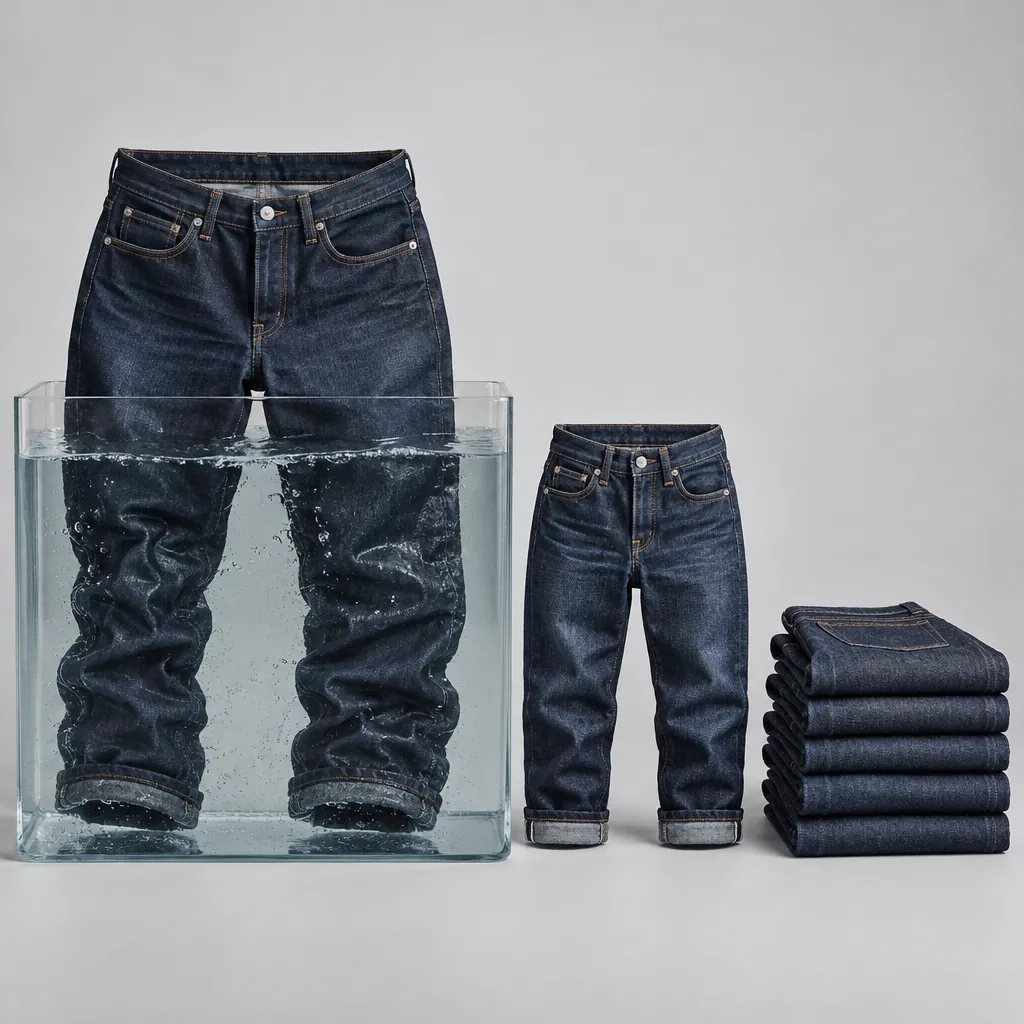
Why denim shrinks
Denim shrinks because the processes that make it leave the fabric holding a stretched state. Spinning, weaving and dyeing all pull tension through the yarn and the cloth, and the fabric leaves the finishing line with that tension locked in. The first wash relaxes it: the weave closes, the yarns settle, and the garment becomes shorter and often narrower than it was on the cutting table. The effect is not a defect and not a sign of poor quality; it is a property of the fabric that the pattern is supposed to anticipate. It becomes a defect only when nobody measured it and nobody allowed for it, which is what turns an ordinary first wash into a fit complaint, a return and a bad review. Shrinkage values for any specific fabric are established by test and confirmed in writing before bulk is approved.
Length and width shrink differently
The two directions of the fabric do not behave alike. Woven fabric usually shrinks more along the length than across the width, because the lengthwise yarns carry more of the processing tension, so a garment can come out of the first wash shorter in the inseam while barely changing at the waist. The difference matters because buyers who ask one shrinkage question and receive one answer have not been given the information they need. A specification should therefore always ask for shrinkage in both directions, measured separately, on the specific fabric and the specific finishing route the program will use. Where a style is cut in more than one fabric, each fabric carries its own values, and a pattern allowance copied from one fabric to another is a fit problem waiting for its season.
Pre-shrink finishes and what they promise
Most commercial denim goes through a mechanical pre-shrink finish that compresses the fabric before it leaves the mill, so the residual shrinkage the customer's wash produces is small compared with untreated cloth. That finish is the reason modern jeans do not transform in the first wash, and it is a standard part of the supply chain rather than a premium feature. What the finish does not do is remove the buyer's job. Pre-shrunk still means some movement, the amount varies by fabric and mill, and the finishing route the laundry applies afterwards can add its own effects on top. The specification should state the residual shrinkage the program is being quoted against, established by test on the actual fabric lot, rather than relying on the words pre-shrunk as though they were a measurement.
The wash test protocol
- Take the sample from the fabric lot that will be used for bulk, not from a development remnant.
- Mark and measure reference points in both directions before any treatment.
- Wash and dry the sample using the care instructions the finished garment will carry, not a gentler laboratory cycle.
- Measure again and record the change in each direction separately.
- Repeat for at least one further cycle, because some fabrics move more on the second wash than the first.
- Compare the results against the residual shrinkage the supplier stated, and record any difference in writing.
The protocol is simple, but its value depends on honesty at both ends: the test must use the real care conditions, and the supplier's stated values must be checked against the results rather than accepted. The page on fabric testing covers the reports a buyer can ask for and how to read them.
Where the allowance belongs
Once the values are known, the pattern maker applies allowances so the garment reaches its approved measurements after the wash rather than before it. The allowance lives in the pattern, but ownership of the calculation is a commercial question that should be settled in the specification: either the buyer supplies the target post-wash measurements and the factory calculates, or the factory states its allowances and the buyer verifies them against the test results. Problems start when both sides assume the other did it. The approved fit sample should also be identified by state, meaning whether it shows the garment before or after the wash, because a buyer who approves the wrong state has approved a fit the customer will never see. The article on rigid denim fit risk follows this thread further for unwashed fabrics.
The clause that holds the fit
The written protection is straightforward and belongs in the order documents: the measurements that govern the order are the post-wash measurements, defined by the agreed test method, measured on the approved fabric lot, with tolerances stated for each point. Bulk fabric is checked against the same method on arrival, and garments from the bulk production are washed and measured the same way during inspection. Without that sentence, a fit dispute after the first wash has no reference to be settled against, because the two sides are measuring different states of the garment and both are technically correct. With it, the conversation becomes a comparison of numbers against a document both sides signed. Shrinkage tolerances, test methods and the governing state of the garment are confirmed in writing for every order, without exception.
Shrinkage across a program
A program rarely runs on one fabric. A jeans wall carries several weights and constructions, each with its own shrinkage behavior, and the differences quietly multiply if every style is allowed its own assumptions. The practical control is program-level: one test method, one definition of the governing garment state, and one place in the specification where each fabric's values are recorded. That structure costs little to maintain and pays off when a style is re-cut in a new fabric mid-season, because the pattern decision becomes a comparison of recorded values instead of a fresh negotiation. It also makes the laundry's life easier, since the wash development for each fabric starts from documented facts. The article on sourcing denim fabric covers how lots and reservations keep those facts stable across seasons.
Telling the customer
Most shrinkage risk ends at the customer, not at the factory. Even a well-controlled garment moves slightly on the first wash, and a customer who was told what to expect reads that movement as normal, while one who was not reads it as a fault. The care label should carry washing instructions that match the test conditions, and product pages for fabrics known to move, such as rigid or lightly rinsed cloths, should state the settling behavior in plain words. Returns teams should be briefed on which movement is within specification so genuine defects are not buried under normal settling, and vice versa. Communication costs nothing at the specification stage and is expensive to retrofit after the reviews start arriving.
Working with jeans
jeans coordinates denim programs in which shrinkage is tested, documented and allowed for before bulk production, working with partner mills and laundries. Shrinkage specifications, tolerances, minimum order quantities and lead times are confirmed in writing for each order. To put a tested fabric plan behind your own fits, request a quote with your target styles and care requirements.