Home / Guides / Sourcing denim fabric: mills, lots and lead times
Sourcing denim fabric: mills, lots and lead times
How denim fabric sourcing works: mills, lots, shade bands, fabric reservation and lead times, written from the buyer's side of the table.
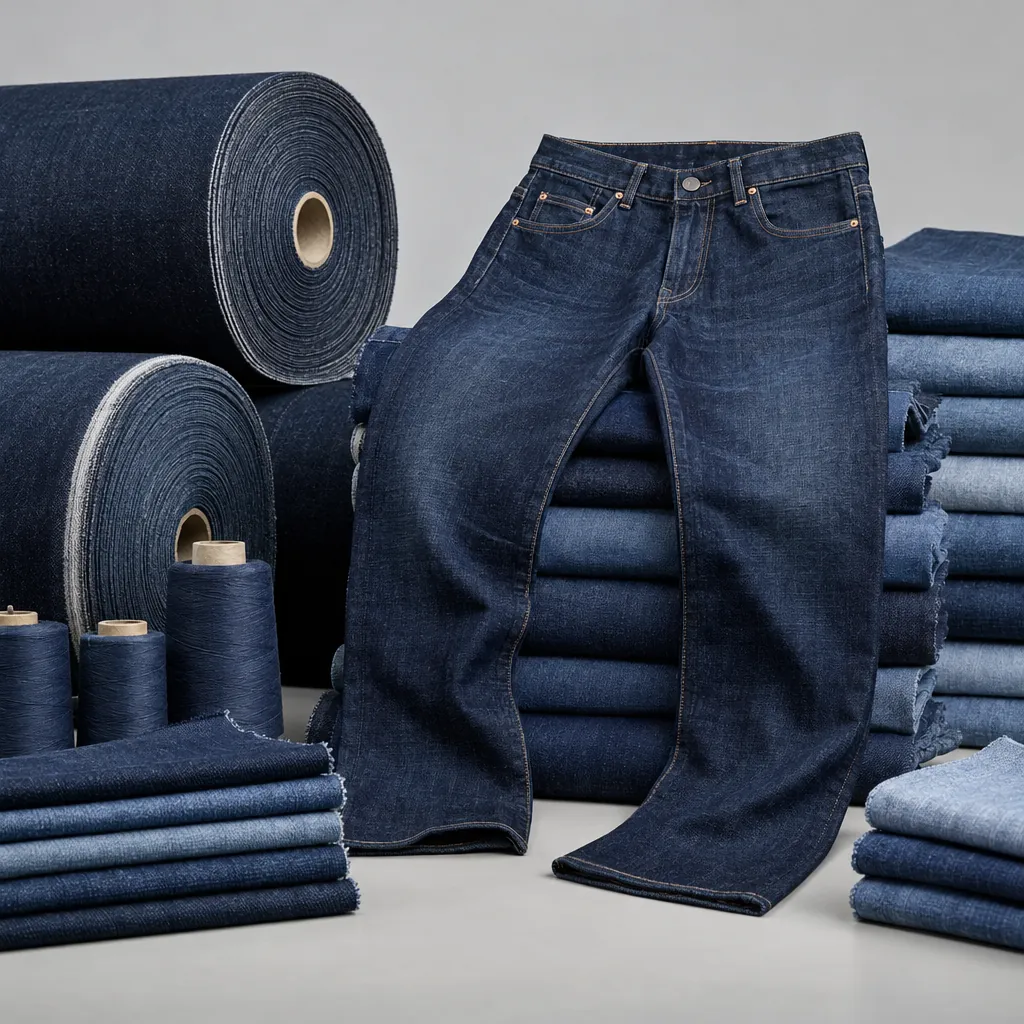
The chain from yarn to garment
Denim fabric passes through more hands than most buyers see. Cotton is spun into yarn, the yarn is dyed, most often the warp only, in the indigo ranges that give denim its character, the dyed yarn is woven with undyed filling yarn, and the woven cloth is finished before it reaches the cutting table. Each stage has its own capacity, its own scheduling logic and its own minimum economic run, and the fabric a buyer quotes against is the output of all of them together. Understanding the chain matters commercially, because lead times, minimums and the possibility of substitution at reorder are all properties of the chain rather than of the fabric itself. A buyer who knows where the bottlenecks sit negotiates differently from one who treats fabric as a catalog item with a price attached.
Mills, converters and garment factories
The mill weaves and finishes the fabric, and the largest ones run their own dyeing capacity; some also spin. A converter commissions fabric from mills and trades it, often holding stock or arranging special runs for buyers whose volumes do not reach a mill's own minimum. The garment factory cuts and sews but usually does not make fabric, which means the fabric decision and the garment decision are separate commitments even when one supplier manages both. For the buyer, the practical consequence is that fabric security is its own agreement with its own terms, not something the garment order secures on its own. Who holds the fabric relationship, what happens if the mill allocates the construction elsewhere, and who is responsible for lot control are all questions to settle in writing before the first order rather than during the first shortage.
What a lot is and why shade drifts
A lot is the batch of fabric produced in one dye and finishing run. Within a lot the shade is consistent; between lots it drifts, because dye strength, yarn lots and finishing conditions all vary slightly from run to run. The drift is normal and unavoidable, and it is usually invisible until two garments from different lots hang side by side on the same wall. At that point the customer sees two products that do not match, and the store sees a quality problem that no one clause addressed. Shade drift is managed, not eliminated: the tools are shade standards approved in advance, shade bands that define acceptable variation, and lot discipline within an order, meaning garments for one order or one shipment are cut from fabric as close in lot as the supply allows.
Shade bands and lot control
A shade band is a set of physical swatches defining the acceptable shade range around an approved standard, agreed between buyer and supplier before production. With a band in place, incoming fabric and bulk production are checked against physical references rather than against memory or against a photograph, which no one can compare a garment against reliably. The specification should name the approved standard, reference the band, and state who checks and at which points: on fabric arrival, during production and before shipment. For programs that reorder across seasons, the standard itself should be archived carefully and re-confirmed at each reorder, because standards age and fade just as garments do. Shade control terms, including what happens when a lot falls outside the band, are confirmed in writing as part of the order.
Reserving fabric for reorders
A core style lives on reorders, and the reorder depends on the fabric being available again with the same shade and the same behavior. Reservation is the arrangement that protects that: the supplier holds a defined quantity of the fabric, or agrees to produce it to the same specification, for a defined period against the buyer's forecast. Reservation terms vary widely in what they hold, for how long and at what commitment from the buyer, and every value in them is confirmed in writing rather than assumed from a friendly conversation. Without reservation, a successful style can stall at its reorder because the mill allocated the construction to a larger program, and the substitute fabric that is offered will differ in shade and hand precisely when consistency matters most. The cost of a reservation is usually trivial beside the cost of a core style that cannot reorder.
Lead time structure
Fabric lead time is not one number but a chain of them. Yarn preparation, dyeing, weaving and finishing run in sequence, and the total is longer than most garment-side lead times, which is why fabric is the long pole in a development calendar. Stock fabrics held by a mill or converter are the exception, and they are the reason open-stock programs can move quickly; special colors, special weights and selvedge constructions are the opposite case, and they inherit the full chain. The article on selvedge denim for small brands shows how sharply minimums and lead times rise on the specialized end of that range. For any program, the fabric lead time, the garment lead time and the calendar that connects them are confirmed in writing, and the delivery commitment belongs in the order terms with a remedy attached.
Second sources and the consistency tradeoff
A second fabric source reduces supply risk and raises consistency risk at the same time. A second mill producing the same construction will differ in shade behavior, hand and shrinkage, even when the specification is copied exactly, because the machinery, the water and the dye lots differ. For a fashion style with a short life, that trade usually favors availability; for a core style built on years of consistency, it favors reservation with one source and a documented fallback plan instead. The middle path is to qualify the second source properly, with its own shade standard and its own test results, and to treat the two fabrics as related products rather than as the same product. Which path a program takes is a decision to record, because it determines what lot control means on every later order.
Reading a fabric quotation
A fabric quotation should be read as a specification document, not as a price line. It should state the construction, the weight with its tolerance, the finishing route, the minimum run, the lead time from order to ex-works and the validity of the price itself. Where any of those is missing, the quotation is an opening position rather than an offer, and building an order calendar on it builds on sand. Price movements in fabric follow cotton markets, dye costs and energy, and the factors that move them are set out on the denim cost factors page. A buyer comparing quotations across mills or across seasons compares like with like only when all of those elements are stated, and asks for the missing ones in writing before treating the number as real.
What to write into the order
- The fabric specification by construction, weight tolerance and finishing route, with the approved sample identified by lot.
- The shade standard and shade band, and the points at which shade is checked.
- Lot discipline within the order, meaning which garments may be cut from which lots.
- The reservation arrangement for reorders, including quantity, period and the buyer's commitment.
- Lead times for fabric and for garments, with the delivery commitment and the remedy for missing it.
A reorder is judged against the first order, and the first order is what makes that judgment possible. Every value above is confirmed in writing with the supplier for each program. The article on midweight denim as a core program shows how these terms carry a style across years.
Working with jeans
jeans coordinates fabric sourcing for denim programs, from mill selection through shade standards to reservation and reorder planning. Fabric quotations, minimum runs, reservation terms and lead times are confirmed in writing for each program. To review fabric options and sourcing structures for your own range, request a quote with your target styles and reorder plans.