Home / Guides / Midweight denim: the core of a jeans wall
Midweight denim: the core of a jeans wall
Why midweight denim anchors a jeans wall: drape, wash latitude, reorder economics and size stability for a core program that sells year round.
Where midweight sits
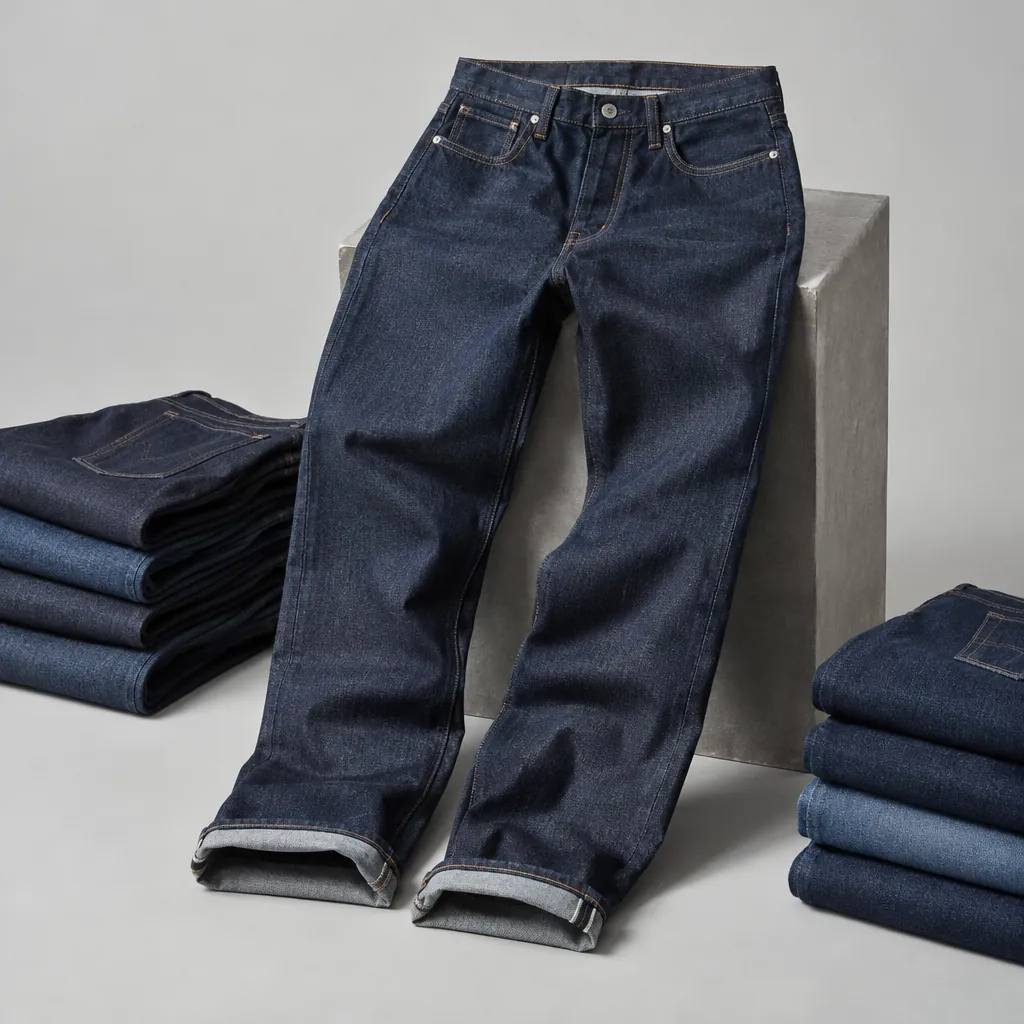
Midweight denim is the middle tier of the weight range, defined by agreement between buyer and supplier against an approved sample rather than by a universal number. It sits between the fluid, fast-fading lightweights and the standing, slow-aging heavyweights, and it borrows a usable amount of character from each side. On the body it holds a straight leg without stiffness, lets a bootcut keep its hem flick, and gives a wide leg enough presence without weighing the garment down through a long day. In the laundry it takes the widest range of wash routes without losing its structure or its hand. The fabric page on midweight denim describes the constructions most often quoted for wholesale programs, and the tier boundaries themselves are confirmed on physical samples in writing.
Why core styles land in the middle
A core style has to satisfy the widest possible set of customers across the longest possible selling window, and the middle tier is where that compromise resolves. Lighter fabrics flatter some bodies and some seasons but thin out in structured silhouettes and in cooler months. Heavier fabrics carry authority but narrow the customer base and read seasonal or specialist to a general audience. Midweight avoids both failures: it drapes well enough for comfort, stands well enough for shape, neither fades too fast in the laundry nor refuses to fade at all. That balance is why, when a buyer asks a factory which fabric its own best-selling straight leg uses, the answer is almost always the middle of the range rather than either edge. The core earns its position by disappointing nobody, which is a quieter achievement than it sounds.
Wash latitude
The midweight tier tolerates more of the wash spectrum than either edge. Dark rinses hold their depth on a midweight without reading stiff, mid blues develop evenly because the fabric takes abrasion at a controlled rate, and light vintage washes can be pushed further without destroying the hand. That latitude matters commercially because a core style lives or dies on its wash range: the same fit in three washes is three products sharing one pattern, one grading rule and one fit approval. A fabric that supports the full wash range lets a buyer multiply the wall from a single approved block, which is the most efficient depth a denim program can buy. Wash recipes for each shade are still developed per fabric and confirmed in writing, but the fabric gives the laundry room to work that the lighter tiers do not.
Reorder economics
Core programs are reorder businesses, and the middle tier is the easiest tier to reorder. Midweight constructions are produced at scale by more mills than the specialized edges, so supply is deeper, substitution is easier when a mill has an allocation problem, and the price band is stable across seasons. Fabric reservation for a reorder is also simpler, because the mill runs the construction continuously rather than as a special batch that has to be scheduled again. For the buyer, that shows up as shorter and more reliable lead times on the second and third orders, which is exactly where a core program earns its margin. The article on sourcing denim fabric covers mills, lots and lead times in detail, including how reservation agreements protect a reorder.
Size curve stability
Fit stability across a size run is easier to hold in the middle tier. The fabric's structure supports the pattern at both ends of the curve, where lighter fabrics collapse on larger sizes and heavier fabrics resist the smaller ones. Returns data across denim categories shows fit complaints concentrated at the size edges, and fabric behavior is one of the controllable inputs to that pattern. A core style is judged by its worst size rather than its best, because the customer who receives the worst size is the one who writes the review and starts the exchange. Midweight gives the pattern maker the most cooperative material to grade across the full run, and that cooperation shows up directly in the exchange rate and in the sizes that stay on the wall longest.
The cost of getting the core wrong
A core built on the wrong tier fails slowly and expensively. A core that is too light shows wear before the customer has decided to keep the garment, and the complaint arrives as quality feedback rather than as fabric feedback, so the cause stays hidden for a season. A core that is too heavy sells in a narrow band of the customer base and leaves the size run unbalanced by mid-season, with the edge sizes marking down first. Both failures surface as weak sell-through without an obvious reason, because the wall still looks right and the fits were approved correctly. The fabric weight is one of the few inputs that shapes every one of those outcomes at once, which is why it deserves more than a line in the cost sheet.
Using light and heavy as accents
The strong wall is not all midweight. The core carries the volume, and the edges of the wall carry interest: a lightweight capsule for the warm months at one end and a heavyweight or rigid statement style at the other. The accents earn attention and give the wall a story, while the midweight core earns the money and fills the size runs. The proportions are a merchandising decision, but a common shape keeps the accents to a minority share of open-to-buy, precisely because neither edge reorders as reliably as the middle does. For the seasonal end of that structure, the article on lightweight denim programs for warm months sets out the capsule mechanics for the lighter edge of the wall.
What to lock in the specification
- The fabric construction and the approved sample that every reorder must match.
- The weight tier with its tolerance, confirmed on the approved sample and checked on arrival fabric.
- The wash range the fabric must support, with a reference wash approved for each shade.
- Lot-to-lot shade control, agreed as shade bands against the approved standard.
- Reorder terms, including the fabric reservation arrangement and the lead time commitment.
A core style lives for years, and the specification is what makes year three identical to year one. Quoted values, minimum quantities and lead times are confirmed in writing for each order rather than carried forward by memory.
Working with jeans
jeans helps buyers build core denim programs on midweight fabrics that are specified for reorder from the first order onward. Fabric options, quotations, minimum order quantities and lead times are confirmed in writing for each program. To review midweight constructions for your own core range, request a quote with your target fits and wash plan.