Home / Guides / Straight leg jeans: building a core program
Straight leg jeans: building a core program
How to build a straight leg jeans program: wash depth, rise ladder, size curve stability and replenishment rules for an evergreen core style.
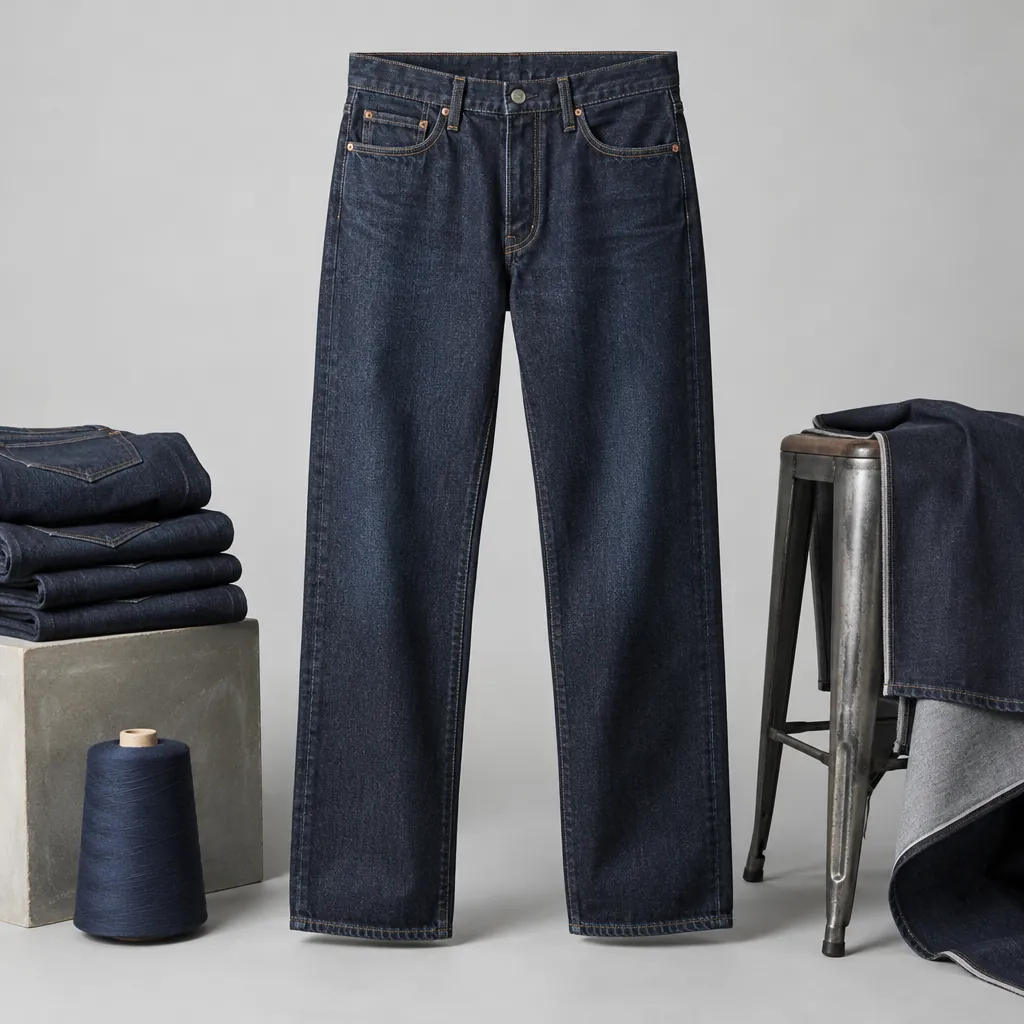
Straight leg jeans rarely lead a trend report, and that is precisely their value. Search interest for straight leg jeans is broad and persistent, the style serves nearly every age group in a store's customer base, and it survives season after season without the fit drama that fashion silhouettes bring. For a wholesale buyer, straight leg is the natural anchor of a denim wall, and the buying question is not whether to carry it but how deep to build it. This article sets out a depth-led program: the wash ladder, the rise plan, the size curve, the replenishment rules and the sample discipline that turn an evergreen silhouette into steady cash flow.
Why the straight leg anchors a wall
The style's commercial strength is its neutrality. It flatters most body shapes, styles with almost any top, works in office and weekend settings, and carries no strong age signal. That neutrality also means it reorders: a customer who finds her fit returns for the same fit in another wash, and the store can forecast that repeat. Fashion silhouettes recruit new customers; the straight leg holds the ones the store already has. A wall built around a deep straight leg program also absorbs trend experiments better, because the stable center makes the newer shapes easy to compare against and easy to merchandise beside. The straight leg catalog page shows the range the silhouette supports, from slim-leaning cuts to relaxed versions.
Depth before variety: the wash ladder
Depth in a straight leg program is measured in washes first, sizes second and new cuts last. A workable ladder has three rungs.
- Dark indigo. The lead wash, carried deepest, because it styles across the widest set of occasions and reorders most predictably.
- Mid and vintage washes. The everyday layer, carried at supporting depth, with abrasion placement checked carefully because the effects sit visibly on a straight leg.
- Seasonal finishes. Light washes, overdyed colors and special finishes, held to a defined window with a fixed markdown date.
The ladder's discipline is simple: a new wash earns its place by the performance of the one beneath it. Adding a fourth wash because a supplier offered it is how walls become cluttered and open-to-buy evaporates into slow stock.
The rise plan
Straight legs tolerate a wider rise range than fitted silhouettes, which is an argument for a planned ladder rather than a full spread. Most programs anchor on a mid rise, which serves the broadest customer set and sits comfortably in both tucked and untucked styling. A high rise earns a second position in women's ranges and can lead where the customer base skews younger. Lower rises remain a statement buy and belong in the seasonal layer. Each rise should be recorded as measurements on the specification sheet, with the front and back rise stated separately, because a straight leg hides a shallow back rise on the hanger and reveals it in the fitting room, usually as a return.
Size curve and replenishment
The size curve of an evergreen style should be built from the store's own sell-through and return data, then held stable season over season. Stability is the point: a customer who learns her size in the program's fit comes back to it, and a curve that shifts between seasons breaks that habit. Replenishment follows the same logic. Each core wash carries a reorder point set from average weekly sales and the confirmed lead time, and the reorder runs on schedule rather than on instinct. Straight legs also absorb a hemming service well, which lets a store cover length variations without stocking every inseam; the service decision should be made before the buy, since it changes how depth is distributed across lengths.
Program structure at a glance
| Layer | Role in the program | Buying discipline |
|---|---|---|
| Lead wash, anchor rise | Carries the majority of sales and all of the reordering | Deepest buy, standing reorder point, never discontinued mid-season |
| Second and third washes | Add styling range for returning customers | Supporting depth, earn their place by prior sell-through |
| Seasonal finishes | Bring freshness between core deliveries | Limited window, fixed markdown date, no reorders |
Sample-stage checks for a core style
Because the straight leg will be reordered for years, the first approval is worth more than usual. The fit sample should be approved on the smallest and largest size of the intended run, and the measurement sheet should record the points that grading will move: waist, hip, thigh, knee, leg opening and both rises. The wash approval matters equally, since the lead wash is the program's face; it should be checked under store lighting as well as daylight, and rechecked after repeated washing, because the customer will wash it far more often than the sample room did. A core style approved casually is a season of reorders built on a weak reference. Specification versions should be dated and kept, so every later reorder can be checked against the same standard rather than against memory.
Where the family extends
The straight leg family extends naturally in two directions. In fit, a slim-straight serves customers who want a cleaner line through the thigh, and a relaxed straight serves those moving away from tighter cuts; both extend the same block rather than introducing a new one, which keeps fit approvals manageable. In silhouette, the bootcut shares the straight leg's waist and thigh engineering and changes only below the knee, which makes it the neighboring style that adds the least new risk with a single new fit approval. The article on bootcut rise and inseam covers that extension in detail. Extensions should be added one at a time and judged on the same sell-through discipline as the core, because an evergreen program earns its status by refusing to dilute itself. Buyers weighing this anchor against a tighter alternative will find the trade-offs set out in the straight versus slim comparison.
Working with jeans
Quotations, minimum order quantities and lead times for a straight leg program are confirmed in writing for each order, and the wash and rise mix shapes the production plan behind the terms. To build the program against real capacity, request a quote with your wash ladder, rise plan and size curve, and the response will state the terms that apply.
Specification fields
| Field | Value |
|---|---|
| Fabric composition | Pending |
| Fabric weight | Pending |
| Wash options | Pending |
| Rise and fit | Pending |
| Leg opening | Pending |
| Stitching and finish | Pending |
| Hardware and trims | Pending |
| Labels and packaging | Pending |
Size chart fields
Measurements are taken flat, in centimeters or inches, and confirmed per size run.
| Field | Value |
|---|---|
| Waist | Pending |
| Hip | Pending |
| Rise | Pending |
| Inseam | Pending |
| Leg opening | Pending |
Pricing
| Tier | Quantity per style | Unit price (USD, FOB) | Lead time |
|---|---|---|---|
| Tier 1 | Pending | Pending | Pending |
| Tier 2 | Pending | Pending | Pending |
| Tier 3 | Pending | Pending | Pending |
Private label options
Private label options for this style, including labels, trims, pocket detail and wash development, are listed on the custom and private label page and confirmed in writing.