Home / Guides / Bootcut jeans: rise, inseam and wash choices
Bootcut jeans: rise, inseam and wash choices
Bootcut jeans specified properly: how rise and inseam work together, how the hem meets boot height, and which washes carry the style.
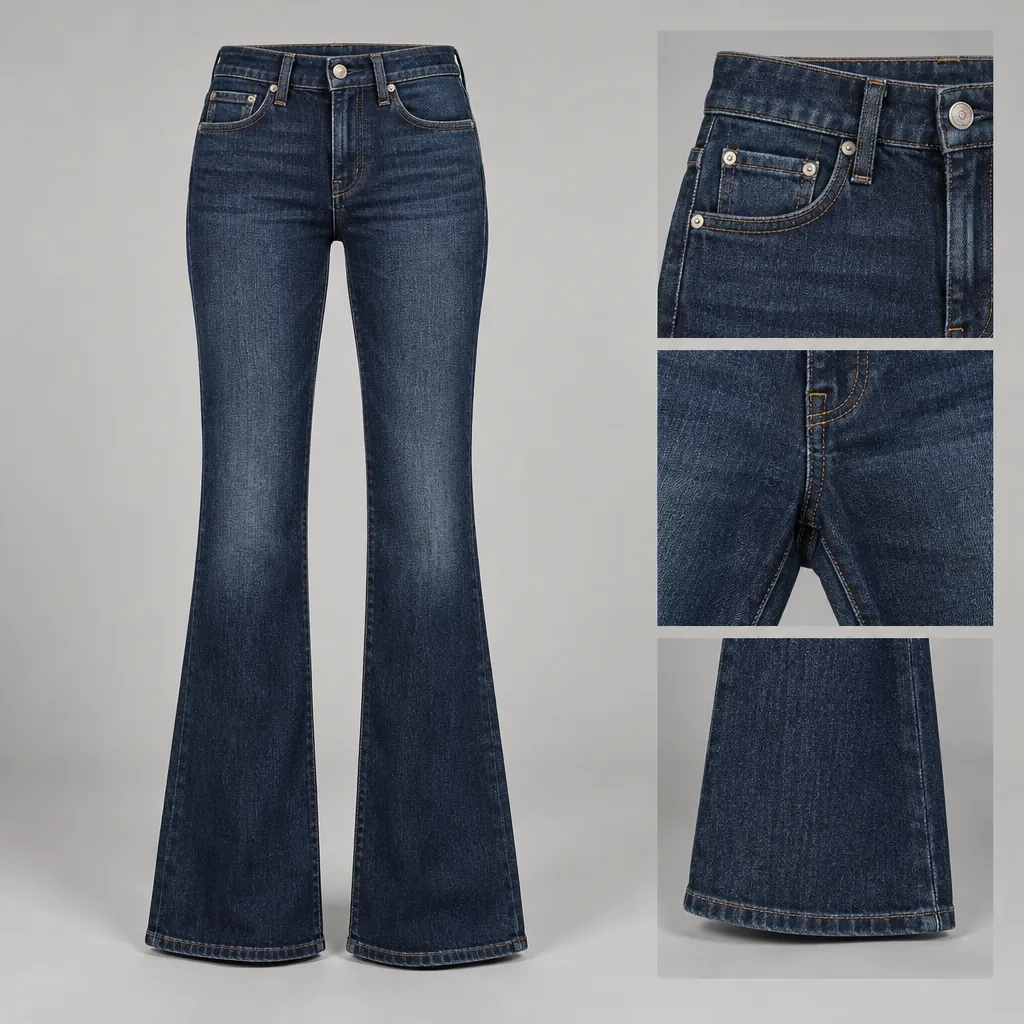
Bootcut jeans are the silhouette where proportion is the product. The style is defined by a leg that narrows at the knee and opens again toward the hem, and that shape only works when the rise above it and the inseam below it are chosen together. Search interest for bootcut jeans has returned to healthy levels in the United States, driven partly by the western revival and partly by customers trading out of extreme wide legs toward a shape with more structure. This guide covers the rise and inseam combinations that define the fit, how the hem meets the boot, and the wash plan that carries the style through a full season.
Why rise and inseam move together
A bootcut balances the body vertically: volume at the hem needs a corresponding structure above it. A lower rise with a strong flare reads rooted in an earlier era; a high rise with the same flare reads current and lengthens the leg visually. The inseam does the matching work below the knee. Too short, and the flare swings above the boot shaft and looks accidentally cropped; too long, and the hem pools and destroys the line the style exists to create. Because the leg opening is wide, inseam errors are more visible than in a straight leg, where an extra fold of fabric barely shows. The specification should therefore state rise and inseam as a paired decision, approved on a body with the intended footwear in the room.
Rise options and who they serve
- Mid rise. The broadest-reach option, comfortable when seated, and the safest choice for a first order in a mixed-age customer base.
- High rise. The current market lead; pairs naturally with the fitted hip the style usually carries and lengthens the leg line under the flare.
- Lower rises. A statement position for trend-led customers; bought in the seasonal layer rather than the core.
The rise measurements, front and back, should be recorded separately on the specification sheet. The rise and fit guide sets out the points to agree before sampling, and the bootcut adds one concern of its own: the back rise interacts with the seat shape under a fitted hip, so the approval should be checked from behind while standing and again while seated.
Inseam and the boot question
The defining question of a bootcut program is where the hem is meant to sit, and the answer depends on the boots the customer actually wears. The decisions to fix before ordering:
- The core inseam, matched to the store's customer height profile and the footwear the range is styled with.
- Whether length variants will be stocked or served through hemming, and how the hem finish survives shortening, since a chain-stitch or distressed hem changes character when cut.
- The hem opening width, judged with the boot in place so the flare clears the shaft rather than fighting it.
A photograph of the approved hem against the intended boot becomes useful size guidance on the product page, and it prevents the most common flare complaint: a hem that reads wrong because the customer paired it with footwear the buyer never imagined.
The combinations at a glance
The pairings below summarize the working combinations a bootcut order usually chooses between, and the discipline each one places on the fit approval.
| Rise and inseam pairing | Customer it serves | Trade-off |
|---|---|---|
| Mid rise, core inseam | Broadest base, mixed ages | Safest read, least fashion signal |
| High rise, core inseam | Current market lead | Demands an accurate back rise and seat approval |
| High rise, long inseam | Taller customers, heeled boots | Depth splits across lengths, tighter size coverage |
| Mid rise, short inseam | Petite customers, flat footwear | Hem finish must survive shortening |
Wash choices for the style
Dark indigo leads a bootcut program for the same reasons it leads most core programs: it styles widely, reads tailored, and reorders predictably. The western-leaning customer often wants exactly that clean dark finish, and mid washes serve the mainstream customer who wears the shape as an everyday silhouette rather than a scene. Heavier vintage abrasion sits oddly on a bootcut because the effects compete with the geometry; where a vintage wash is used, the abrasion should be concentrated above the knee and kept off the flare. Black serves a dedicated base and earns a pillar position where the store's customer data supports one. A practical opening is a dark wash at depth and a mid wash at supporting depth, with a third finish added only on evidence from the first two. Where the customer base leans western, the dark wash can move toward a truer indigo; where it leans mainstream, a softer vintage tone carries the same shape with a wider styling range.
Fit checks at the knee and hem
The bootcut's control points are the knee and the hem, and they should be checked as a pair. The knee should narrow visibly from the thigh; if the pattern keeps the thigh width down to the knee, the flare reads as a wide leg wearing a bootcut label. The leg opening is then judged against the knee, and the ratio between them is what the eye reads as bootcut. Both measurements belong on the sheet with tolerances, and both should be verified on the smallest and largest size of the run, because grading that starves the knee width on larger sizes turns the flare into a suggestion. A hem that loses its parallel line after laundering points at the finishing rather than the cutting, and it belongs in the tolerance conversation before bulk. Buyers comparing this shape against a fully fitted leg will find the contrast points in the guide to where skinny demand holds, which covers the opposite end of the fit spectrum.
Working with jeans
Quotations, minimum order quantities and lead times for a bootcut program are confirmed in writing for each order, and the rise and inseam mix shapes the production terms behind the quote. To specify the combinations your customer needs, request a quote with your rise and inseam plan and target washes, and the response will state the terms that apply.
Specification fields
| Field | Value |
|---|---|
| Fabric composition | Pending |
| Fabric weight | Pending |
| Wash options | Pending |
| Rise and fit | Pending |
| Leg opening | Pending |
| Stitching and finish | Pending |
| Hardware and trims | Pending |
| Labels and packaging | Pending |
Size chart fields
Measurements are taken flat, in centimeters or inches, and confirmed per size run.
| Field | Value |
|---|---|
| Waist | Pending |
| Hip | Pending |
| Rise | Pending |
| Inseam | Pending |
| Leg opening | Pending |
Pricing
| Tier | Quantity per style | Unit price (USD, FOB) | Lead time |
|---|---|---|---|
| Tier 1 | 300-499 pcs | Pending | approx. 30 days* |
| Tier 2 | 500-999 pcs | Pending | approx. 30 days* |
| Tier 3 | 1,000+ pcs | Pending | approx. 30 days* |
*Typical industry reference ranges for custom denim programs. Final MOQ, quantity tiers, unit prices and lead times are confirmed in writing for each program.
Private label options
Private label options for this style, including labels, trims, pocket detail and wash development, are listed on the custom and private label page and confirmed in writing.