Home / Guides / Skinny vs slim: where the line sits now
Skinny vs slim: where the line sits now
Slim and skinny jeans overlap on the sales floor. A buyer's guide to the taper line, stretch tiers, product copy and stocking depth for each.
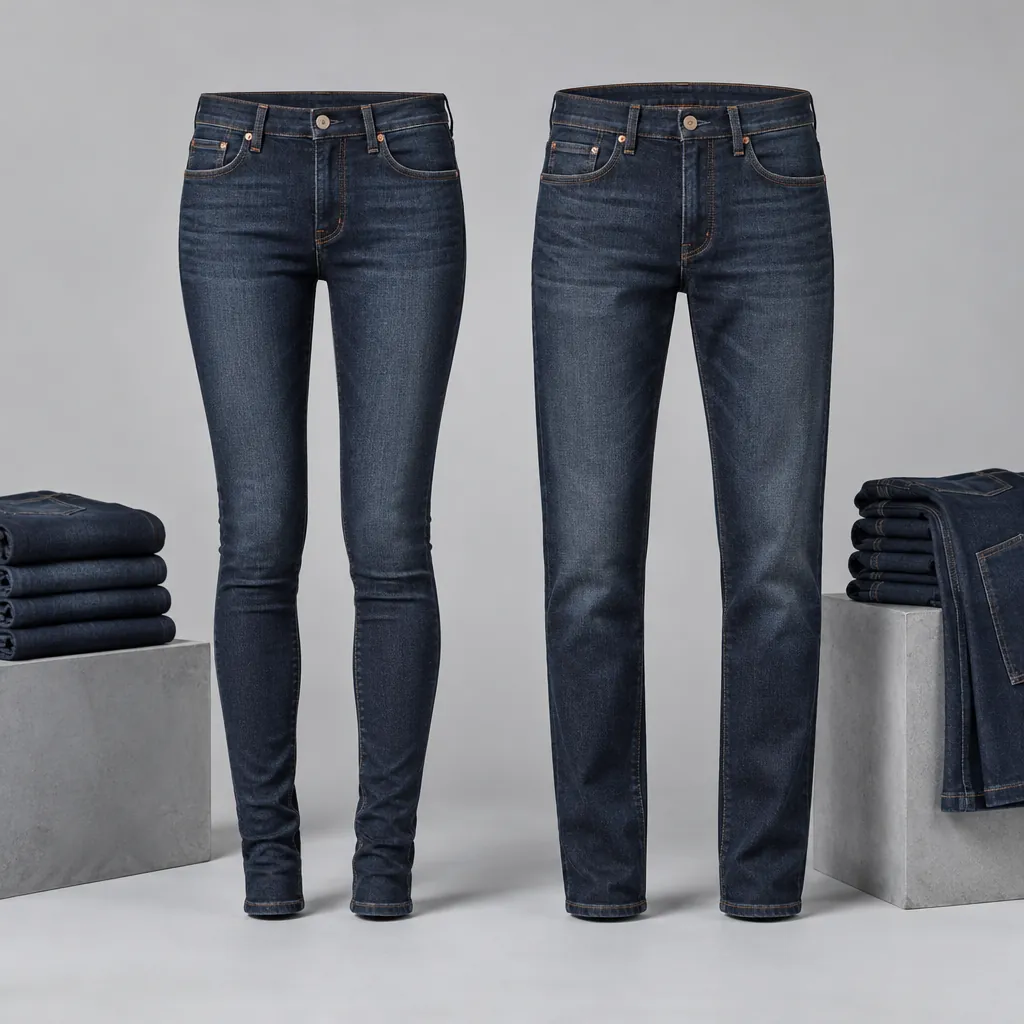
Few denim terms are used as loosely as slim and skinny. Suppliers label fitted jeans with either word, product pages use them interchangeably, and the customer arrives with her own definition shaped by whatever she wore last decade. A buyer who treats the two as synonyms ends up with a wall where two products compete for the same customer and neither has the depth to sell steadily. A buyer who separates them deliberately, in measurements and in copy, gets two programs that serve two different fitting expectations. This article sets out where the line sits and how to buy both sides of it.
The line is the taper, not the label
Slim jeans follow the leg with a taper that begins below the knee and leaves room at the ankle for a shoe. Skinny jeans carry the taper up through the knee and calf, close over the ankle, and are usually cut with more stretch so the leg opening can sit close without pulling at the calf. The distinction is measurable in three points: leg opening, knee width, and the ease allowed at the thigh. Buyers should require those three measurements on the specification sheet for any fitted style, because two suppliers can ship garments under the same label with visibly different tapers. Written measurements settle the argument that marketing labels create, and they give the store's product copy something factual to describe.
Communication is where that measurement discipline pays off. A store that publishes the knee width and leg opening for each fitted style lets the customer match the garment to what she already owns, which reduces the exchanges that look like sizing problems but are fit-description problems. Staff should be trained on the same three points, so a request for a slimmer leg is answered with the style that is actually slimmer at the knee rather than the style whose label says so.
What demand looks like now
Skinny denim no longer leads the fashion conversation, but a general decline in search interest hides the segments where it still sells. Customers who tuck jeans into boots, riders, shoppers in colder regions who layer over denim, and a core of loyal wearers who simply prefer the fit continue to buy skinny styles, often as replacements rather than experiments. Slim denim has absorbed much of the fashion-facing demand because it reads current while remaining wearable to work. For a buyer, the practical reading is this: slim is the default fitted offer and deserves core status; skinny is a deliberate offer for a known customer, bought at a narrower wash range but full size depth, rather than a guess at a returning trend.
How fabric changes the read
The same silhouette reads differently across stretch tiers. A rigid or low-stretch slim jean holds a crisp line and creases at the knee over a day of wear; a high-stretch skinny recovers close to the body and keeps showing the leg shape continuously. Recovery, not stretch alone, decides whether a fitted jean bags at the knee and seat by the end of the day, and recovery is the property most often left out of a quote request. Buyers should check recovery on a worn sample rather than a fresh one, and compare behavior across the stretch tiers described on the stretch denim page before fixing the fabric for either style. The trade-off against non-stretch constructions is set out in the comparison of stretch vs rigid denim, which matters most at this end of the wall.
Slim and skinny compared on the buying sheet
| Dimension | Slim | Skinny | Implication for the buy |
|---|---|---|---|
| Leg opening | Room for a shoe | Closes at the ankle | Measure, do not trust the label |
| Ease at thigh and knee | Comfortable with little stretch | Depends on stretch to work | Skinny pairs fabric and pattern tightly |
| Fabric demand | Flexible across weights | Needs strong recovery | Test recovery on a worn sample |
| Customer overlap | Some crossover from skinny wearers | Loyal core, slow to switch | Do not assume one converts to the other |
| Styling range | Works tucked or loose, most shoes | Defined look, boots or low profile | Slim carries the broader wardrobe |
| Risk profile | Core-style risk | Trend-adjacent, replacement-driven | Narrower wash range for skinny |
Writing product pages so the two do not cannibalize
Online, slim and skinny compete for the same click unless the copy separates them. Each product page should describe the fit in terms the customer can check against a size chart: where the taper begins, how the leg opening sits, and how much give the fabric has. A shopper who wanted skinny and receives a leg opening that fits a boot will return the pair, and the return reason will look like a size problem when it is really a description problem. The wording on the page should match the specification sheet exactly, and the same fit language should be used across both channels so the store trains one expectation rather than two.
Stocking logic for the fitted end of the wall
Depth rules differ between the two. Slim deserves full size runs across the core washes and belongs on the replenishment rhythm with the rest of the core range. Skinny deserves a narrower wash selection but complete size depth in the sizes its core customer actually wears, reviewed against replacement demand rather than trend signals. Buying both at the same wash count halves the depth of each, and the result is two thin programs instead of one deep one. The wash counts, size curves and reorder points should be planned separately for each. Where the boundary between fitted styles matters to your assortment, the comparison of jeggings vs stretch jeans continues the analysis at the stretch end of the spectrum, and the skinny option set in the catalog shows how the fit is currently specified.
Working with jeans
Quotes, minimum order quantities and lead times for either fit are confirmed in writing before an order is placed, and the measurements agreed in writing are the ones the bulk is held to. To request a quote, send the fits, fabrics and size runs you intend to carry.