Home / Guides / Straight vs slim jeans: stocking both
Straight vs slim jeans: stocking both
How buyers split a denim buy between straight and slim jeans: depth, washes, size runs and reorder habits that keep both silhouettes selling.
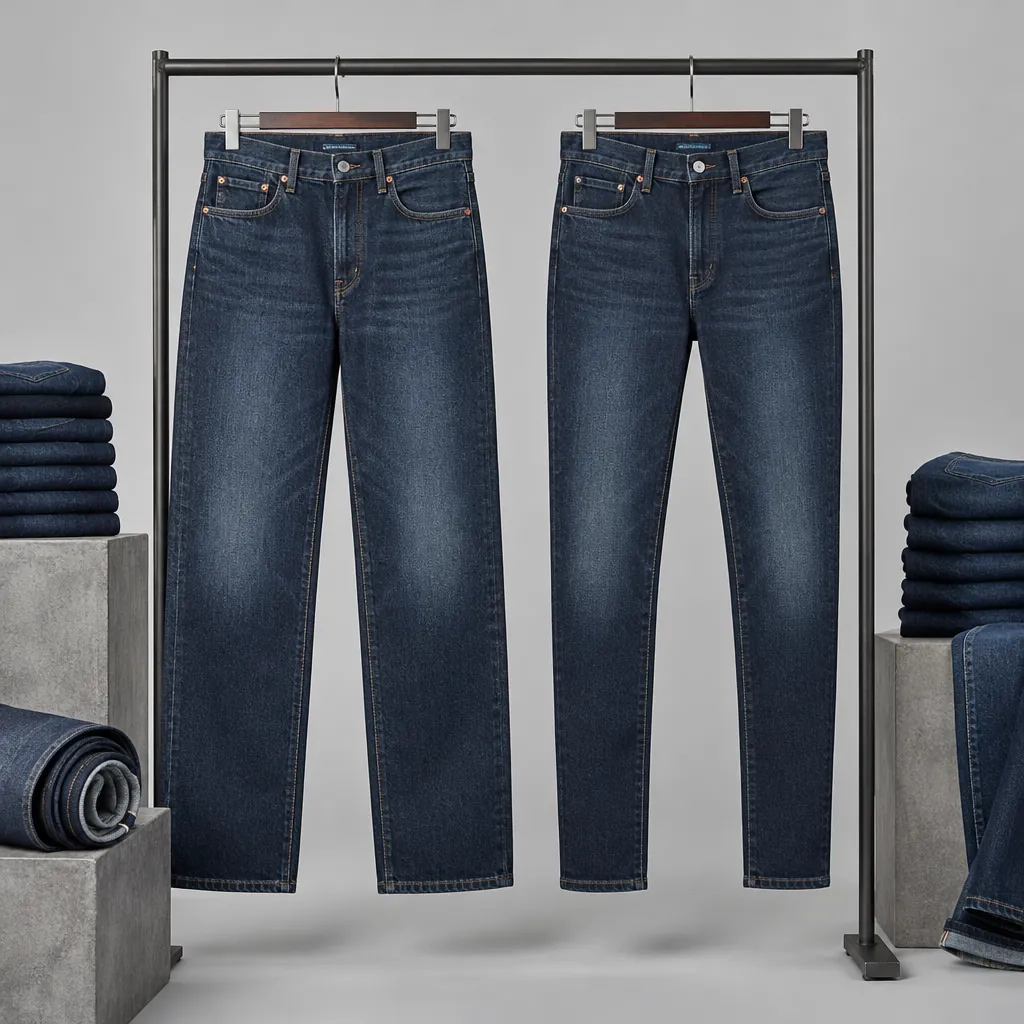
Straight and slim are the two silhouettes that anchor most American denim walls, and they are also the pair most often bought without a plan. Buyers order both because both sell, then discover at mid-season that one side of the order has sold through while the other sits in three sizes nobody asked for. The problem is rarely the silhouettes themselves. It is that a two-silhouette program doubles every variable behind the product: size runs, washes, rises, fabric and reorder timing. This article explains how a retail buyer can split a buy between straight and slim deliberately, using the store's own demand signals rather than habit.
Why these two carry most walls
Straight leg is the default jean for a broad customer base. It reads as neutral from the front, works across ages, pairs with almost every shoe height and survives trend cycles with little restyling. Slim leg is the fitted counterpart. It follows the shape of the leg, layers cleanly under longer tops and reads more deliberate in photographs, which matters to stores selling online. Together they cover the two answers a customer gives when asked how a jean should fit: close to the body, or straight down from the hip. Most other silhouettes are variations on one of those two answers, which is why these two deserve the largest share of open-to-buy.
Read your own demand before you split the buy
The correct split is written in the store's own records, not in trend reports. Three records matter most. First, fitting room requests: which silhouette do staff fetch most often, and in which sizes. Second, return reasons by style: a slim program with a high exchange rate is often a size-curve problem rather than a demand problem. Third, sell-through by week: straight legs tend to sell steadily, while slim legs can spike when a new wash lands and flatten afterward. A buyer who reads those three records can usually see within a season whether the wall is weighted correctly, and by how much the next order should shift.
Regional and customer mix matter as well. A store serving a commute-and-office customer usually holds a straight-heavy mix. A store serving a younger or photo-driven customer usually carries more slim. Neither mix is wrong; both become expensive when the buyer copies another store's ratio instead of reading its own.
Depth decides the outcome, not the silhouette count
Carrying two silhouettes is affordable only if each one is carried deeply enough to be shoppable. Depth means the full size run in the core washes, replenished, rather than a thin scatter of sizes across many washes. A straight program with a few washes and a complete size run will outsell a straight program with twice as many washes and broken size runs, even though the second looks fuller on the wall. When the buy is planned, the buyer should fix the wash count per silhouette first, then the size depth per wash, and only then consider adding another wash or a new rise.
Size runs are where the cost hides. Two silhouettes with the same nominal size range do not always share the same demand curve: slim fits often concentrate sales in particular waist and hip sizes, while straight fits spread demand more evenly. The buyer should review size sales per silhouette each season and grade the buy accordingly, rather than ordering an identical size curve for both.
Straight and slim compared for a stocking decision
| Dimension | Straight leg | Slim leg | Trade-off for the buyer |
|---|---|---|---|
| Leg line | Falls straight from knee to hem | Tapers below the knee | Straight suits broader wardrobes; slim reads more styled |
| Core customer | Spans a wide age range | Skews to style-led shoppers | Straight is safer depth; slim can grow into a pillar |
| Wash sensitivity | Sells steadily in core washes | Responds to new wash launches | Give slim the seasonal washes; keep straight on indigo |
| Fabric demand | Works in most weights | Needs recovery to hold shape | Slim places more demands on the fabric spec |
| Markdown behavior | Clears slowly but predictably | Clears fast or not at all | Time slim markdowns earlier |
| Reorder rhythm | Replenishes on a schedule | Reorders follow wash wins | Track the two on separate reorder points |
Presenting the two on one wall
On the floor, the two silhouettes should never be interleaved in one stack. A customer looking for a straight leg will not dig through slim pairs to find her size, and the mixed stack hides size gaps in both programs. Group by silhouette first, then by wash within each group, and stack sizes in a consistent order across the wall. A short fit card at each block, naming the leg line and the rise, saves staff time and reduces the questions that slow the fitting room. The same grouping logic should carry through to the online store, where silhouette is usually the first filter a shopper applies.
Share what can be shared, separate what must differ
The economical way to run two silhouettes is to share everything behind them that the customer cannot see. Fabric can often be shared when both silhouettes are cut from the same base cloth, which simplifies fabric minimums and keeps hand feel consistent across the wall. Washes can be shared across silhouettes so that a customer who likes the wash in one fit can find it in the other. What must differ is the pattern and the grading: a slim block scaled from a straight block, or the reverse, produces fits that look correct on the table and fail on the body. Each silhouette needs its own approved fit sample and its own grading rules, and the two should never share a specification sheet.
Reorder habits that keep both sides healthy
A two-silhouette wall needs two reorder conversations. Straight legs should sit on a replenishment rhythm, with reorder points set from confirmed lead times and checked weekly against sell-through. Slim legs should be reviewed after each wash launch, with the decision to repeat a wash made on evidence rather than enthusiasm. Staff should be briefed to report size gaps by silhouette, because a missing size in the slim program reads to the customer as a merchandising failure even when the size was simply never ordered. Where the wall drifts, the correction belongs in the next order rather than in a mid-season transfer that strands stock in the wrong channel. For buyers who want to go deeper on the fitted end, the comparison of skinny vs slim extends this analysis, and the dedicated page on straight vs slim fits breaks the two leg lines down point by point. The jeans catalog lists both silhouettes with the wash and rise options currently offered.
Working with jeans
Quotes, minimum order quantities and lead times for both silhouettes are confirmed in writing before any order is placed, and the figures apply only to the specification and quantity stated in that confirmation. To request a quote, send the silhouettes, washes and size runs you have in mind, and a written confirmation will follow.