Home / Guides / Jeggings vs stretch jeans for retail
Jeggings vs stretch jeans for retail
Jeggings and stretch jeans serve different customer expectations. Where the category boundary sits, and what it means for sizing, copy and returns.
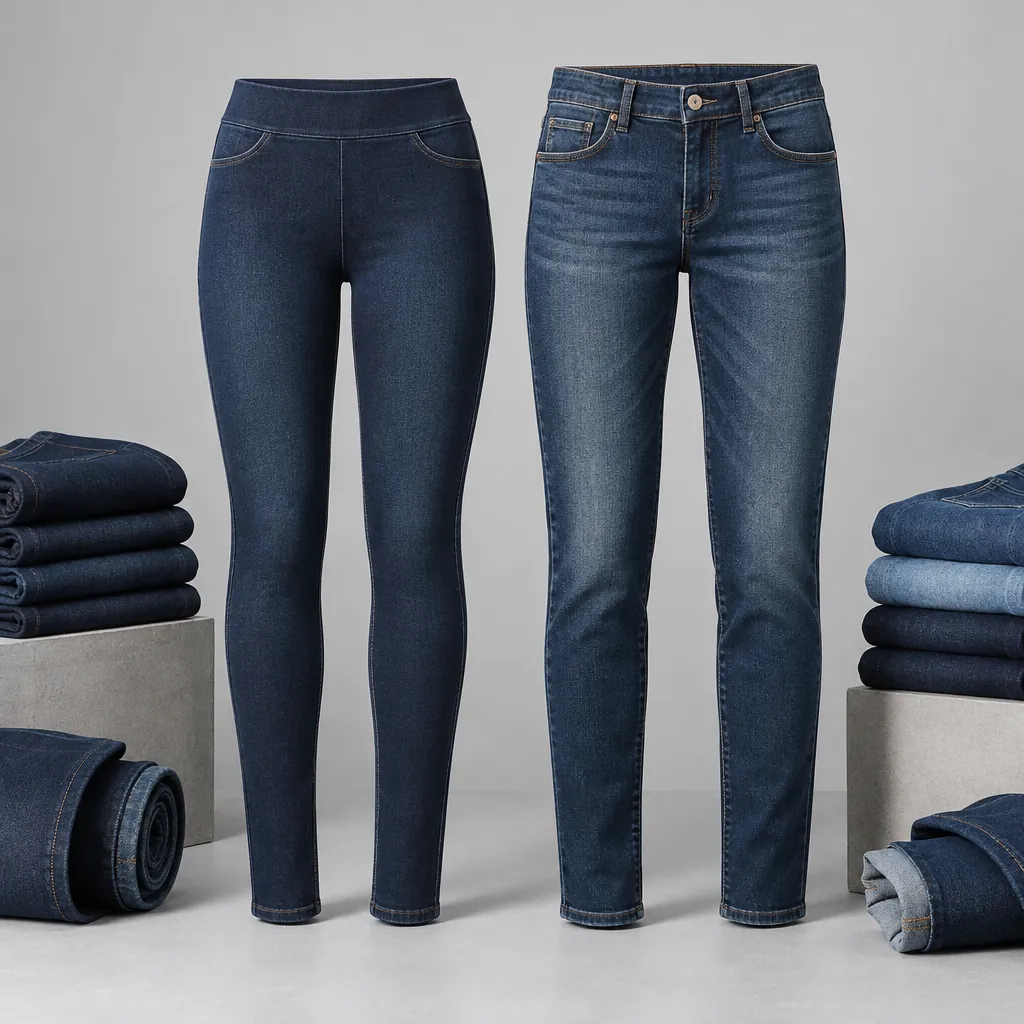
Jeggings sit at the boundary between denim and leggings, and the boundary is exactly where retail problems start. A store that shelves them as jeans gets comfort-driven customers who expected pull-on ease and finds them confused by hardware; a store that shelves them as leggings misses customers searching the denim wall for them. The two categories also behave differently in sizing, in returns and in how honestly the product page must describe them. This article draws the line between jeggings and stretch jeans in construction terms, then works through what the distinction means for a retail buy.
What makes a jegging a jegging
A jegging is defined by construction, not by advertising. It uses a denim-look fabric with a high elastane content relative to ordinary stretch denim, a soft hand closer to knit than to woven, and a simplified closure: many jeggings use a pull-on waistband or a minimal front closure, and some drop traditional hardware altogether. A stretch jean, by contrast, is a conventional five-pocket garment in woven denim with a modest elastane addition: it keeps the fly, the rivets, the belt loops and the structured waistband, and the stretch exists to add comfort within the classic construction. The two can look similar on a hanger. On the body, and in the customer's expectation, they are different products.
Why the boundary matters commercially
Each category recruits its buyer with a different promise. The jegging buyer wants comfort first: easy on, easy movement, no gap at the waist, no stiffness at the knee. The stretch jean buyer wants the jean look and the jean construction, with give as a quiet benefit. When a product crosses the line without saying so, the mismatch returns as an exchange or a review: a customer who ordered what the page called jeans and received a pull-on garment feels misled, even if the garment itself is well made. The distinction also decides placement. Jeggings can sit in a comfort or essentials section beside leggings; stretch jeans belong on the denim wall. Placement drives attachment: the wall sells the outfit, the comfort section sells the repeat purchase.
There is also a pricing boundary to manage. Because jeggings use more elastane and simpler closures, their cost structure differs from a conventional stretch jean, and a store that prices the two as if they were the same article invites questions the staff cannot answer well. The cleaner approach is to treat them as neighbors rather than substitutes: different shelf, different copy, different promise, each priced on its own construction.
Recovery and shape retention decide satisfaction
At the elastane levels jeggings use, recovery is the property that separates a repeat purchase from a returned one. A fabric that stretches easily but recovers slowly bags at the knee and seat over a day of wear, and the bagging is more visible on a close-fitting garment than on a straight leg. Buyers should treat recovery as a specification item, not a hope: state the recovery expectation in the spec sheet, check it on a worn sample over a full day, and re-check it after washing, because elastane behavior changes with laundry cycles. The stretch tiers used in woven denim, and how they change the read of a fitted jean, are covered on the stretch denim page.
Jeggings and stretch jeans compared on the buying sheet
| Dimension | Jeggings | Stretch jeans | What it changes for the buyer |
|---|---|---|---|
| Construction | Knit-like hand, simplified closure | Woven denim, fly, rivets, belt loops | Describe the closure plainly on the page |
| Customer promise | Comfort and ease first | Jean look with give | Placement and copy follow the promise |
| Waistband | Pull-on or elastic-assisted | Structured waistband | Sizing behavior differs at the waist |
| Fabric demand | High elastane feel, strong recovery | Modest stretch, classic hand | Spec recovery explicitly for both |
| Sizing behavior | Forgiving range, gradual fit loss | Defined fit, clearer size boundaries | Size curves are planned differently |
| Return drivers | Expectation mismatch, bagging | Fit and rise issues | Read return reasons by category, not together |
Labeling and honest description
The category line is also a labeling line. The fiber content label must state the actual composition of the fabric, whatever the product is called on the sign, and customers who feel a knit-like hand while reading a rigid-denim content claim will notice. Product pages should say plainly whether the garment pulls on or buttons, how high the waist sits, and how the fabric behaves over a day of wear. The label and compliance content a US program needs is summarized on the fiber labeling page, and the safest rule is the simplest one: call the garment what its construction makes it, and let the customer self-select correctly.
Where each belongs in an assortment
In most assortments the stretch jean is the mainstream fitted offer and belongs in the core plan with full size runs in core washes. The jegging works best as a focused comfort capsule for the customers the store already knows want it, with demand that often crosses into plus size and maternity selections and holds through the year rather than following silhouette trends. Depth should follow that demand shape: narrow wash range, full size depth in the proven sizes, replenishment rather than seasonal restyling. Treating the jegging as a trend item is the common error; its customers are chasing comfort, not fashion cycles. How a two-tier denim wall is structured around products with different roles is set out in the article on value vs premium denim.
Returns data should be read separately for the two categories as well. A jegging return driven by bagging or by an expectation mismatch is a signal about fabric or copy, while a stretch jean return driven by rise or waist fit is a signal about grading. Merging the two into one return report blurs both signals, so the reporting split should exist from the first order, not be reconstructed later from order numbers.
Working with jeans
Quotes, minimum order quantities and lead times for either category are confirmed in writing before an order is placed, with the fabric construction and closure type stated in the specification the quote refers to. To request a quote, describe the fits, fabrics and size runs you intend to carry.