Home / Guides / School uniform denim: compliance and sizing
School uniform denim: compliance and sizing
What school uniform denim programs require: consistent washes, full youth size coverage, adjustable waists and which test documents to request.
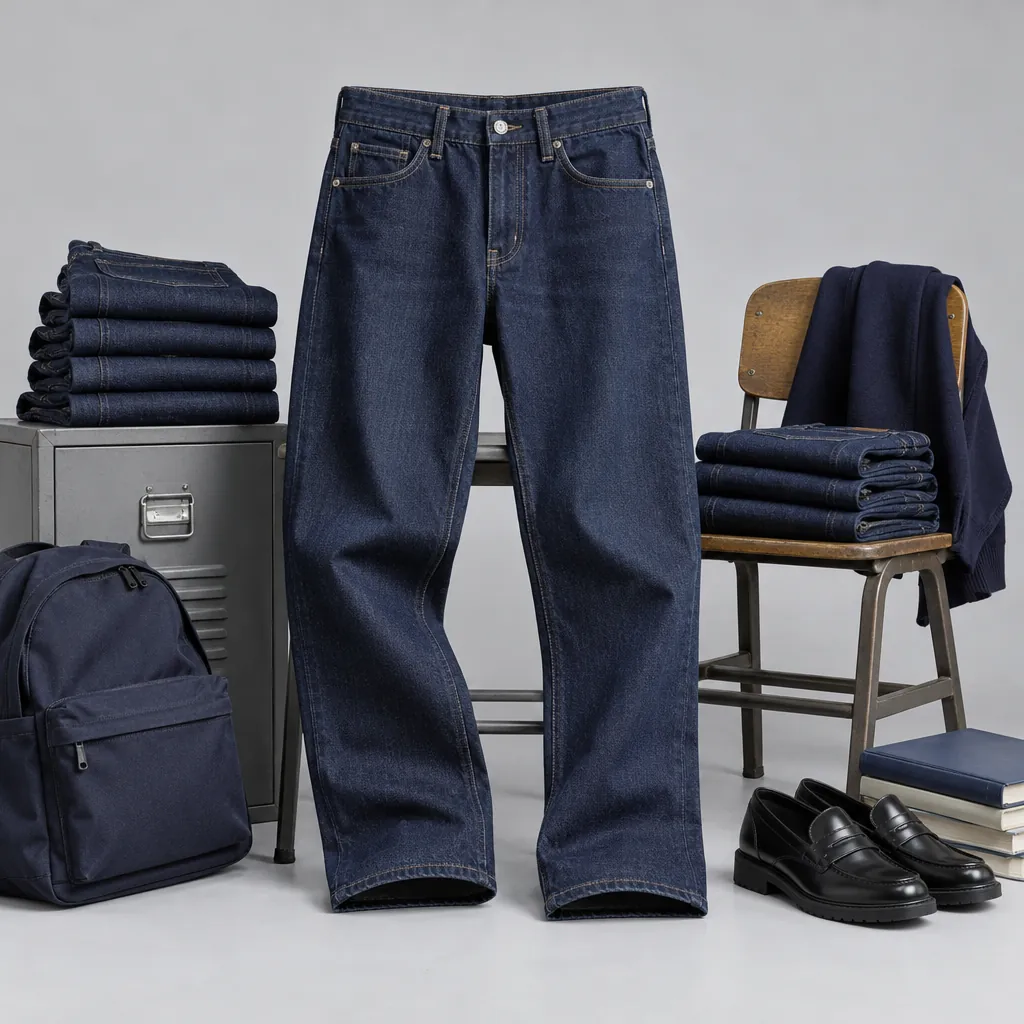
Schools that adopt denim as part of a uniform turn a fashion category into a supply program. The buying priorities shift accordingly: the wash must be repeatable across the school year, the size run must cover every student who enrolls mid-year, and the documents behind the garment matter as much as the garment itself. This article describes what a school uniform denim program typically specifies, how size coverage is planned for a youth population, and which testing and labeling questions a buyer should raise with suppliers and then verify with its own advisers. Requirements differ by district and by jurisdiction, so nothing here substitutes for that verification.
What a school program actually specifies
Most school denim programs converge on a narrow brief, and the narrowness is deliberate:
- One or two fits, most often a straight or a slim straight.
- One wash, dark enough to read as uniform and durable enough for daily wear.
- No distressing, no decorative destruction, minimal fashion detailing.
- A full youth size run, including the sizes a fashion wall would drop.
- Consistent labeling so families can identify the approved garment easily.
The product is intentionally boring, because the program's success is measured in consistency and coverage rather than novelty. Buyers should expect the specification to be written down once and held to it across reorders, since a mid-year delivery that arrives in a visibly different wash is what generates the complaints that end programs.
Size coverage is the product
A uniform program cannot sell out of a size, because the student who needs it has no alternative that meets the dress code. That changes the size plan from a demand forecast into a coverage obligation: the run should be continuous across the youth range the school serves, including both ends of the range where a retail wall would cut losses. Adjustable waists carry much of the fit burden in youth denim, letting one size serve a growth range and reducing mid-year exchanges for families. Generous hems, clear alteration guidance and a fit that tolerates growth all reduce the replacement frequency that families feel as cost. General fit and grading practice for denim, including how size runs are planned, is covered in the sizing guide.
Fabric and construction for daily wear
Daily school wear sits between fashion and workwear. The fabric is usually oriented toward the mid-to-heavier range with little or no elastic content, because shape retention through frequent laundering matters more than stretch comfort. Reinforced knees are a common request in the younger sizes, where abrasion is concentrated. Adjustable waistbands add construction steps at the waistband, and their hardware should be checked for smooth edges and secure attachment on the fit sample. None of these choices is exotic; the discipline is writing them into the specification so the reorder matches the first delivery. Fit and fabric interact as well: a stable, low-stretch fabric holds the range an adjustable waist sets better than a stretchy one, because the garment keeps the shape the waistband gives it. Where schools allow a choice, a slim and a regular fit on a shared block give families a real option without doubling the specification.
Safety and testing: what to ask suppliers for
Children's garments carry expectations that adult denim does not, and a buyer should treat them as questions to answer with documents rather than with assurances. The usual areas of attention are small parts and how securely they are attached, cords and drawcords around the head and neck areas of children's upper-body garments, sharp edges on hardware, and chemical safety of dyes and finishes. For each area the practical step is the same: ask the supplier which tests the fabric and trim package has been through, request the reports, and have the scope reviewed by an adviser who knows the destination market and the districts involved. An overview of the common test areas for children's denim, and what each of them covers, is set out on the kids denim testing page. FULVERA coordinates sourcing and provides documentation with orders on request; it does not certify compliance, and responsibility for meeting a given district's or market's requirements rests with the buyer and its advisers.
Consistency across the school year
The program's hardest test arrives mid-year, when a family needs a replacement pair and the school expects it to match what every other student is wearing. Meeting that expectation requires the supplier to reproduce the same wash across lots, which in practice means an approved wash standard, retained reference samples on both sides, and lot comparisons against the standard before shipment. Buyers should ask specifically how the wash will be matched on a replenishment order placed months after the first, and should keep an approved reference sample on file where it can be reached quickly. Programs that skip this discipline usually discover the gap in the middle of the school year, when it is most visible and least fixable.
The commercial shape of a uniform program
School programs are quoted and ordered differently from retail buys. The annual cycle runs ahead of the school year, with the bulk delivery landed before the back-to-school window and a planned replenishment tranche reserved for mid-year growth. Quantities are forecast from enrollment rather than from fashion demand, which makes them unusually stable, and that stability is precisely what makes the program economical to produce. The same structure, an annually renewed specification with staged deliveries and identical reorders, also describes staff uniform supply in other industries, as set out in the article on corporate denim programs. Renewal is part of the cycle too. A program quoted for one school year should be re-confirmed before the next, with any change to fabric, wash or labels treated as a specification change rather than a quiet update. Districts adjust requirements, enrollment shifts the size mix, and a written renewal keeps both sides working from the same page.
Working with jeans
FULVERA coordinates denim sourcing for school and institutional uniform programs, including wash standards, size planning and documentation requests, all confirmed in writing before production. Test scopes and label requirements should be verified with your own adviser for the districts and markets you serve. When your program outline is ready, request a quote with the fits, wash and size coverage your schools need.