Home / Guides / From resale to bulk: scaling a jeans business
From resale to bulk: scaling a jeans business
What changes when a jeans resale business moves to bulk buying: turning sales data into specs, first order structure, margin and compliance duties.
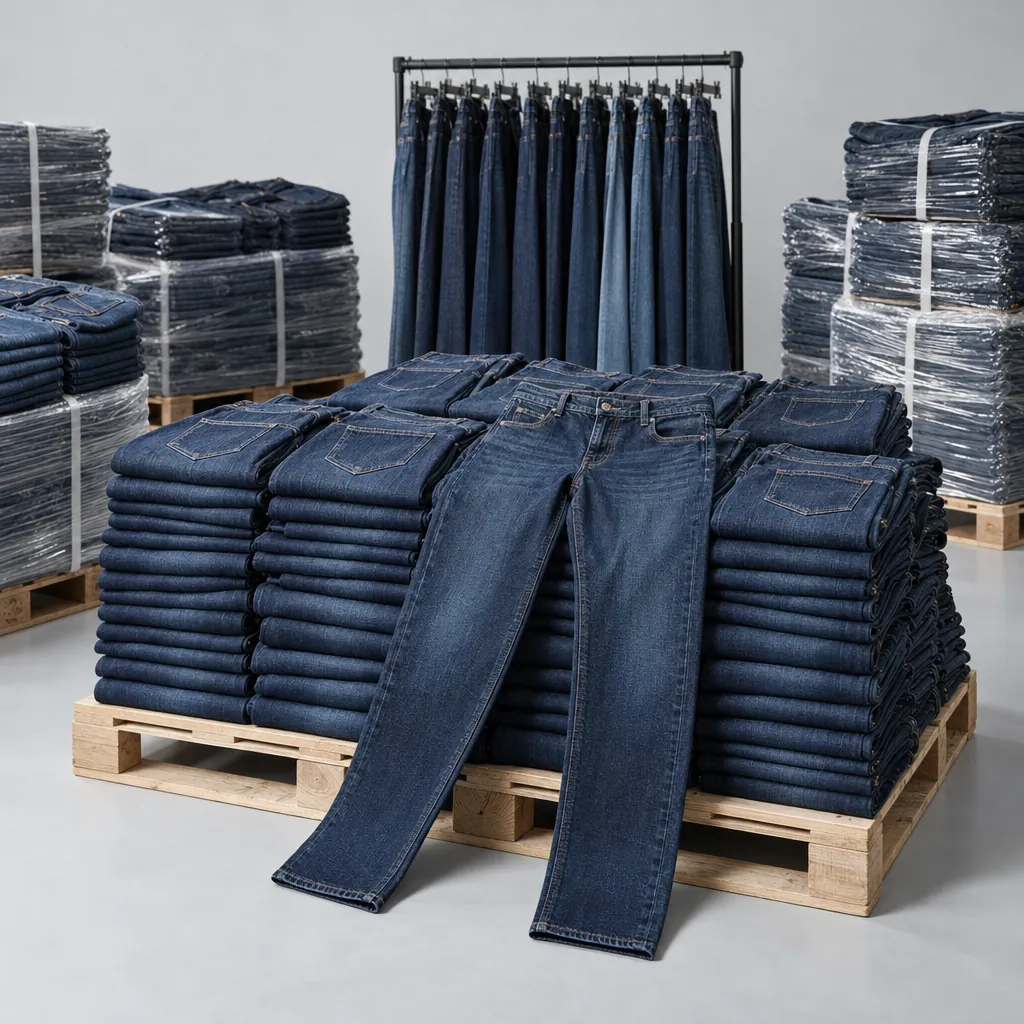
A large share of denim sellers start by reselling: liquidation lots, closeout pallets, secondhand finds graded and sold online. The model teaches product knowledge and demands little capital, but it plateaus quickly, because the seller never controls sizes, consistency or supply. Moving from resale to bulk buying is less a step up in volume than a change of job: from selecting what exists to specifying what gets made. This article describes what actually changes, how to convert resale data into a first specification, and where new bulk buyers most often stumble.
What changes when you buy bulk
Resale rewards an eye; bulk rewards paperwork. In resale, every unit is inspected individually and sold as found. In bulk, the buyer approves one sample and then receives hundreds of units that must match it, which moves the work into specifications, tolerances and written confirmations. Margins change shape too: the unit cost drops, but capital sits in stock for months, so cash flow discipline replaces the fast turnover resale enjoys. And accountability moves in-house: once the buyer specifies the product, the buyer owns whatever the specification left out. None of these changes is a reason to stay in resale; they are the reason the move should be planned rather than improvised. The rhythm of the work changes with it. Resale is a stream of small decisions made quickly on individual pieces; bulk is a small number of large decisions made slowly and then lived with for a season. Buyers who settle into the second rhythm do well, and buyers who miss the first should keep a resale or limited test lane alongside the bulk program rather than abandoning it.
Turn resale data into a specification
The resale phase produces something genuinely valuable: a record of what actually sold. Sizes that moved first, washes that drew attention, price points that cleared quickly, and the complaints that came back all convert directly into a first spec. A seller who knows that one dark wash sold twice as fast as anything else has found a hero wash. A seller who fielded complaints about thin fabric knows to orient the specification differently. The discipline is to write these findings down as requirements before approaching a supplier, and to keep the first range inside what the data supports rather than inside what the founder has always wanted to sell. The conversion also works in reverse: what never sold is as informative as what did. A size the resale operation never moved is a size the first bulk order should skip, and a wash that sat for months is a wash to leave behind even if it was personally preferred. The first order is not a statement of taste; it is the sharpest available summary of demand.
Structure the first bulk order narrowly
The first bulk order should be narrower than the resale operation was. One or two fits, in the washes the data supports, on a shared fabric, with a size run weighted toward the sizes that sold first. The temptation is to replicate the variety resale offered; the discipline is to fund depth instead, because depth in the proven sellers is what makes the unit economics work. The full sequence from brief to first delivery, including sampling and approval steps, is set out in the checklist for opening a denim line, and it applies to a reseller's first order as much as to a new brand's.
Pick the supplier relationship deliberately
Buying bulk is a different relationship from buying lots. A lot seller moves inventory; a production partner holds a specification and reproduces it. The differences show up in the questions worth asking before committing: who answers during production, how changes are communicated and confirmed, whether the factory can hold an approved wash standard across seasons, and what happens when a reorder is needed quickly. A seller used to one-off lot purchases should expect slower onboarding and better long-term economics, and should treat the first order partly as an audition for the reorder.
The margin math changes shape
Bulk buying lowers the unit cost, and that is where the resemblance to easy money ends. Stock takes months to sell through, sizes sell at different speeds, and the tail of the size run often needs markdowns that resale never faced because resale never bought the full run. Buyers coming from resale should model margin on the slowest sizes rather than the fastest, and should hold a reserve for the second order rather than reinvesting everything in the first. A conservative first order that reorders successfully beats a large one that strands cash in the edge sizes.
Compliance becomes your responsibility
A reseller moving secondhand or closeout goods operates under different obligations than an importer of new garments. Once the business imports and sells new denim under its own name, questions of fiber content labeling, care instructions, country of origin marking and general product safety move in-house. The scope depends on the market and on the claims made, and it should be reviewed with an adviser before the first order rather than after the goods land. Suppliers can provide the underlying documents; assembling and verifying them is part of the buyer's job, and the time it takes belongs in the plan. Labeling is the most common gap. Resale goods carry whatever label the original maker applied, while a new program built under the buyer's own name needs a complete label set produced to the destination market's expectations, from fiber content through care instructions. Ordering labels late is one of the quietest ways to lose a delivery window.
Keep the resale habits that still work
Two resale habits deserve to survive the transition. The first is granular attention to what sells, now expressed as sell-through review by size and wash. The second is small, structured risk: testing one new wash or fit at a time, the way a limited run tests a market without committing the business, as described in the article on streetwear denim drops. What should be left behind is dependence on whatever inventory happens to exist, since the entire value of bulk buying is specifying what gets made instead of choosing among what did.
Working with jeans
FULVERA works with sellers making the move from resale to bulk denim supply, including first orders built on proven size and wash data. Entry routes around high minimums, including shared-fabric and multi-style structures, are summarized on the MOQ barriers page. Terms for any first order are confirmed in writing; when your sales data is organized, request a quote with what your resale record supports.