Home / Guides / Private label jeans: where costs add up
Private label jeans: where costs add up
Where private label jeans add cost: labels, hardware, packaging and development, and how to scope each before you request the quotation.
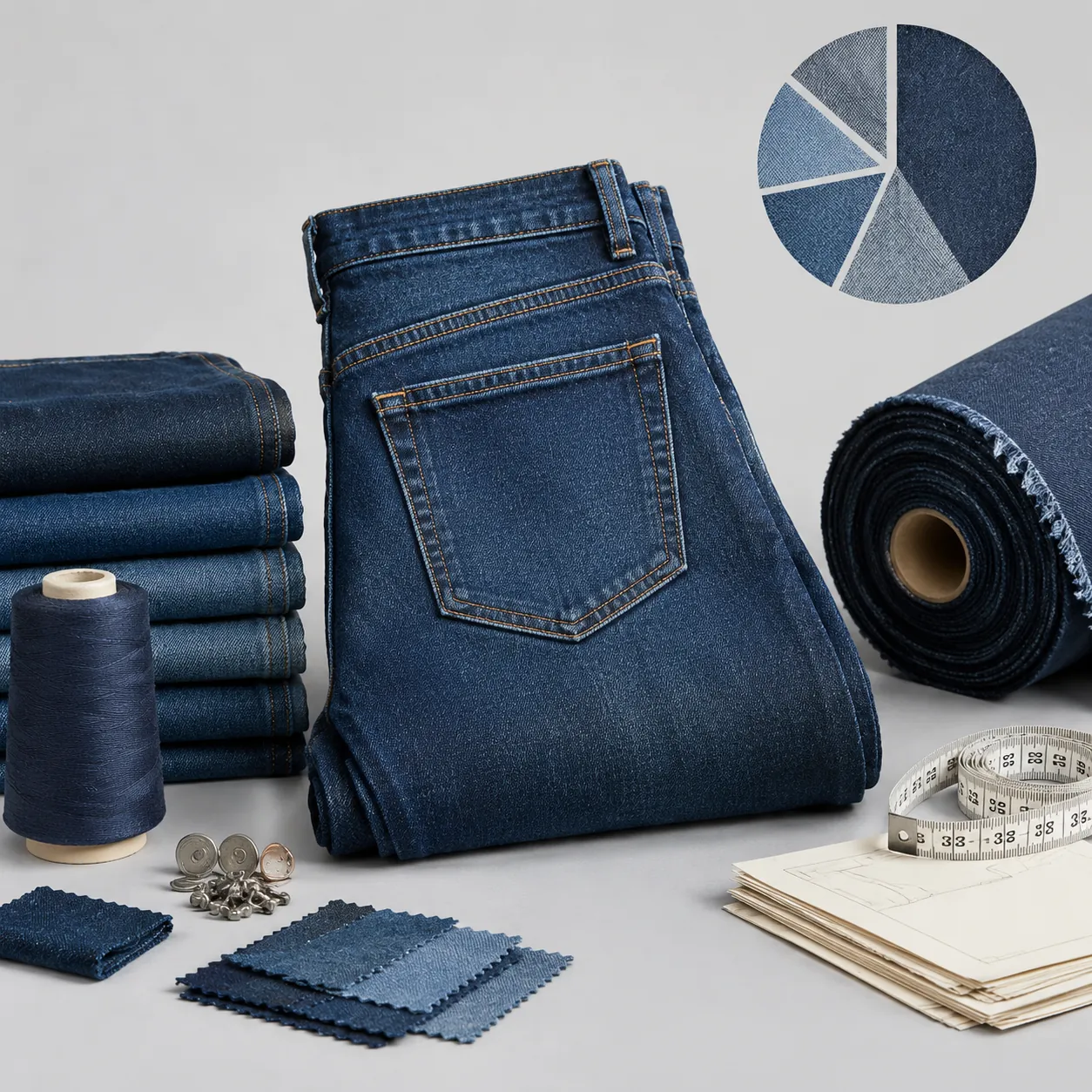
Private label promises a retailer margin and identity at the same time: jeans made to the store's specification, carrying the store's name, in packaging the store designed. The promise is real, and so is the gap between a stock program and a branded one, which shows up first in the quotation. Buyers who scope their private label requirements completely before requesting a quote receive figures that hold; buyers who add branding elements one at a time after the quotation receive a program made of change orders. This article maps where the costs accumulate, which of them are one-time and which repeat with every order, and how to present the program so the quotation covers it in one pass.
What changes when the jeans carry your name
- Labels. A main label, a size tag, a care label to the target market's rules and often a flag or brand tab at the back pocket. Woven labels carry a setup cost and a per-piece cost; printed labels are lighter on both but read as lighter on the garment.
- Hardware. Custom buttons, rivets and zipper pulls carry tooling and minimum order quantities of their own, and the tooling usually belongs to the program for reuse on reorders.
- Trim color matching. Threads, pocket bags and waistband finishes matched to the brand palette add a development step that stock programs skip.
- Packaging. Branded hangtags, polybags with printed warnings for the destination market, and carton marking to the retailer's receiving requirements.
- Paperwork alignment. Invoices, packing lists and shipping documents that carry the brand consistently, which matters to buyers reselling under the name.
None of these elements is exotic; each is ordinary garment work. What changes the economics is their interaction with quantity, because most of them carry minimums that only a program's volume absorbs gracefully.
Ownership of label compliance is worth settling explicitly. The retailer owns the brand and usually supplies the artwork; the factory executes it. But the content that must appear on a care label, the fiber declaration and the origin marking are factual claims that somebody must draft and somebody must verify, and the division should be written into the order: who supplies the approved text, who prints it, and who is responsible if it is wrong. Buyers who leave this division implicit discover at the worst possible moment that everyone assumed the other party was checking.
Development costs that appear before production
A private label program carries costs that precede the first bulk piece by weeks: pattern work from the buyer's sketches or a modified block, sampling through the ladder described in sample pricing versus bulk pricing, wash development until the approved standard exists, and sometimes artwork and die charges for labels and hardware. These costs are one-time in the happy case and repeatable when the specification changes, which is the quiet argument for finishing the specification before development starts. Suppliers handle these costs differently, some quoting them transparently as separate lines and some folding them into the unit figure with a reorder commitment behind it. Both structures can be fair; the buyer's job is to know which one a quotation uses, because a folded-in structure obligates the volume that pays for it.
Where private label pays for itself
A private label program earns its adders through position rather than through cost. The retailer controls the identity on the garment, cannot be compared item for item with the store across the street, and builds an asset in the brand name that outlives any single season. The program also earns through fit continuity: once a block is approved and a size curve is trusted, reorders carry no new development cost, and the unit economics improve with the program's age. The honest comparison is therefore not stock versus private label on the first order's quotation, but on the third or fourth, when development is amortized and the brand position is established. Retailers who evaluate private label on a single order usually conclude too early, in either direction.
The reorder is where the structure shows its real economics. Development is already paid, labels repeat at run cost rather than setup cost, hardware tooling is amortized, and the factory produces a style it already knows, with fewer defects and less supervision. A buyer planning a private label program should therefore model at least two cycles before comparing it with open stock, and should ask the supplier to quote the reorder case explicitly rather than the first order alone. Suppliers quote the two situations differently because they are different businesses: one funds development, and the other harvests it.
A checklist before you request the quotation
- Fix the label set: which labels, which material, and artwork ready in a format the supplier can use.
- Decide hardware honestly: stock hardware for the first order and custom at the reorder is a common and sensible path.
- Specify packaging to the receiving requirements of your own warehouse, including carton marking.
- Confirm which market's care and content labeling rules apply, and who supplies the approved text.
- State the reorder intention, because it changes how a supplier structures development charges.
One more habit protects the budget: phase the branding investment. It is common and sensible for a first order to carry the brand's labels and packaging while using stock hardware, then to introduce custom hardware at the reorder once volume justifies the tooling. The garment reads as the retailer's either way, and the cash that tooling would have consumed goes instead into depth on the sizes that are selling. Phasing also gives the program a natural point to revisit what the market responded to before committing to metal. The sequence can be written into the program plan so that both parties price each stage knowingly.
The quotation structure that all of this lands inside is taken apart in cost anatomy, and the program mechanics, from artwork to labeling, are set out on our custom private label page.
Working with jeans
Label setup, hardware tooling and development charges are quoted per program and confirmed in writing, with one-time and repeating costs separated. Share your brand requirements and target quantities, and request a quote scoped to the full program.