Home / Guides / What jeans cost at wholesale: cost anatomy
What jeans cost at wholesale: cost anatomy
A line-by-line anatomy of a wholesale jean quotation: fabric, trims, wash, labor and margin, and how to compare two quotes that look different.
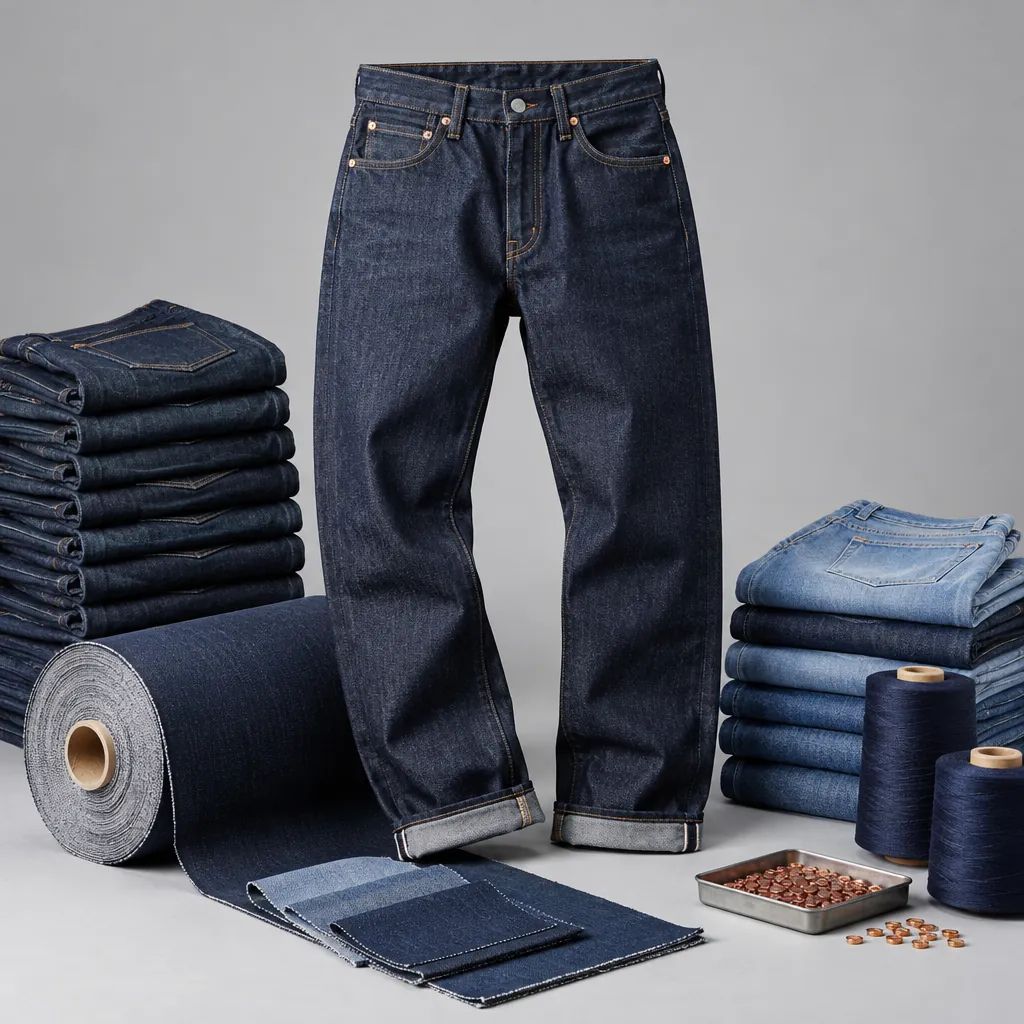
When a buyer asks what a pair of jeans costs at wholesale, the honest answer is that the question contains several questions. A quotation is not one figure pulled from a rate card; it is the sum of fabric, trims, washing, cutting and sewing, overhead and the supplier's commercial position, and each of those layers moves when the specification moves. A buyer who can read a quote line by line can see where the money sits, can predict which changes will shift the number and which will not, and can compare two offers whose scopes look similar but are not. This article takes apart a quotation for a standard five-pocket jean, explains what each layer covers, what a buyer should ask about each layer, and where the misunderstandings between buyer and supplier usually start.
What a quotation should state before the number
A usable quote describes its own scope. Before comparing costs at all, a buyer should check that the offer states the fabric construction and weight, the fiber content, the wash and finish, the trim package, the packing method, the quantity the offer is based on, the trade term, and the validity period of the offer itself. If any of these is missing, the figure quoted is not comparable with the next offer, because the supplier may have assumed a lighter fabric, a simpler wash or a smaller quantity than the buyer has in mind. The disciplined habit is to ask the supplier to restate the specification on the quotation document itself, so that the cost and its scope travel together through the whole negotiation and survive personnel changes on either side.
The same discipline applies to what the quote excludes. Tooling for custom hardware, label setup, third-party testing and freight are the items most often left outside a headline figure. None of these exclusions is improper; they only become a problem when the buyer discovers them after the order is placed rather than before. A buyer who asks for the exclusion list in the first exchange sets a tone that usually carries through the whole program.
Fabric: the largest single line
In most jean quotations, fabric carries the largest share of the cost, which is why fabric decisions deserve the most attention when a buyer needs to understand or move the number. The weight of the denim, the fiber content, whether the weave is rigid or contains stretch, and the origin of the fabric all sit inside this line. A change from a rigid construction to a stretch weave, or from a lighter to a heavier weight, changes not only the fabric line but also the washing behavior and sometimes the making cost, because heavier or more elastic fabrics are slower to sew and harder to handle on the line. Buyers should also note whether the quotation is based on fabric the supplier already stocks or on fabric that must be milled for the order. Stocked fabric shortens the chain, removes a mill minimum from the calculation, and gives the supplier more freedom in the commercial terms it can offer; milled fabric buys the buyer an exact specification at the price of a longer, less flexible chain.
Trims, wash and finishing
The trim package is small in area but not in cost. Buttons, rivets, the zipper, the pocket bags, the waistband interfacing, the main label, the care label and the hangtag all belong to this layer. A buyer who moves from stock trims to custom-molded hardware, or from a printed main label to a woven one, is moving a real cost line and should see that movement reflected in the quotation rather than absorbed into it. The wash is a cost line of its own: the same jean can be offered rinsed, stone washed, enzyme washed or laser finished, and each route carries a different process cost, a different consumption of water and chemicals, and a different development time. Hand distressing is priced differently again, because it is measured in minutes of skilled labor rather than in machine cycles, and it introduces variation that both parties need to define and tolerate in writing.
Making, overhead and the supplier's position
The making layer covers cutting, sewing, pressing and packing, and it responds to the complexity of the style: the number of panels, the presence of cargo pockets or shaped yokes, the density of topstitching and the seam constructions specified. On top of making sit overhead and the supplier's own commercial judgment, which reflects the order size, the season, the current loading of the sewing floor and the history between the parties. This is the layer where two suppliers can legitimately differ on the same specification, and it is the layer a buyer should not try to negotiate away entirely, because a supplier left with no room in the figure also has no room to absorb a problem when one appears, and in apparel production a problem always appears somewhere.
Why two quotes for the same jean differ
| Cost driver | Effect on the quote | What to ask the supplier |
|---|---|---|
| Fabric weight and construction | Shifts the largest line and the wash behavior | Which stock fabric the offer assumes, and what changes if the spec changes |
| Wash complexity | Adds process steps and development time | Whether the wash is priced separately and how it was sampled |
| Trim customization | Adds setup or tooling outside the unit cost | Which setup costs are one-time and which repeat with each order |
| Order quantity | Moves the cost through tier breakpoints | What quantity each quoted figure is based on |
| Trade term | Decides which transport legs sit inside the number | Which trade term the offer uses and what it includes |
A quote that looks higher than a competitor's sometimes simply includes more. The remedy is not to average the two numbers but to align the scopes and compare again, which matters most while the buyer is still forming a view of the full cost of the program, before the figure meets freight and duty on the way to a landed cost. The mechanics of quantity sit in our guide to price tiers, and the underlying drivers are set out in more detail on the denim cost factors page.
How to compare two quotations fairly
First, normalize the specification: confirm that both offers describe the same fabric, wash, trims and packing, and get any assumption restated in writing. Second, normalize the quantity: each figure should be read against the order size it assumes, because a number quoted at a program quantity is not a number quoted at a trial quantity. Third, normalize the term: a figure that includes the main carriage is not comparable with one that stops at the factory gate. Fourth, list the exclusions side by side and price the gaps separately, so the comparison happens on complete rather than partial scopes. Only after these steps does the difference between two numbers mean anything. A buyer who follows this sequence will sometimes find that the offer that looked expensive was the more complete one, and that the real conversation with the favored supplier is about scope and assumptions, not about the figure itself.
Working with jeans
Quotations, minimum quantities and lead times are confirmed in writing for each specification, and the figures in this article are described as method rather than as amounts. Share your styles, target quantities and wash directions, and request a quote so that the offer you receive states its own scope completely.