Home / Guides / Landed cost: from FOB to shelf price
Landed cost: from FOB to shelf price
What sits between a factory quote and your shelf: freight, duty, insurance and handling, and how to build a landed-cost model for jeans.
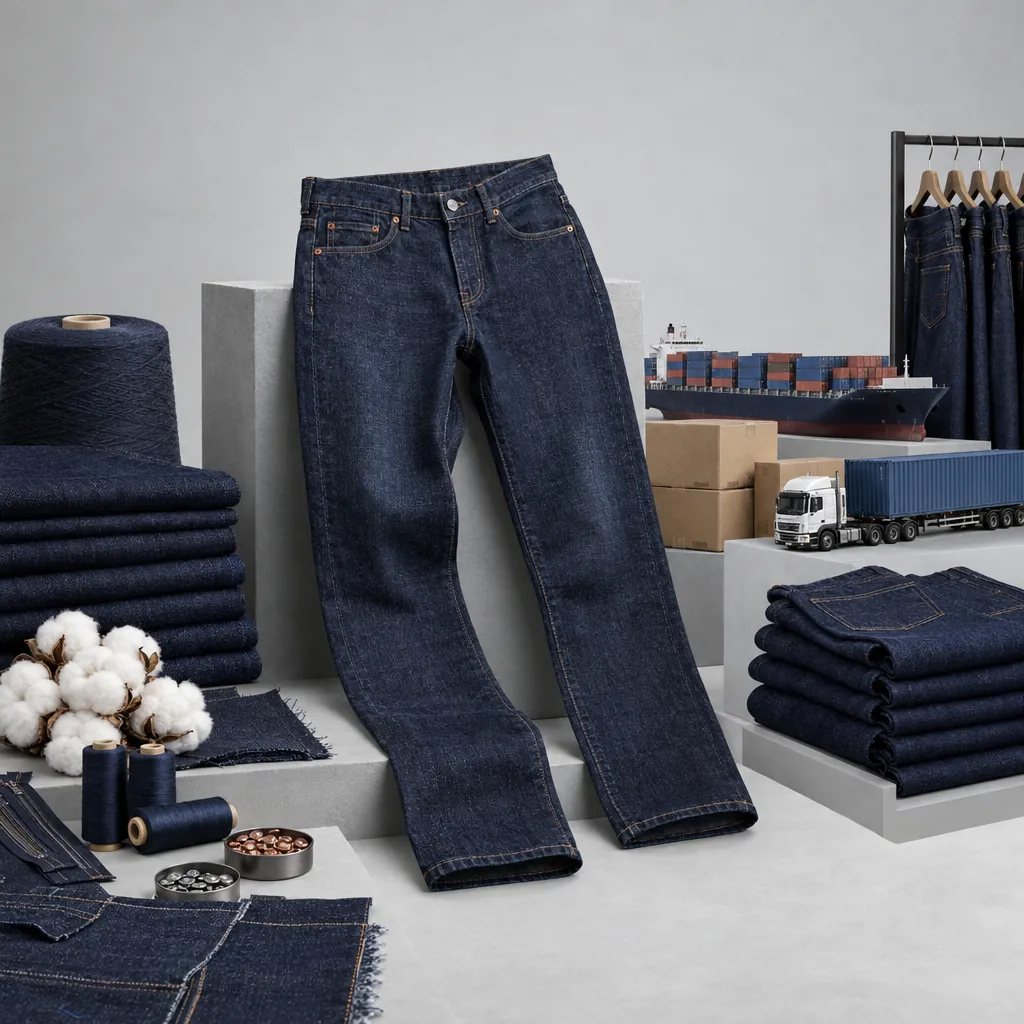
A factory quotation is the beginning of a cost, not the end of one. Between the quoted figure and the shelf sit freight, insurance, duties, port handling, inland transport and receiving, and every one of those legs adds to the number the buyer actually pays per pair. Retailers that buy on the quoted figure alone chronically underestimate their true position and then discover the gap in the season's margin report, when nothing can be done about it. This article walks the path from an ex-factory or FOB quotation to a shelf-ready landed cost, shows which legs the trade term assigns to which party, and describes how to build the calculation as a maintained model rather than a one-time guess.
The legs between the quote and the shelf
- Origin handling. Movement from the factory floor to the port of exit, export documentation, and terminal charges at the origin end.
- Main carriage. The ocean or air leg itself, charged by container, by weight or by volume depending on the mode and the equipment used.
- Insurance. Coverage while the goods are in transit, arranged by whichever party the trade term makes responsible for that leg.
- Import clearance. Entry filing, duties and taxes in the destination country, and any examination or storage charges that arise during clearance.
- Destination handling and delivery. Terminal and drayage charges at the arrival port, then carriage to the warehouse and the cost of receiving it.
Which of these legs sit inside a quoted figure depends entirely on the trade term, which is why the term printed on a quotation deserves as much attention as the figure next to it. Two offers quoted on different terms can differ by the whole cost of the journey while describing identical jeans. The common terms, what each includes and where responsibility changes hands are set out on our freight and Incoterms page, and the physical journey itself is followed in freight from factory to warehouse.
Ownership of a leg matters beyond who writes the check, because it decides who manages the risk while the goods sit inside that leg. A buyer who takes responsibility at origin chooses the carrier, controls the transit and carries the insurance decision; a buyer who buys to destination trades some cost transparency for simplicity and a single responsible counterparty. Neither structure is better in general. What matters is that the buyer knows which legs are its own, prices them deliberately instead of discovering them, and keeps the documents for each leg filed where the next order's model can find them.
Building the landed-cost model
A landed-cost model is a spreadsheet habit more than a calculation. The buyer lists every leg in the table above, attaches a source to each: the freight quotation, the duty classification from the official tariff schedule, the insurance certificate, the warehouse tariff. Every figure in the model carries an owner and a validity date, because freight rates and duty treatments change, and a number without a date quietly becomes wrong. The model then divides the total by the number of sellable units, which must be net of the pieces withheld for display, damaged in transit or held back as samples. Buyers who keep this model per program rather than rebuilding it per season accumulate a library of actuals, and actuals are the strongest input a buyer can bring to the next negotiation, because they replace the supplier's estimates and the buyer's assumptions alike with numbers the business has already lived through.
First shipments deserve a more conservative model than reorders. A first program rarely runs cleanly: a sample round stretches, a container misses a sailing, a clearance question adds storage, and the model built from estimates absorbs each of these before any actuals exist. Building the first model with explicit buffers on the transport and clearance lines, and then replacing those buffers with actuals as invoices arrive, turns the first order's frictions into the second order's precision. The buffers are not padding against the supplier; they are honesty about which parts of the journey the buyer does not yet control.
Where landed-cost models go wrong
The classic failures are structural rather than arithmetic. Duty is estimated from a guess at the classification instead of from the tariff schedule, and the error surfaces at entry. Destination charges are omitted because they arrive as separate invoices weeks after the goods, from parties the buyer never spoke to. The model divides by the gross carton count instead of the sellable unit count. And the carton is assumed to arrive full, when in practice size curves leave partial cartons that still consume freight space and handling labor. Jeans are soft goods and pack efficiently, which favors ocean carriage on cost, but the charge can be driven by volume as easily as by weight depending on the mode and equipment, so a sound model records both dimensions rather than assuming one.
From landed cost to the shelf
The landed cost is the input the retail side needs; what the buyer does with it is a pricing decision with its own method, covered in our guide to retail margin math. Two buyers receiving identical landed costs can make opposite pricing decisions and both be right, because the right ticket depends on the channel, the markdown plan and the position of the style in the range. The connection worth keeping is one of direction rather than magnitude: every unit of avoidable landed cost is harder to earn back at the shelf than it was to save at the sourcing stage, which is why the model deserves maintenance after the goods arrive and the actuals replace the estimates. A model that is only built once, at order time, converts from a control into a souvenir within a single season.
Working with jeans
Trade terms, validity periods and what each quotation includes are confirmed in writing for every offer, and freight figures belong to a quotation only as estimates until booked. Share your destination and target quantities, and request a quote so the terms are stated plainly.