Home / Guides / Price tiers: how quantity breaks work
Price tiers: how quantity breaks work
How tiered pricing works for wholesale denim: breakpoints, mixed-style tiers, and when chasing a lower tier costs more than it saves.
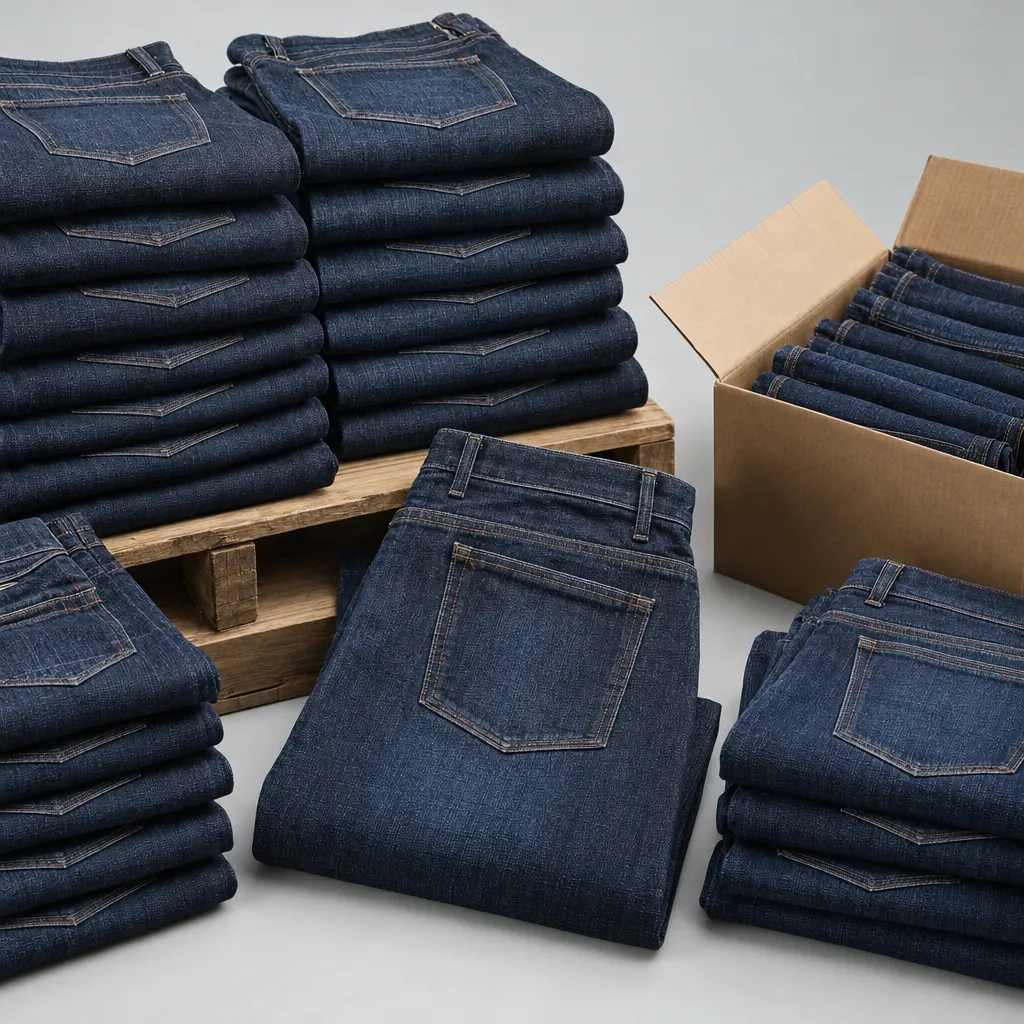
Tiered pricing is the most common structure in wholesale denim: the unit figure steps down as the order quantity steps up, usually at defined breakpoints rather than continuously. The structure rewards planning and punishes improvisation. A buyer who understands how the tiers are built can plan an order to land inside a favorable band with confidence; a buyer who chases the next tier without a plan can end the season with more inventory than it needed and an effective cost per sold pair that is worse than the tier table promised. This article explains how tier tables are constructed, how they should be read, and where the traps sit for a buyer meeting them for the first time.
The anatomy of a tier table
A tier table maps order quantity to unit cost. A typical denim quotation carries a small number of tiers, each defined by a total quantity and each carrying a unit figure that applies across that whole band. The table below shows the shape of such a table with the quantities and figures left where they belong in any real negotiation, to be confirmed in writing on the quotation itself.
| Tier | Total order quantity | Unit cost basis |
|---|---|---|
| Entry tier | Pending | Pending |
| Mid tier | Pending | Pending |
| Program tier | Pending | Pending |
Three features of tier tables deserve attention. First, the step usually occurs at the breakpoint rather than smoothly, so two orders of nearly the same size can carry meaningfully different unit figures, and a small top-up can move a whole order into a better band. Second, the largest step normally sits between the entry tier and the next one, because fixed setup costs spread fastest over the first increments of scale. Third, the tiers are usually defined on the total order rather than per style, and that single fact is what makes mixed-style planning possible for a buyer carrying several looks.
How breakpoints are set
Breakpoints reflect the supply chain's own physical thresholds: full fabric rolls, full washing batches, full cutting tables and full container loads. Because these thresholds are physical, they can be negotiated in structure even when they cannot be moved in size. A buyer who asks why a breakpoint sits where it sits will usually learn which physical unit governs it, and that knowledge opens options that a flat number never does. Topping an order up to a full roll quantity, shifting a style onto a stocked fabric whose rolls are already committed, or combining two delivery windows into one production run are all structural moves that a supplier can accept quickly, because they make the factory's own planning easier at the same time as they improve the buyer's position.
Breakpoints also move with the season and with the fabric market, which is why a tier table carries a validity date and should be read together with it. When fabric is tight, the quantities that unlock a better band can shift, because roll availability rather than policy is doing the governing. When a season is slow, a supplier may hold a table in place longer to keep the lines loaded. The buyer's protection is procedural rather than clever: confirm the table's validity in writing, confirm the quantity basis of each band, and reconfirm both before any purchase order is issued against a quotation that has aged. A tier table without a date is an invitation to a misunderstanding. It also pays to ask whether the table applies to the current season only or to the program across seasons, since suppliers treat repeat volume differently.
Mixing styles within a tier
The most useful property of a total-order tier is that several styles can share it. A buyer carrying two silhouettes in three washes can often reach a better band by counting the whole program, provided the styles share a fabric platform or at least a common trim base. The supplier's condition is usually that the mix must be fixed before production planning starts, because the tier figure was calculated on a particular production sequence. Buyers should therefore confirm in writing whether the quoted band applies across mixed styles, what happens if one style's share of the order changes after the quotation, and whether the mix can be rebalanced between washes after cutting has begun. These questions cost a short exchange at the quotation stage and prevent the most common dispute in tiered orders, which is a buyer assuming flexibility the supplier never priced.
When chasing a tier backfires
The arithmetic of a tier table describes the cost per unit produced, not the economics of the season. Moving up a band to reach a better unit figure adds inventory, and inventory carries costs of its own: cash tied up, storage occupied, markdown risk accumulated, and the possibility that a trend style cools before it sells through. The discipline is to compare the tier gain against the carrying cost and the markdown exposure of the extra pieces, using the store's own sell-through history where it exists. For a core style with reorder history, the case for stepping up is usually strong, because the extra depth will sell. For an untested style, the entry tier exists precisely for it, and a buyer who fills a first order at a program tier has converted a test into a bet. Buyers should also watch the false economy of splitting an order across several suppliers to catch a tier at each, which multiplies sampling rounds, inspection trips and freight consolidation work, and often costs more in effort and risk than it saves at the unit level.
Tier mechanics connect back to the parts of a quotation described in cost anatomy, and to the entry-point questions covered in MOQ negotiation. The formal definitions again sit on the MOQ explained page.
Working with jeans
Tier structures are quoted per program and confirmed in writing, with the quantities each figure is based on stated on the quotation itself. Share your style plan and target volumes, and request a quote with the tier basis spelled out.