Home / Guides / Men's jeans: a wholesale program outline
Men's jeans: a wholesale program outline
A wholesale program outline for men's jeans: five-pocket basics, the fit ladder, the waist and inseam size grid, and replenishment planning.
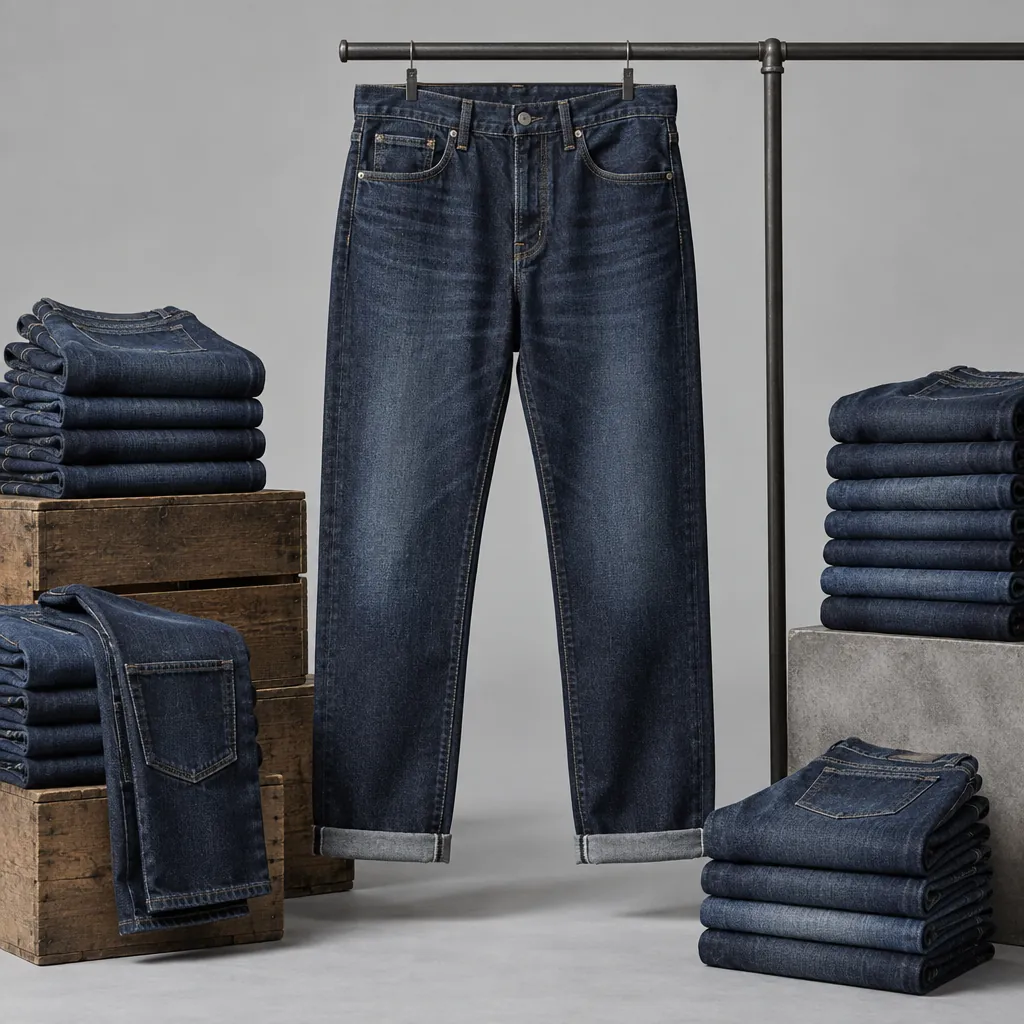
Men's denim is a narrower and more repetitive business than women's, and that is its appeal. Search interest for mens jeans stays strong in the United States, and the male customer typically finds a fit he likes and replaces it for years. A men's jeans program is therefore a structure business: the right fits, a disciplined wash count, and a size grid that is planned rather than improvised. The five-pocket jean is the foundation of that structure, and this outline covers how to build around it: the fit ladder, the waist and inseam grid, the wash plan, the seasonal patterns and the replenishment rhythm.
The five-pocket foundation
The five-pocket architecture — two front pockets, a coin pocket, two back pockets — is not one style among styles; it is the platform every men's fit stands on. Customers read it as the definition of a jean, which means departures from it are read as statements and should be made deliberately. For a wholesale program, the five-pocket base in a straight fit and a dark wash is the deepest single position on the wall, because it carries reorders, serves gifting, and gives the store a reference point for every other fit it adds. Cargo styles and fashion details extend the program; the article on cargo pocket specifications covers the main extension in its own terms.
The fit ladder
Men's fits are named loosely across the market, so the ladder should be defined by measurements rather than by labels. A workable core ladder has three rungs.
- Slim. Close through the hip and thigh with a tapered leg, serving younger customers and those wearing the jean under boots.
- Straight. The anchor: even width from knee to hem, serving the broadest age range and carrying the deepest buy.
- Relaxed. Extra room through the seat and thigh, serving comfort-led customers and work-adjacent wear.
Each rung needs its own fit approval, and the measurement points — waist, hip, thigh, knee, leg opening, front and back rise — should be recorded for each. The naming can follow the store's own convention, but the sheet behind the name must be unambiguous, because one supplier's relaxed is not necessarily the store's.
The waist and inseam grid
The men's size problem is a grid, not a curve. Women's denim grades along a single size axis; men's jeans are bought by waist and inseam together, and the grid multiplies quickly. Stocking every combination is the fastest way to sink open-to-buy in slow-moving corners. The disciplined approach: stock the full waist run in a core inseam, carry a second inseam only where the store's data shows real demand, and serve the remaining lengths through hemming. The grid should also be planned with grading discipline; the guide to size grading covers how measurements should move across a range, and in men's fits the waist-to-thigh relationship is where poor grading shows first, because a waist that grades faster than the thigh produces fits that gap at the belt and pull at the leg.
Wash structure for men
Men buy fewer washes and replace them more predictably. A workable structure holds a dark rinse as the lead, a mid wash as the everyday second, and black where the customer base supports it. Fashion washes and heavy distressing play a smaller role than in women's ranges, and they should enter the program as tested additions rather than opening positions. Stitch color and hardware finish deserve attention in men's programs because the customer notices them less at purchase and more over years of wear; a hardware finish that dulls or a thread color that fades oddly becomes the reason the next replacement is bought elsewhere.
Replenishment and size continuity
The men's program lives on replenishment. A customer who finds his fit returns for the identical garment, and the store's job is to have it in his size every season. Each core fit and wash carries a reorder point set from average weekly sales and the confirmed lead time, and continuity rules matter as much as the reorder math: a fit that is discontinued and relaunched breaks the habit the program depends on. Style numbers should stay stable across seasons, and any change to the specification — even a small one — should be versioned and communicated, because a silent change in the thigh grade is read by the customer as a different jean. The straight fit catalog page shows the anchor position this outline builds around.
Gifting and seasonality
Two demand patterns sit outside the weekly reorder and deserve their own line in the plan. Gifting peaks around the holidays, and it concentrates in the anchor position: the dark straight in the middle of the size grid, bought by someone who does not know the recipient's exact fit and chooses the safest interpretation. Planning extra depth in that cell for the gifting window is one of the few seasonal bets men's denim reliably rewards. Back-to-school and work-season rhythms move the relaxed rung in workwear-adjacent regions. Neither pattern changes the structure of the program; both change where the depth sits in a given quarter, and both should be planned from the store's own history rather than assumed from the category's.
Program structure at a glance
| Position | Role | Discipline |
|---|---|---|
| Straight, dark rinse, core inseam | The anchor and the reorder engine | Deepest buy, stable style number, never discontinued mid-season |
| Slim and relaxed rungs | Cover the fit spectrum around the anchor | Own fit approvals, supporting depth |
| Second inseam and black | Serve proven demand outside the core grid | Added on data, held to the same reorder rules |
Working with jeans
Quotations, minimum order quantities and lead times for a men's program are confirmed in writing for each order, and the fit ladder and size grid shape the terms behind the quote. To structure the program, request a quote with your fit ladder, grid plan and wash list, and the response will state the terms that apply.
Specification fields
| Field | Value |
|---|---|
| Fabric composition | Pending |
| Fabric weight | Pending |
| Wash options | Pending |
| Rise and fit | Pending |
| Leg opening | Pending |
| Stitching and finish | Pending |
| Hardware and trims | Pending |
| Labels and packaging | Pending |
Size chart fields
Measurements are taken flat, in centimeters or inches, and confirmed per size run.
| Field | Value |
|---|---|
| Waist | Pending |
| Hip | Pending |
| Rise | Pending |
| Inseam | Pending |
| Leg opening | Pending |
Pricing
| Tier | Quantity per style | Unit price (USD, FOB) | Lead time |
|---|---|---|---|
| Tier 1 | Pending | Pending | Pending |
| Tier 2 | Pending | Pending | Pending |
| Tier 3 | Pending | Pending | Pending |
Private label options
Private label options for this style, including labels, trims, pocket detail and wash development, are listed on the custom and private label page and confirmed in writing.