Home / Guides / Cargo jeans: pocket specs that matter
Cargo jeans: pocket specs that matter
Cargo jeans pocket specs that matter in production: pocket type, flap and closure, placement and reinforcement, written down before bulk.
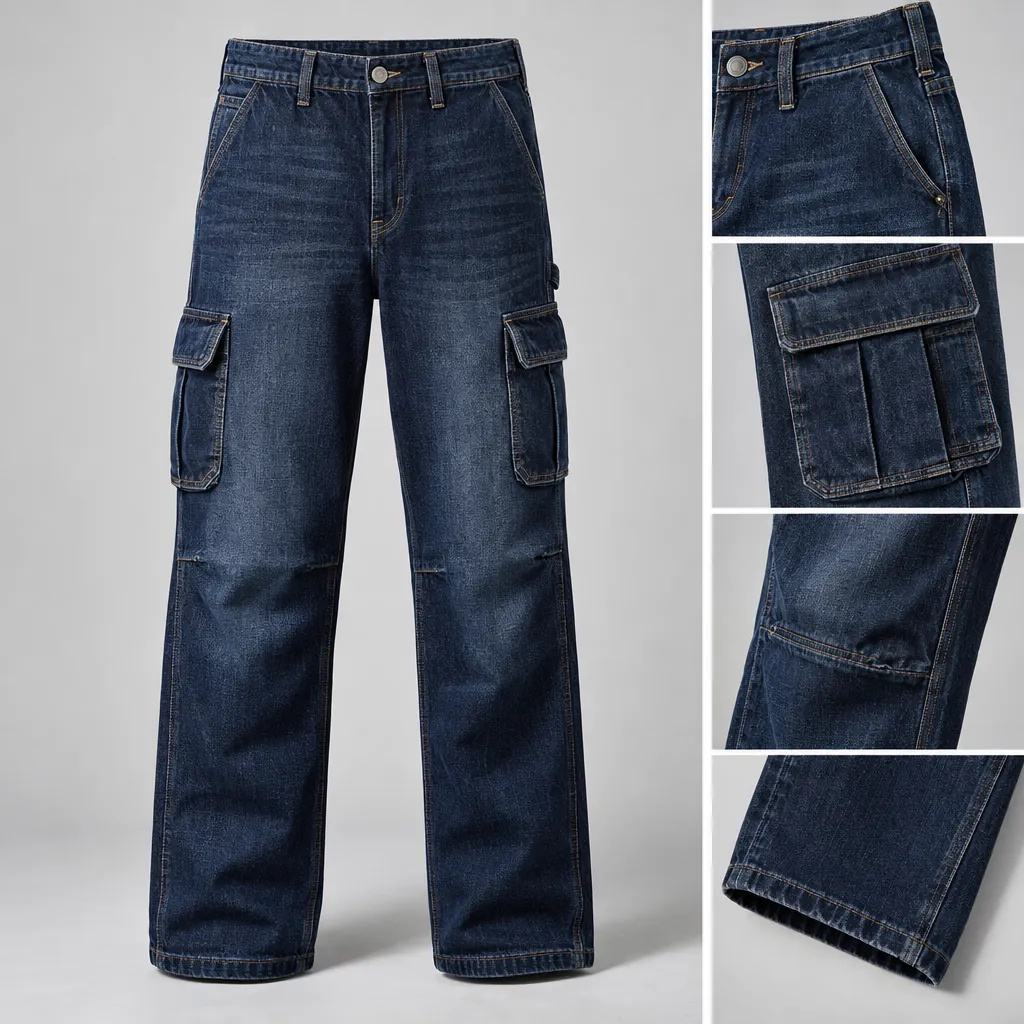
Cargo jeans return to the market in waves, and each wave renews the same production problem: the pockets are the product, and pockets are the part of a jean most often left to the factory's interpretation. Search interest for cargo jeans is solid in the United States, the style reads strongly on younger customers, and the position is attractive because shoppers accept a higher price point for visible utility. The program fails when the specification says only cargo pockets and the bulk arrives with pockets the buyer never pictured. This article sets out the pocket specification lines that matter, the construction that supports them, and the order discipline the style's cycle demands.
What the style borrows from workwear
Cargo jeans are a fashion reading of workwear, and the borrowing explains both the demand and the risk. From workwear the style takes its utility narrative: pockets that hold tools, fabric that survives kneeling, construction that expects load. Customers respond to that narrative even when they will never load a pocket, which is why the style commands attention on the floor. The risk is that a fashion interpretation keeps the pockets and drops the construction that made them functional, producing a garment that looks the part on the hanger and fails the part in wear. A buyer who specifies cargo jeans with workwear logic — real depth, real reinforcement, fabric that holds shape — gets a garment that satisfies the customer who wears the story and the one who uses it. The distinction is invisible in a photograph and decisive in returns.
Why pocket specs decide the garment
On most jeans, pockets are a detail; on cargo jeans they are the silhouette's entire argument. A customer reads the pocket from across the floor — its size, its angle, how it stands away from the leg — and that reading decides the sale. Yet pocket construction varies more between factories than almost any other element, because a sketch on a line sheet cannot communicate depth, bellows width or flap geometry. Two samples from the same drawing can read as two different garments. The fix is not a better drawing but a written specification with the options chosen line by line, approved on a sample, and referenced by version in the order.
The specification lines to write
| Spec line | Options to choose between | Why it matters |
|---|---|---|
| Pocket construction | Bellows pocket versus flat patch pocket | Bellows adds volume and utility; patch reads cleaner and washes flatter |
| Flap and closure | Flap with snap, hook-and-loop, or open top | The closure changes both the look and the finishing steps |
| Placement | Height and angle on the side seam, described as measurements from reference points | Placement decides whether the leg reads balanced or overloaded |
| Pocket depth and width | Stated as measurements, confirmed on the approved sample | Depth that looks right in a sketch fails in the hand |
| Reinforcement | Bar tacks at stress points, stated explicitly | Unreinforced corners are the first failure in wear |
Each line should carry a tolerance and a version date. Where a buyer leaves a line open, the factory will close it, and the choice will not be reversed cheaply after bulk.
Fit and balance around the pockets
Pocket placement is a proportion decision as much as a utility one. Pockets set high on the thigh read utilitarian and keep the leg line long; pockets set low and wide read heavy and shorten the leg. The opposite leg should stay clean in most programs, because pockets on both sides double the visual load and narrow the customer base. The top block should be specified with the same restraint the pockets forgo: a standard five-pocket front, ordinary back pockets, and the cargo elements confined to the legs keep the garment readable as jeans first. Where a buyer wants a bolder version, the bolder choice belongs in the trend layer of the assortment, not in the core reorder program.
Construction that supports the pockets
Cargo pockets load the side seam in a way ordinary five-pocket construction never meets. The fabric must carry that load: a midweight denim or a heavier construction holds pocket shape through wear and washing, while a lightweight fabric lets the pockets collapse and the garment read tired within a season. Stitch density at pocket attachments, bar tacks at the corners and the flap, and the way the pocket bag joins the side seam all belong on the specification. The wash adds a final consideration: pockets with layers and flaps wash differently from flat panels, and the wash approval should be checked on a full cargo sample rather than a plain-leg swatch, because the creasing and abrasion pattern around the pockets is part of the finished look.
Checks on the cargo sample
- Fill each pocket with the intended load and check how the pocket and the side seam carry it.
- Sit, squat and climb with the loaded pockets, since the load changes where the garment strains.
- Wash the sample and check flap shape, snap function and pocket recovery against the fresh sample.
- Compare the wash around the pockets with the plain panels, and approve the difference as intended.
The cycle and the order discipline
Cargo demand is cyclical, driven alternately by workwear revival and streetwear adoption, and the buyer's discipline is to treat the style as a trend position regardless of how strong the moment feels. A limited first run in the cleanest version of the style — controlled pocket size, a mid wash, no extreme detailing — carries the lowest exit risk and the broadest customer base. The reorder decision follows the same written trigger as any trend buy, and the exit is planned before the entrance: a markdown date in the calendar and a carryover path toward the store's straight fit program, which the outline of the men's wholesale program describes. Loud versions of the trend, with oversized pockets and heavy distressing, sell fast and date faster, and they should be sized to the window they will actually have rather than to the mood of the moment.
Working with jeans
Quotations, minimum order quantities and lead times for a cargo program are confirmed in writing for each order, and the pocket specification changes both construction cost and finishing steps. To put a specification into pricing, request a quote with your pocket lines, fabric weight and wash plan, and the response will state the terms that apply.
Specification fields
| Field | Value |
|---|---|
| Fabric composition | Pending |
| Fabric weight | Pending |
| Wash options | Pending |
| Rise and fit | Pending |
| Leg opening | Pending |
| Stitching and finish | Pending |
| Hardware and trims | Pending |
| Labels and packaging | Pending |
Size chart fields
Measurements are taken flat, in centimeters or inches, and confirmed per size run.
| Field | Value |
|---|---|
| Waist | Pending |
| Hip | Pending |
| Rise | Pending |
| Inseam | Pending |
| Leg opening | Pending |
Pricing
| Tier | Quantity per style | Unit price (USD, FOB) | Lead time |
|---|---|---|---|
| Tier 1 | Pending | Pending | Pending |
| Tier 2 | Pending | Pending | Pending |
| Tier 3 | Pending | Pending | Pending |
Private label options
Private label options for this style, including labels, trims, pocket detail and wash development, are listed on the custom and private label page and confirmed in writing.