Home / Guides / Kids jeans sizing: adjustable waists and growth
Kids jeans sizing: adjustable waists and growth
How kids jeans sizing works with height-based grading, adjustable waistbands and growth allowance, and what to confirm for children's garments.
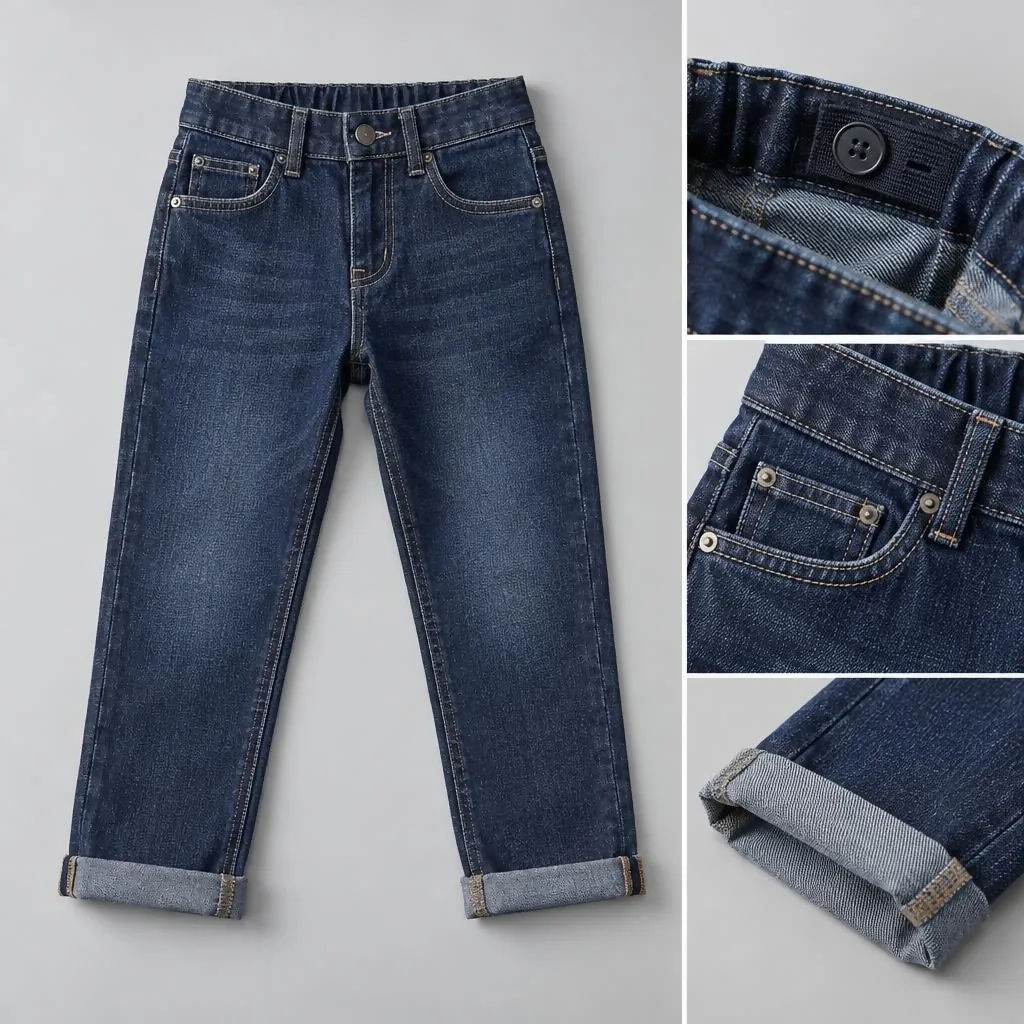
Children outgrow a pair of jeans faster than any program can replace it, and parents shop accordingly: they buy for the size the child is reaching, not only the size worn today. Kids jeans sizing therefore runs on different logic from the adult wall, built on height bands, adjustable waistbands and planned room for growth. It also carries a set of safety considerations that adult denim does not, because hardware, cords and small parts on children's garments are treated differently in many markets. This article covers the sizing structure, the adjustable waist specification, growth allowance and the points a buyer should confirm in writing before a kids program is produced.
Size by height, with age as the secondary label
Height is the measurement that grows predictably, so most kids denim is graded and labeled by height bands, with age ranges offered as a rough guide. Age labels are unreliable across markets, because children of the same age differ widely in height and build, and a label that means one thing in one market reads differently in another. The chart should lead with height, state the garment measurements for each band, and treat age as a hint rather than a promise. The grading steps between bands differ from adult grading too, which is another reason the kids range needs its own rules rather than a small copy of the adult sheet; the document that carries those rules is the same one described in grading rules from sample to size run.
Specify the adjustable waist mechanism
An adjustable waistband is the feature parents look for first in this category, and it is more than an elastic band. The common mechanisms are a back panel of elastic inside the waistband and internal adjusters, usually buttons or tabs, that shorten the waist. The specification should name the mechanism, its placement, the range of adjustment it provides and the hardware it uses. It should also cover durability: elastic that relaxes after washing stops doing its job within the first weeks of a garment life measured in outgrowths, so recovery after repeated washing belongs in the order terms, with the test method agreed in writing. The adjustment range and the recovery figures are confirmed against the approved sample and recorded as Pending until then.
Plan growth without oversizing
Growth allowance is a deliberate decision, not simply a larger size. Room in the hem lets a pair be let down once; room at the waist is handled by the adjuster; but too much length is its own problem, because a hem that pools on the floor is a tripping nuisance, and parents will roll it in ways that change the look of the garment. The specification should state the reserved length in the hem for each band, Pending until the block is approved, and the product page should tell parents how the pair is meant to fit at purchase and what the hem is designed to do later. A chart that states this plainly prevents both complaints at once: too short to grow and too long to wear. Where the range includes shorts, the growth logic shifts to the waist and the hem finishes higher, and the same written allowance applies with the selling window in mind.
Safety points for children's garments
Hardware and trims that are routine on adult denim deserve a second look on kids product. Drawcords at the waist, and any cord near the head and neck area, are restricted in several markets. Buttons, rivets and snaps count as small parts whose attachment strength is tested. Decorative transfers and prints can carry their own requirements. The buyer should confirm the applicable requirements for the destination market with its own adviser before production, and should request the corresponding test documents from the supplier as part of the order terms. Nothing on this page is a compliance statement. It is a list of the questions that need written answers before a kids order is confirmed.
Plan the pack for how kids product is bought
Kids denim is rarely bought as single sizes the way adult cores are. Buyers and suppliers often work with prepacks built by height band, and the pack ratio decides which bands a store actually has on the floor by the second week. A prepack weighted toward the middle bands starves the fast-growing ages, which are precisely the customers whose parents are back every season. The pack structure should be agreed in writing with the order, band by band, and reviewed against sell-through by band each season like any other allocation decision. Where a store sells online, single-size reordering matters more, and whether the supplier will break packs should be confirmed before the first order rather than assumed. None of this changes the garment itself. It changes whether the right band is on the shelf when the parent walks in, which is the only outcome the sizing work exists to produce, and it costs nothing to specify at order time and a lost season to discover afterwards.
What to confirm before production
- The height band definitions used for labeling, and the garment measurements behind each band.
- The waist adjuster mechanism, its placement and its adjustment range, Pending until the sample is approved.
- Elastic recovery after repeated washing, with the test method named.
- Reserved hem length per band, and the approved hem type.
- The market requirements that apply to cords, small parts and prints, with test documents requested in writing.
The presentation side matters as much as the specification. Parents read kids charts more carefully than any other segment, because they are buying for a body they cannot try the garment on. A chart structured to answer the fit questions in order, following the approach in building a size chart that cuts returns, does as much for this category as the adjuster itself. The silhouette options for the category are collected under kids jeans.
Working with jeans
Sizing bands, adjuster specifications and safety-related documents for kids programs are confirmed in writing before production starts. To discuss a kids program, request a quote and we will reply with the specifications to confirm.