Home / Guides / Small orders: paths around high MOQs
Small orders: paths around high MOQs
High minimums block small denim orders more often than price does. Structures that reduce the real minimum: shared fabrics and phased quantity plans.
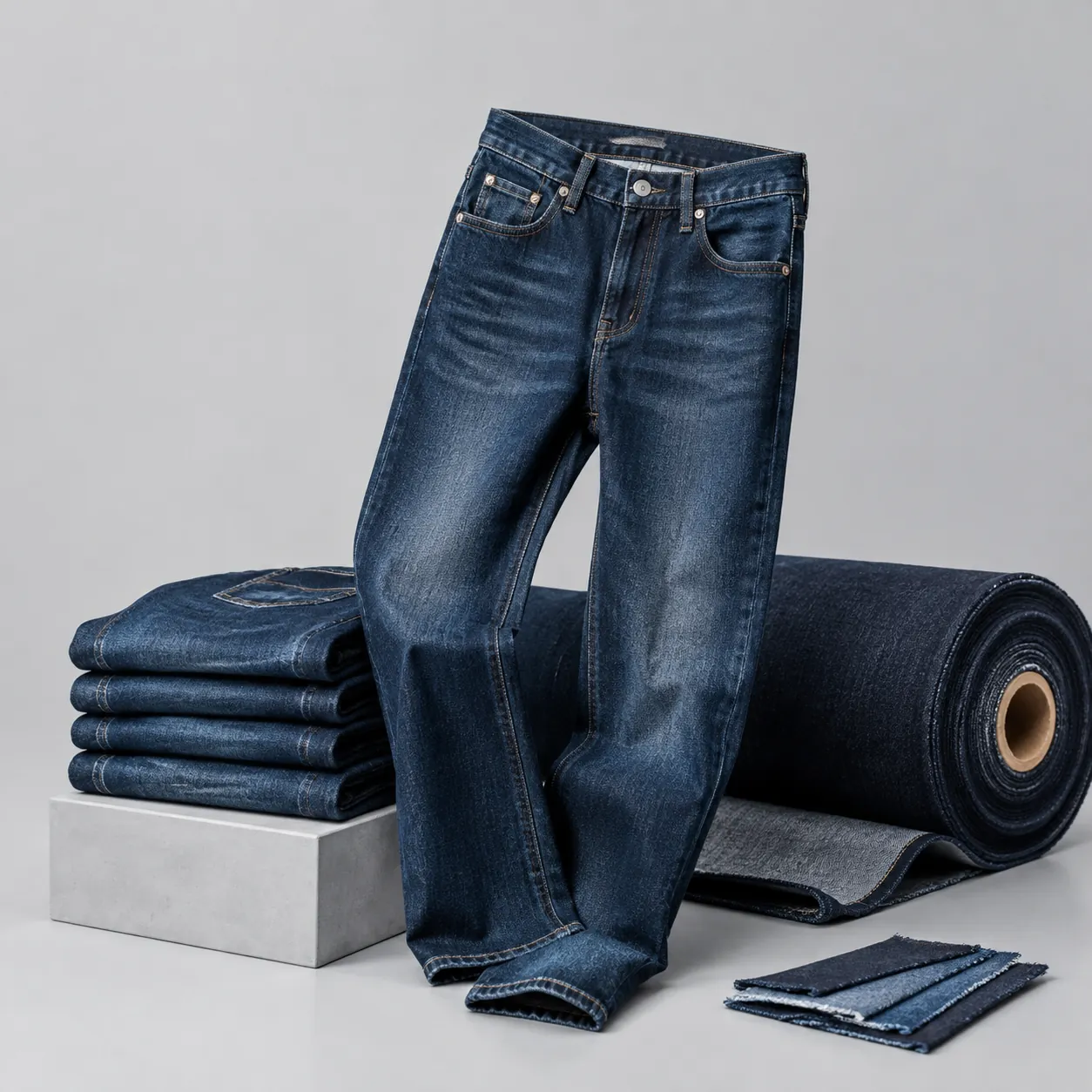
A buyer who wants a few hundred pairs across several styles often hears one number back: the minimum. Minimum order quantities feel like a wall, but they are mostly arithmetic. A factory's minimum reflects the fabric it must buy by the roll, the dye and wash lots it must run, the trims it must order in case quantities and the cost of changing a line over to a new style. Each of those can be attacked with structure rather than with haggling. This article describes the paths that make small denim orders practical, and the trade-offs a buyer accepts on each path.
Why minimums exist
Understanding the arithmetic makes the paths visible. Fabric is usually the largest minimum: mills sell by the roll or by the dyed lot, and a custom fabric for a small order can leave the buyer paying for cloth it does not use. Wash and dye add their own lot sizes, because a machine needs a full load to run a recipe at all. Trims arrive in case packs, and a custom rivet or a woven label carries setup charges regardless of the quantity that follows. A line changeover consumes capacity whether two hundred garments or two thousand follow it. A supplier who quotes a minimum per style is usually adding all of these together, and the paths around the minimum work by sharing those costs across styles, across buyers or across time.
Path one: shared fabric, different washes
The most reliable structure for a small program is to build several styles on one base fabric and differentiate through wash and finishing. The fabric minimum is paid once instead of per style, and the wash lot becomes the only lot that has to be filled per colorway. A three-style capsule on one midweight base is a far smaller commitment than three styles on three custom fabrics, and the garments still read as a coordinated range on the floor. The trade-off is narrower fabric expression: silhouette and wash carry the range instead of cloth variation, which most customers read as coherence rather than as limitation.
Path two: stock-service fabrics
Where a program does not need a custom cloth, stock-service denim changes the arithmetic completely. Fabrics held in running production can be bought in shorter lengths, because the mill's minimum is already amortized across the market. The buyer gives up some exclusivity and some control over the exact hand, and gains speed and a much lower entry quantity. For a first order, or a test capsule, the trade is usually worth taking. Exclusivity matters more once a style has proven sell-through and justifies its own fabric booking for the second run.
Path three: consolidate styles, phase quantities
A supplier may accept a smaller per-style minimum if the total order across styles reaches a workable size, or if the buyer commits to a repeat within a stated window. Both structures are common and both should be written down. A phased plan, in which a first delivery is followed by a defined second run, lets a buyer test depth without betting the whole quantity up front, and gives the factory a repeat it can plan fabric and capacity for. The realistic version of this path requires the buyer to treat the repeat forecast honestly, because a promise of a repeat that never arrives costs the supplier its arithmetic and the buyer its credibility on the next negotiation.
Path four: simpler specifications
Every special detail in a garment carries a minimum of its own: a custom rivet, a woven label with its own setup, a wash that exists only for this program. A small order that simplifies its specification survives the arithmetic better than one that carries a large program's details at a fraction of the quantity. Standard hardware, printed labels where woven ones are not essential, and washes drawn from the factory's running recipes all remove lots from the plan. The details that define a range on the floor are usually silhouette, wash direction and fit; most of the expensive minimums live elsewhere.
A capsule inside a running program
Some of the friendliest small-order structures are found not by negotiating a new minimum but by joining an existing flow. A capsule that uses the factory's current base fabric, its running wash recipes and its standard trims can often be scheduled inside a program already in production, because the lots are already open. The buyer's styles ride on fabric whose minimum has been paid by a larger order. This path rewards buyers who ask what is running rather than only what is possible: a supplier can show current base cloths and wash standards, and a small program can be drawn around them in weeks instead of months. The range will not be exclusive in its cloth, and for a test capsule that is rarely the binding constraint.
What to confirm in writing
Small-order structures work only when the terms are explicit. The minimum per style and per colorway, the total order minimum, the sample charges and any repeat commitment that underpins the structure should each be stated in the order confirmation, with the tier structure if one applies. A request that lays these questions out in the right order gets comparable answers from several suppliers; the article on writing an RFQ for jeans shows how to frame the enquiry. Once a small order is confirmed, schedule discipline matters more rather than less, because there is no spare quantity to absorb a late or off-spec lot; the article on shipping delays and contract fixes covers the milestone terms that keep a compact order on its calendar. The supplier-side view of the same problem is described on the MOQ barriers page.
Working with jeans
Minimum order quantities, tier terms, sample charges and repeat commitments for small jeans programs are to be confirmed in writing before the order is placed. FULVERA structures small orders around shared fabrics and phased runs and coordinates them with the producing partner. To discuss a small program, request a quote.