Home / Guides / Common denim quality issues and clauses
Common denim quality issues and clauses
The denim quality issues that recur in wholesale orders, from seam stress to hardware failure, and the contract clauses that keep each one contained.
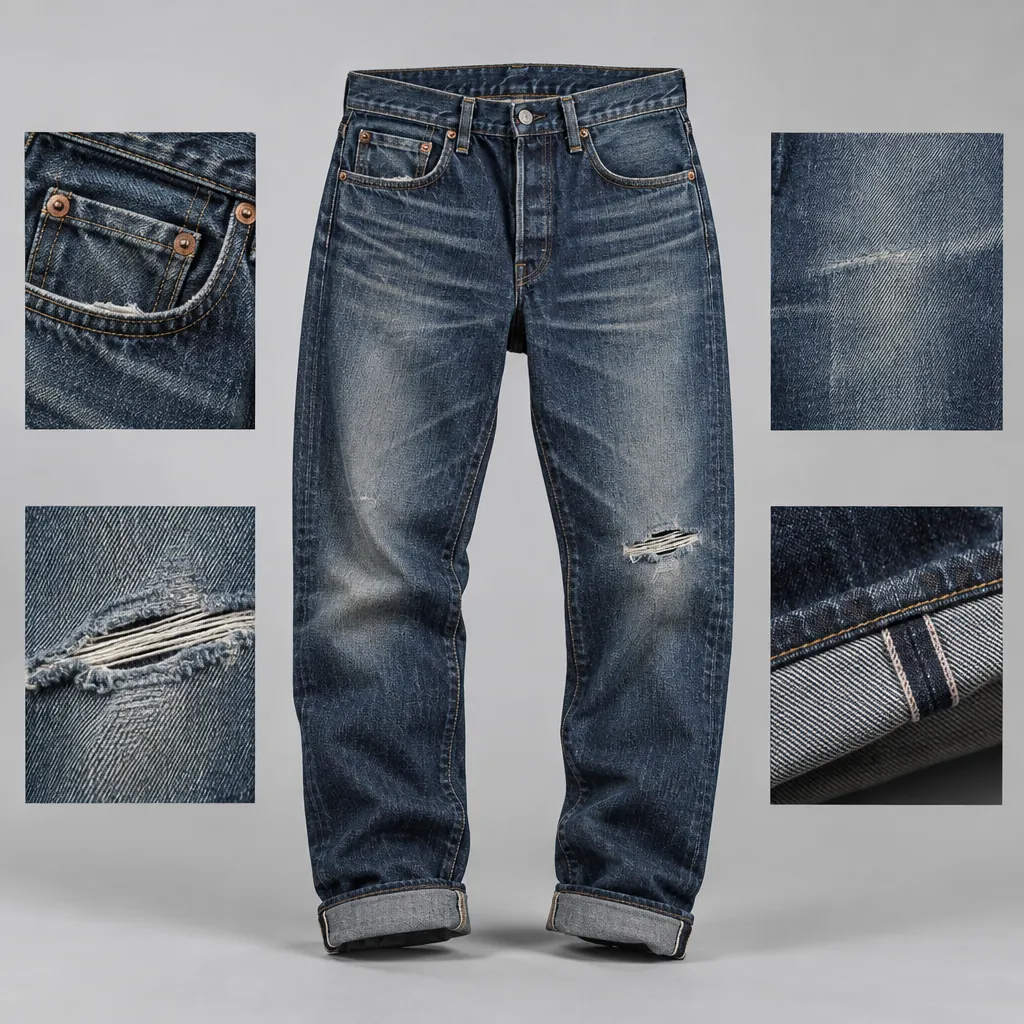
The same short list of defects accounts for most denim quality claims: seams that open at stress points, hardware that fails or discolors, color that varies between pieces, waists that twist, and stretch that does not recover. None of them is exotic. Each has a known cause and, more usefully, a known clause that contains it. This article describes the recurring issues in wholesale denim orders and the written defenses a buyer can build into the specification and the purchase order, so that the conversation after delivery is about a remedy that was agreed in advance rather than a dispute about what was expected.
Why the same issues recur
Denim concentrates stress in a few places. The crotch seam, the back pocket corners, the belt loops and the fly carry more load per stitch than most garment seams, and a thread or stitch density that would be adequate on a shirt fails there. Hardware sits on top of a heavy, abrasive fabric and is washed aggressively. Indigo is applied in a way that leaves color sitting near the surface of the yarn, which is what gives the fabric its character and also what makes it sensitive to lot and wash variation. Because these are structural facts about the category, they recur across suppliers and seasons. The defense is not trust; it is specificity, written where both parties can point to it. Specificity also shortens the conversation when something does go wrong, because the discussion moves from whether a problem exists to which clause covers it and what the agreed remedy is.
Seams and stitch failures
The common forms are a center-back or crotch seam that opens after a short period of wear, belt loops that detach, and pocket corners that fail where the pocket bag meets the front panel. In the order, three written points control this: the stitch type and density at each stress point, named in the specification; the reinforcement requirements, such as bar tacks at defined positions; and the thread quality, described by type and construction rather than by brand. The buyer should also state the inspection point at which seam strength is checked, and on what evidence. A clause that says seams must be strong is unenforceable; a clause that names the seam, the stitch count and the test method can be checked and, if needed, enforced.
Hardware, rivets and zippers
Hardware complaints take two forms: functional failure, where a zipper breaks or a rivet pulls through the fabric, and appearance failure, where a plating discolors, scratches or marks the surrounding cloth after washing. The specification should name the hardware positions, the attachment method and the finish, and should state that any substitution of hardware after approval is a specification change requiring written agreement. For zippers, the buyer should require that a sample of the approved zipper be kept as the standard for the order. A trial wash on the counter sample is the least costly place to see whether a coating survives the wash chemistry, and that wash test should be written into the sampling plan rather than left to goodwill.
Color variation and shade
Color claims usually arrive as a comparison: pieces in one carton do not match pieces in another, or the bulk does not match the approved sample. The written defense has three layers. First, the approved wash standard sample is named by date and version in the specification, and the tolerance against it is defined, including the lighting under which comparison is made. Second, the buyer sets rules for lot grouping, so that garments in a carton come from a defined dye or wash lot rather than from whatever is on the line. Third, the remedy for a lot outside tolerance is agreed in advance, in the same clause that defines the tolerance. The article on color consistency and wash lot drift covers these controls on the buying side.
Waistband twist, shrinkage and stretch
A waistband that twists after washing is usually a fabric and construction interaction: uneven shrinkage between panels, or a seam allowance that was never stabilized. The specification should require a wash test on the approved fabric and state who bears the cost if the bulk fails the agreed dimensional tolerance. Stretch denim adds a second risk, because elastic content that relaxes under heat or over time changes both fit and recovery. Recovery requirements belong in the fabric section of the specification, with the test method named, and the fit approval should be repeated on a washed garment, not only on a fresh one. Where a correction cannot be verified on paper and another physical round is needed, the decision framework is in the article on when to order a second sample.
Putting the defenses into the order
Each of these clauses is ordinary purchasing practice, and none requires the buyer to inspect every garment by hand. What it requires is that the specification names the standard sample, the tolerance, the test method and the remedy, and that both parties treat any later change as a written amendment. A compact way to review an order before signing is to read the four defect families against the paperwork:
- Seams: stitch type, density and reinforcement positions named, with the inspection point stated.
- Hardware: positions, attachment and finish named, with substitution treated as a specification change.
- Color: the standard sample named by version, tolerance and lighting defined, lot grouping rules set.
- Dimensional: wash test required, dimensional tolerance stated, responsibility for failure assigned.
The quality control page describes where inline and pre-shipment inspection sit around those clauses, so that detection supports the contract instead of substituting for it.
Working with jeans
Tolerances, test methods and remedies for every jeans order are to be confirmed in writing before bulk production starts. FULVERA helps buyers translate recurring defect risks into specification language and coordinates inspection against the approved standard. To discuss a program, request a quote.