Home / Guides / Color consistency: managing wash lot drift
Color consistency: managing wash lot drift
Denim color can shift between production lots even when the wash is approved. How buyers control drift with shade bands, lot grouping and packing rules.
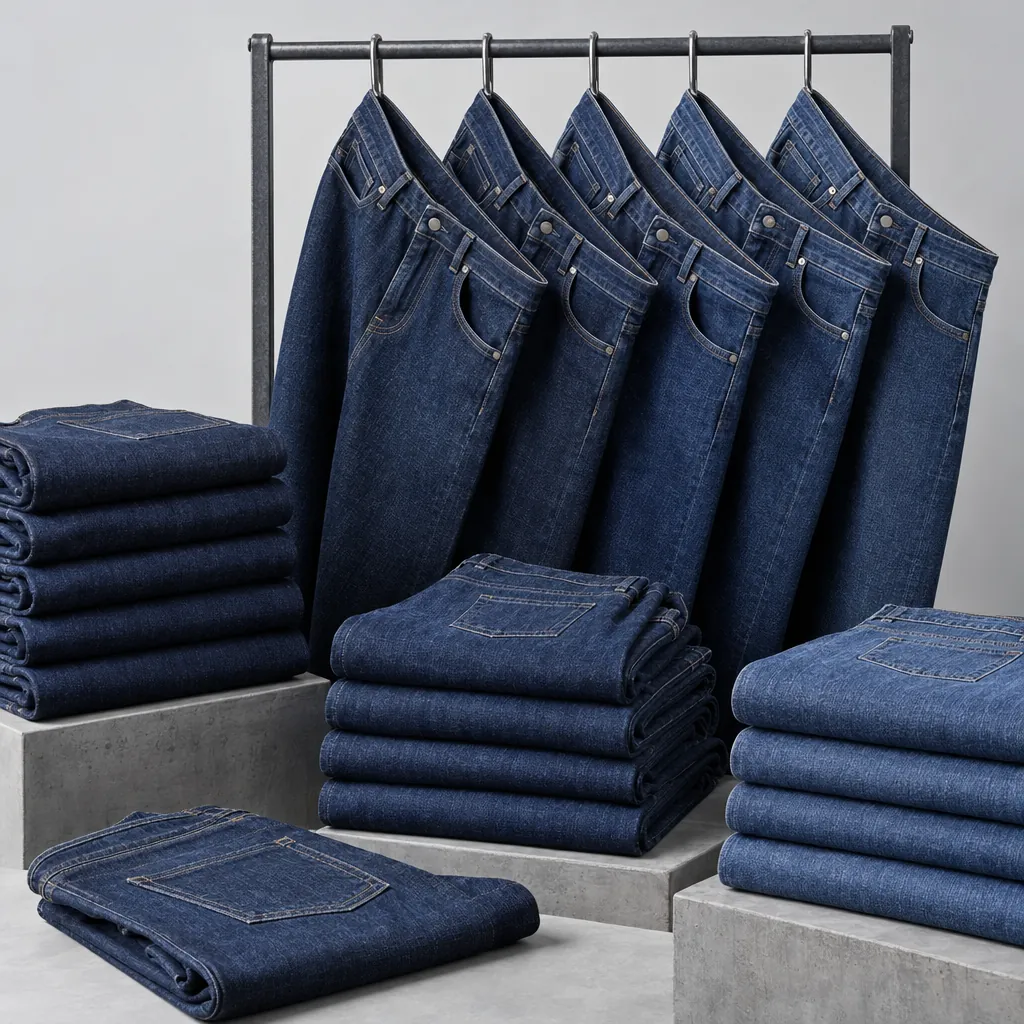
Denim color is never entirely uniform, and buyers who expect it to be set themselves up for disputes. Indigo sits near the surface of the yarn, garments move through wash lots in batches, and each batch emerges with its own shade within a range. None of this is a defect by itself; the defect is a shipment in which the range was never defined, or in which pieces of visibly different shade were packed into the same carton. Color consistency on a jeans program is therefore a buying-side discipline: standards, tolerances, lot grouping and packing rules, agreed before bulk. The controls cost little, and most of them are paperwork.
Where shade variation comes from
The variation has ordinary sources. Yarn is dyed in lots, and lot-to-lot shade differs slightly even under a controlled recipe. Fabric woven from different yarn lots reads differently after wash. In garment wash, the result depends on the garments in the machine together, on the recipe and on the equipment, which is why two runs of the same recipe rarely land on exactly the same tone. Garment-dye programs add another layer, because the bath is matched to the garments rather than to the cloth, and the resulting range behaves differently from piece-dyed goods. The buyer's task is not to eliminate this variation, which is not possible, but to bound it and to keep the bounds visible in the packing.
Standards before bulk
Consistency starts with an approved reference that both parties can point to. For a wash program that is a sealed wash standard garment, approved after the lab dip stage; for a garment-dye program it is a dyed standard agreed with the same formality. The standard should be labeled and dated, and both sides should hold part of the same set. Alongside it, the specification should define how comparison is made: under which light source, at what distance, and by whom. Shade evaluation in a showroom and in a light box gives different answers, and the specification should say which one governs. Where a range carries several washes, the full set of standards should be approved together, so that the washes read as a family on the floor and not only one by one. Each standard should also be large enough to judge: a full leg panel reads differently from a swatch the size of a card, because shade perception changes with the area of fabric in view. Where the wash includes hand finishing, the standard should carry that finishing too, not only the base tone.
Tolerance and the shade band
A tolerance can be written as words or as a physical band of swatches spanning the acceptable range around the standard. The band approach, familiar from piece-dyed goods, works well in denim: the supplier shows where each production lot falls, and the buyer approves the band limits before bulk rather than arguing after. The specification should state the consequence of a lot outside the band, in the same clause that defines the band. A shade tolerance without a stated remedy is a topic for negotiation rather than a term. The clause structure that attaches remedies to defect categories is covered in the article on common denim quality issues and clauses.
Lot grouping and packing rules
The second half of the discipline happens at packing. Garments from one wash lot should be packed together, cartons should be labeled with the lot, and an order for one store or one style should be drawn from as few lots as the quantity allows. A mixed carton is where shade differences become visible: two jeans side by side in the same box invite comparison, while pieces separated across cartons and across a size curve rarely meet a customer's eye at once. The packing instruction should state the lot-segregation and carton-marking requirements explicitly, and the pre-shipment inspection should check the packing against it, not only the garments against the seal. Where a program ships to several stores or channels, the plan can go one step further and dedicate lots to destinations, so that a single location receives a single tone. That instruction belongs in the packing specification, where the crew can read it, rather than in correspondence.
Keeping bulk honest against the standard
Between approval and shipment, two checkpoints keep shade honest. The pre-production sample, made on bulk fabric through the bulk wash, is compared with the standard before cutting proceeds. Later, the pre-shipment inspection compares packed goods with the same standard under the agreed light. When a program's recipe changes for any reason, the change goes through the amendment process and, where shade could move, through a new approval; the change control habits that keep this orderly are in the article on spec drift from mockup to production. Inspection points and how they are staffed are described on the quality control page.
What consistency can and cannot promise
Even a disciplined program ships jeans within a range, not at a point. Buyers can set expectations honestly downstream by describing tone in words on the product page and by photographing the shipped lot rather than a heroic sample. A small degree of variation is part of how the category is made, and customers who understand that read it as character. The aim of the controls above is that the variation stays inside an approved band and that no carton tells a different story from the carton beside it. Programs that state their bands in writing find shade conversations shorter, because the agreement predates the goods instead of following them. That is the quiet benefit of the discipline: the shade conversation happens once, at approval, instead of repeatedly, at delivery.
Working with jeans
Shade standards, tolerances, lot grouping and packing rules for a jeans program are to be confirmed in writing before bulk production. FULVERA coordinates wash approvals, shade bands and packing instructions with the producing partner and checks bulk against the approved standard. To start a program, request a quote.