Home / Guides / Private Label Jeans: A Preparation Checklist for Retail Buyers
Private Label Jeans: A Preparation Checklist for Retail Buyers
What a retailer needs ready before starting a private label denim programme: brand brief, artwork, specifications, compliance and order planning.
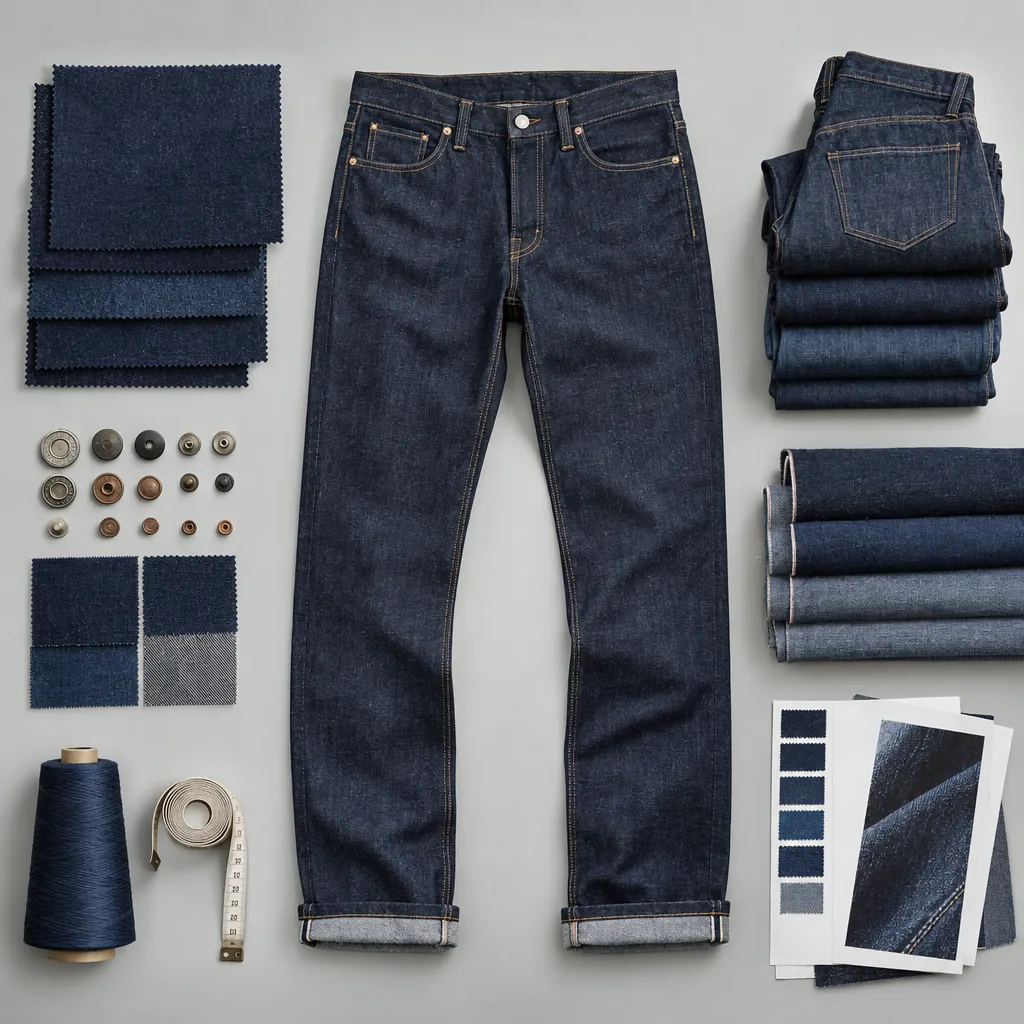
Private label lets a retailer sell jeans under its own name, with a garment made to its own specification. The appeal is clear: the store controls the identity of the range, the labels and the packaging, and it can build a repeat business around a product that no competitor carries. The risk is also clear. A private label program that starts without a complete brief tends to stall at artwork, stall again at the first fit approval and cost more than planned. This checklist covers what a retail buyer should prepare before the first conversation with a manufacturer, so that the program moves from enquiry to production with fewer rounds of revision.
1. Write the brand brief
The brand brief is the single document that describes what the range is for. It should state the target customer, the price position the store intends to hold, the styles the range will include and the occasions the customer will buy them for. It should also name the sales channels: physical stores, online, or both. A brief that is short and specific gives the manufacturer enough information to propose fabrics and silhouettes. A brief that is vague leads to a long sequence of proposals that do not match the store's intent.
The brief should also state what the store does not want. Excluding a wash, a finish or a logo style early saves time later, and it signals to the manufacturer which parts of the range are fixed and which are open for suggestions.
2. Choose the core styles
A private label range does not have to be large. A focused range of two or three core silhouettes, each in full size depth, often performs better than a wide range of thin styles. The core styles should match the customer data the store already has. A buyer who wants to add a new silhouette should plan a limited test run before committing the whole range to it. The choice of silhouettes sets the fit approvals the team must manage, so the list should match the team's capacity for review.
3. Prepare the artwork and label files
Every label, hang tag, swing ticket and carton mark needs a final artwork file. The manufacturer will specify the file format, the color references and the resolution required for printing or weaving. The store should supply the final text for every label, including the size, fiber content, care instructions, country of origin and any legal wording required by the target market. Artwork that changes after proof approval is a common source of cost and delay, so the text should be fixed before the first proof is requested.
4. Set the specification sheet
The specification sheet is the contract between the store and the factory. It should list the fabric, the wash, the finish, the trims, the hardware, the stitching, the measurement points for each size and the packaging. It should be approved in writing before production starts. Any change after approval should be recorded as a revision with a date and a reason. A buyer who keeps a clean version history avoids disputes about what was approved.
5. Plan the compliance and labelling
Labelling and compliance requirements depend on the target market and on the type of garment. Children's garments and some product claims carry specific requirements. A buyer should confirm the labelling content, the test reports and any documents the destination market needs before the labels are produced, not after goods have shipped. The store's own legal or compliance adviser should review the requirements, because the manufacturer can produce to the specification but cannot decide what the store must legally print. Requirements and test scope are to be confirmed in writing for each program.
6. Agree the sample and approval steps
A private label program needs at least a fit sample, a wash sample and a pre-production approval. The buyer should set a timetable for each, and should name the person who gives approval on each stage. Where the store works with more than one person on approvals, the sign-off rules should be agreed in advance. Sample charges, lead times and whether charges are credited against the bulk order are to be confirmed in writing.
7. Forecast the order and the repeats
Manufacturers plan materials and production slots around forecasts. A buyer who shares a realistic order mix and an expected repeat schedule helps the factory secure fabric and trims at a stable cost. A forecast that changes sharply after confirmation can delay the order and raise the unit price. The forecast should be treated as a planning figure, not a commitment, and the commitment terms should be agreed in writing.
8. Confirm the commercial terms
Before any artwork is produced, the store should have written terms for the minimum order quantity, the unit prices in each quantity tier, the set-up charges for labels and packaging, the deposit, the balance payment, the delivery terms and the lead time from order confirmation to ready-to-ship. These terms differ by program and by manufacturer. None of them should be assumed from a general price list. All values are to be confirmed in writing before the deposit is paid.
A short list before the first call
- A one-page brand brief covering customer, price position, channels and styles.
- A list of core silhouettes and the size run each one needs.
- Final label text and artwork files, or a clear plan for producing them.
- The target market and the labelling and compliance content it requires.
- A forecast of the order mix for the first season and for repeat orders.
- The name of the person who approves each stage, and the approval timetable.
Summary for the buyer
A private label denim program succeeds when the brief, the artwork, the specification and the compliance plan are ready before production starts. Keep the core range focused, fix the label text early and approve every stage in writing. Minimum quantities, set-up charges, lead times and payment terms are to be confirmed in writing with each manufacturer before any commitment is made.