Home / Guides / How Retail Stores Can Merchandise Jeans to Sell More
How Retail Stores Can Merchandise Jeans to Sell More
Merchandising jeans in a retail store: wall and table layout, size and fit display, silhouette grouping, fixtures and replenishment routines.
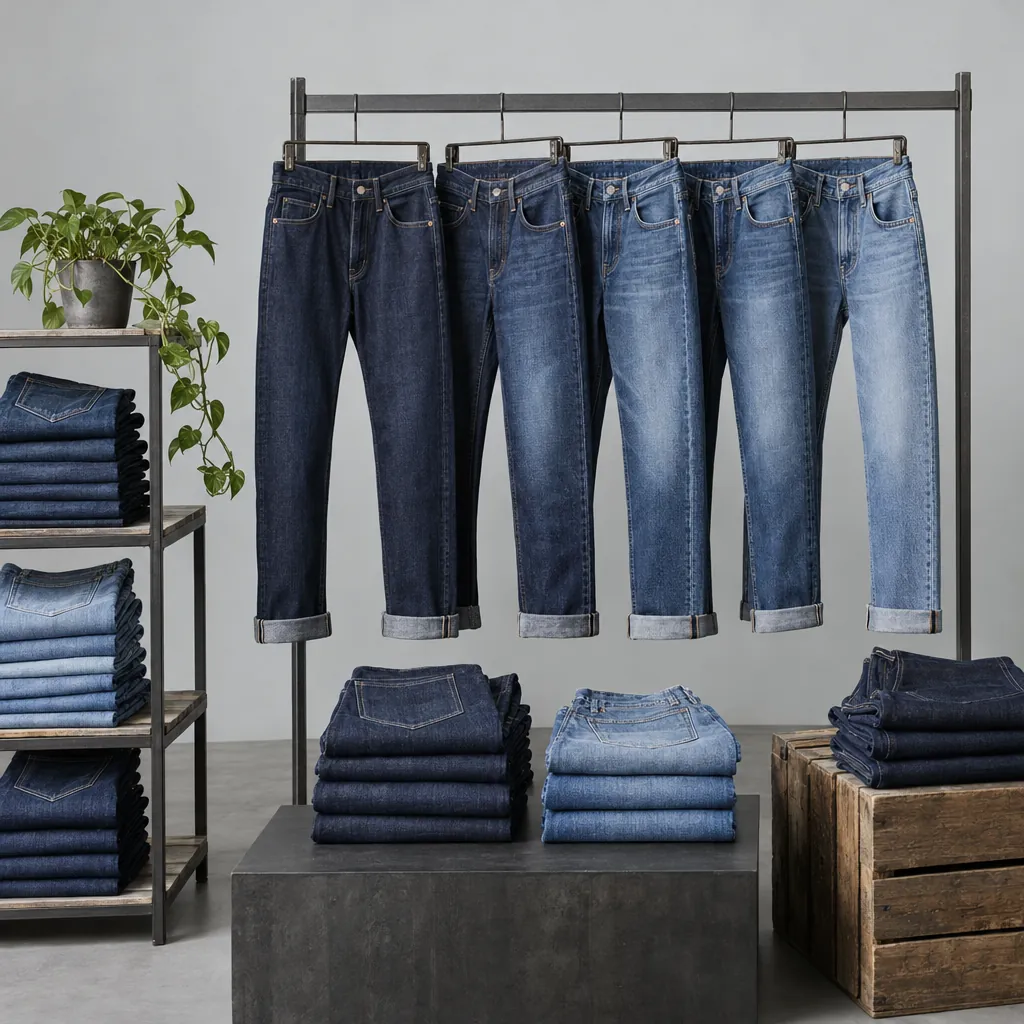
Jeans are one of the most visited categories in a clothing store, and one of the easiest to make look untidy. Stacks fall over, sizes are mixed, and a wall of similar washes can make it hard for a customer to find the cut she wants. Good merchandising makes it easy to compare, easy to find the right size and easy to see what is new. This article gives retail store managers and visual merchandisers a practical approach to displaying jeans, from the layout of the wall to the routine that keeps it looking full through the week. It is written for stores that buy wholesale and want the denim section to support sales rather than slow them down.
Start with the customer's question
Customers come to the denim section with a question. They usually know the cut they want, or at least the feel they are looking for. The display should answer that question quickly. A store that groups jeans by silhouette, such as straight, wide leg or skinny, lets the customer move to the right area in seconds. A store that groups by brand or by price makes the customer search every stack. For most stores, silhouette is the clearest first level of grouping, and rise or wash is the second.
Plan the wall
A denim wall works best when it is organised from the top down. The top row shows the newest or most important styles, styled on a mannequin or a folded display, so that the customer can see how the jeans look when worn. The middle rows carry the core range, folded in size order so that each size can be found without disturbing the stack. The bottom rows hold the full size run for the most popular styles and the replenishment stock. A well-planned wall has a clear logic from top to bottom, and the staff know where each category sits.
Fold and stack for size
Folding is a skill, and it affects how the jeans look for the whole time they are on display. A consistent fold keeps the wash visible and the edges straight. Jeans should be folded with the pocket and the label in the same position on every piece, so that the stack looks uniform. Sizes should be stacked from the smallest at the top to the largest at the bottom, or in the order the store chooses, but the same order should be used on every table and wall. Staff should restack the table at least once a day, because the customer will always disturb the order during the day.
Show the fit, not only the product
A customer who understands the fit buys with more confidence. Display can help. A simple card that describes the rise, the leg width and the fabric in plain language gives the customer a reference point. A size chart near the wall, consistent with the product page online, reduces the number of questions to staff. Where the store has a fitting room, the fitting room should carry the sizes that are most often tried on, so that the customer does not need to ask.
Use the table and the wall together
The table is the place for new arrivals, promotions and styling ideas. It should be shallow and easy to browse, with the best sizes on top. The wall is the place for the full range. A customer who finds a style on the table can see the full size run on the wall, and a customer who finds the size on the wall can see the styling on the table. The two should be planned together, not as separate displays.
Fixtures and spacing
Fixtures should be strong enough to carry the weight of the stacks, and the shelves should be deep enough that the folded jeans do not fall forward. Spacing matters as well. A wall that is too full is hard to browse and makes the stacks look untidy. A wall that is too sparse looks like it lacks depth. A typical approach is to keep each style on a consistent block, with clear space between silhouettes. Fixture dimensions and quantities are to be confirmed against the store's own layout, not taken from a general plan.
Styling and mannequins
Styling shows the customer how the jeans can be worn. A mannequin in a wide leg style with a fitted top and a simple jacket tells a different story from a mannequin in a skinny style with boots. Rotate the styling every week, and use the same silhouette in more than one look. Styling should use the products the store sells, not items from other brands, because the customer is looking to buy the jeans on display.
Keep the section full
An empty size is a lost sale. Staff should check the wall and the table for gaps at least once a day, and should record the sizes that are sold out. A replenishment routine links the store to the buyer: when a core size runs low, the store raises a request, and the buyer reorders against the reorder point. Replenishment times depend on the supplier's lead time, which is to be confirmed in writing for each order.
Track what the display is doing
- Sales per linear metre of wall, compared week to week.
- Sell-through of the top row against the core rows, to see whether the display is pulling customers to the core range.
- Fitting room use by style and size, to see which sizes customers want to try.
- Sizes that run out first, to guide the next buy.
Summary for the store
Good denim merchandising starts with the customer's question and organises the section around silhouette, rise and size. Plan the wall from top to bottom, fold and stack consistently, show the fit clearly, and keep the section full through a daily routine. Measure the display and feed the results back to the buyer. Stock levels, reorder points and fixture quantities are to be confirmed with the supplier and the store's own layout for each season.