Home / Guides / How to Choose Jeans Styles for a Wholesale Denim Assortment
How to Choose Jeans Styles for a Wholesale Denim Assortment
A buyer's guide to choosing jeans silhouettes for a wholesale assortment: core styles, trend styles, sizing depth and how to balance risk across a season.
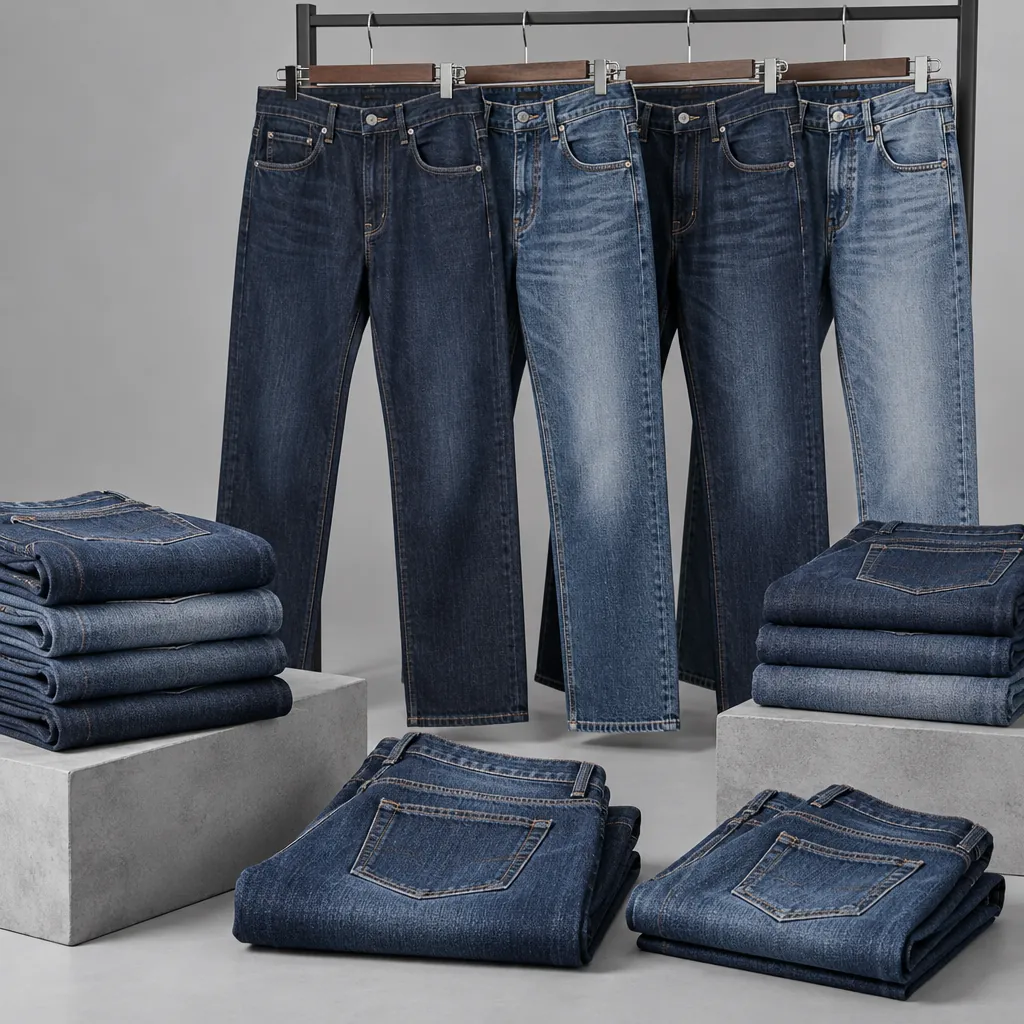
Choosing the silhouettes for a denim assortment is the first buying decision that shapes everything after it. The silhouette sets the fabric weight, the rise options, the size curve, the wash program and the number of fit samples a buyer needs to approve. A store that carries too many silhouettes spreads its open-to-buy thin and dilutes its size depth. A store that carries too few misses the customers who came in looking for a specific cut. This article explains how a retail buyer can structure the choice, using the silhouettes that customers search for most often as a starting point.
Start with the core and the trend
A workable denim range usually has two layers. The core is the set of silhouettes that sell steadily from season to season. The trend layer is the smaller set that follows the current shape of the market. Core styles protect the business because they reorder predictably. Trend styles bring new customers and a reason to visit the store between seasons. A common mistake is to build the whole range from trend styles, which makes sell-through hard to forecast and leaves the buyer with stock that does not reorder.
Consumer search interest is a useful signal for the trend layer. In the current United States search landscape, wide leg and flare denim draw the strongest shopper interest among the silhouette terms, while straight leg and skinny styles have broad demand spread across many long-tail variations. These signals describe what shoppers look for, not what a given store will sell, so they should be read as a direction for the trend layer and not as a sales forecast.
Match silhouettes to the customer you actually serve
Search volume tells a buyer what the market is interested in. It does not tell the buyer who walks into its own store. Before adding a silhouette, a buyer should write down the customer it serves, the age range, the body shape mix it sees in fitting rooms and the occasions the customer dresses for. A store serving office workers will usually give straight and bootcut a larger share. A store serving younger shoppers may give wide leg and cargo a larger share. A plus size customer base needs its own grading and should not be treated as a footnote to the standard range.
A practical method is to review the last two seasons of sales by silhouette, then compare the sell-through rate with the number of styles carried. Silhouettes that sold well with few styles are candidates for more depth. Silhouettes that needed many styles to sell modestly are candidates for trimming.
Decide the depth before the breadth
Breadth is the number of silhouettes. Depth is the number of washes, rises and sizes within each silhouette. Most buyers under-invest in depth. Two silhouettes carried deeply, with three washes, two rises and a full size run, often outsell five silhouettes carried thinly. Depth also reduces the risk of size gaps, which are one of the most common reasons a denim section looks incomplete by the second week of a season.
A sensible starting structure for a single season is to carry a small number of core silhouettes in full depth, one or two trend silhouettes in medium depth, and one test silhouette in a limited run. The test run gives the buyer real sales data before the next buying cycle.
Plan the rise and the wash together
Rise and wash are the two variables that multiply the number of products. A silhouette with three rises and four washes becomes twelve products before the size run is added. Buyers should decide which rise anchors the range and which rise is an option, then choose the washes that match the core customer. Dark indigo is generally the most flexible wash for a core range, because it works with a broad set of tops and occasions. Lighter washes work better for seasonal capsules, where they can carry a fashion message for a shorter period.
Timing also matters. A silhouette that arrives in the store after the peak weeks of its season has to be sold at a lower margin, so the buyer should work back from the expected selling window. Development time for a new fabric or wash often runs longer than a buyer expects, and it should be scheduled against the season rather than the order date. Lead times for each silhouette are to be confirmed in writing before the buying calendar is fixed.
Use fit approval to control risk
Every silhouette needs a fit approval before the first bulk order. A buyer who approves a wide leg fit on a single model may find that the same pattern does not hold on the full size range. For this reason, the fit approval should cover the first and last size of the run, and the specification sheet should record every measurement point. The more silhouettes a buyer carries, the more fit approvals the team must manage, so the number of silhouettes should match the buying team's capacity to review them properly.
A simple decision checklist
- Does the silhouette serve a customer the store already has, or does it bring in a new customer the store can reach?
- Can the buyer carry the silhouette in full size depth, or only in a thin run?
- Does the silhouette fit an existing rise and wash plan, or does it add a new set of variables?
- Has the fit been approved on the full size range, not only on one model?
- Is there a plan for reordering the silhouette if it sells above expectation?
Summary for the buyer
A strong denim assortment is built on a stable core, a limited trend layer and a small test layer. The silhouettes that search volume highlights are useful signals for the trend layer, but the core must be chosen from the store's own customer data. Depth is more valuable than breadth, and every silhouette added should come with a clear fit approval and a reorder plan. Pricing, minimum quantities and lead times for each silhouette are to be confirmed in writing with the supplier before the order is committed.
Specification fields
| Field | Value |
|---|---|
| Fabric composition | Pending |
| Fabric weight | Pending |
| Wash options | Pending |
| Rise and fit | Pending |
| Leg opening | Pending |
| Stitching and finish | Pending |
| Hardware and trims | Pending |
| Labels and packaging | Pending |
Size chart fields
Measurements are taken flat, in centimeters or inches, and confirmed per size run.
| Field | Value |
|---|---|
| Waist | Pending |
| Hip | Pending |
| Rise | Pending |
| Inseam | Pending |
| Leg opening | Pending |
Pricing
| Tier | Quantity per style | Unit price (USD, FOB) | Lead time |
|---|---|---|---|
| Tier 1 | 300-499 pcs | Pending | approx. 30 days* |
| Tier 2 | 500-999 pcs | Pending | approx. 30 days* |
| Tier 3 | 1,000+ pcs | Pending | approx. 30 days* |
*Typical industry reference ranges for custom denim programs. Final MOQ, quantity tiers, unit prices and lead times are confirmed in writing for each program.
Private label options
Private label options for this style, including labels, trims, pocket detail and wash development, are listed on the custom and private label page and confirmed in writing.