Home / Guides / Budgeting a first denim order: ranges and pitfalls
Budgeting a first denim order: ranges and pitfalls
How to budget a first denim order: the cost skeleton beyond the goods, where first orders overspend, and a sequence for sizing the buy.
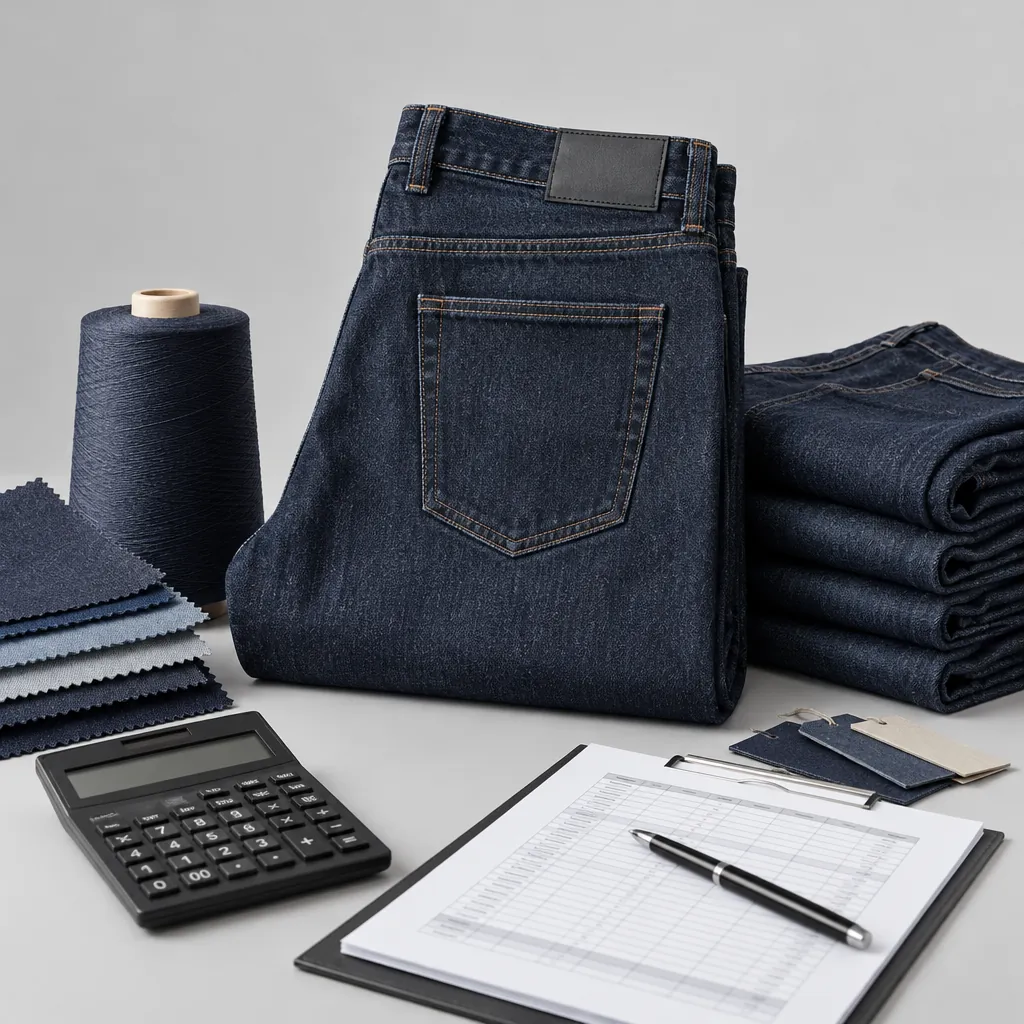
A first denim order fails in the budget more often than it fails in the market. The goods are quoted, the goods are affordable, and then sampling, freight, duty, photography and a second round of samples arrive around the quoted figure like a tide. Retailers who budget the whole journey up front place their first order calmly and can afford the second one; retailers who budget only the goods meet their first cash squeeze at the exact moment the program starts working. This article sets out the full skeleton of a first-order budget, the places where first orders reliably overspend, and a sequence for sizing the buy to a business that has not yet sold a pair.
The budget skeleton beyond the goods
- Sampling and development. The prototype, fit and pre-production rounds, plus the pattern and wash development a first program always needs.
- Freight and delivery. The legs from the factory door to the warehouse door, plus a buffer for destination charges that arrive as separate invoices.
- Duties and clearance. Entry charges based on the correct classification, not on a guess, plus brokerage.
- Selling assets. Photography, size chart production and any content the channel needs before the first pair can be listed, which online sellers chronically underestimate.
- Contingency. A reserve for the second sample round, the air shipment that saves a launch, or the reorder the first season demands. A budget without this line funds surprises by raiding the marketing budget.
The discipline is to build this skeleton before requesting quotations, because knowing the non-goods lines changes what a buyer can accept on the goods line, and it changes which supplier structures make sense.
It also helps to separate the budget's layers by their character. Goods cost scales with what is ordered and is largely quoted. Development cost happens once and is largely scheduled. Selling assets are discretionary and can be phased. Contingency is neither quoted nor scheduled, only sized. Budgets fail when these layers are blended into a single figure, because an overrun in one silently consumes another, and the team cannot tell which. A line per layer is all the sophistication a first budget needs, and it is enough to make the conversation with suppliers, and with the bank, concrete.
Where first orders reliably overspend
The recurring failures are predictable enough to plan against. Style count is the first: a first order that spreads the budget across many silhouettes buys depth in none of them, produces broken size runs, and multiplies sampling cost per unit of learning. Tier chasing is the second, when a buyer steps up a quantity band to earn a better unit figure and finances the extra inventory from the contingency line that was meant for emergencies. Air freight is the third, usually purchased under deadline pressure and rarely modeled in advance, so it is paid for at spot rates on top of a schedule that was already slipping. Re-sampling is the fourth, and it is not always overspending; the failure is not budgeting for it, which converts a normal development step into a crisis. Each of these costs less as a planned line than as a mid-course surprise.
Beyond the famous four sit the quiet adders. Cartons, polybags and labels on a first program are often bought at small-quantity prices that surprise buyers who assumed packaging rode free with the goods. Third-party inspection, where used, is charged per visit. Photography reappears whenever a style is added late. And the time of the buyer's own team is the largest quiet line of all, which is why style count discipline is a cash decision and not only a merchandising one: every style added to a first order adds coordination across every function the program touches.
Sizing the first buy
The first buy should be sized to produce information, not to fill a wall. A workable pattern for many first programs is a small set of core silhouettes in a concentrated size curve, with the budget weighted toward the one or two styles the retailer is confident it can sell, and a deliberately small trial allocation for the one style it wants to learn about. Depth beats width on a first order because depth produces clean sell-through signals: a style sold in full size runs tells the buyer whether to reorder and at what depth, while a style sold in fragments tells the buyer nothing except that the run was broken. The quantity structures that make small first orders practical are covered in MOQ negotiation.
Provision for the reorder belongs in the first budget even though the reorder itself does not. A first order that sells through faster than expected is the good problem, and it is only a good problem if cash exists to chase it; a retailer who spent the whole allocation learning that a style works has funded the learning and forfeited the reward. Holding back a share of the season's denim budget against the possibility of a fast reorder converts the first order from a bet into an experiment with an option attached, which is what a first order should be. The size of the reserve is a judgment about how confident the buyer is, stated in the plan rather than improvised in month two, so that releasing it is a decision rather than a reflex. Retailers who skip this line do not avoid the cost; they pay it in stockouts instead of in cash.
A sequence for building the budget
- Fix the style count and size curve first, since every other line scales from them.
- Price the goods at the entry tier, without assuming the tier above will be reached.
- Add the non-goods skeleton from the list above, each line sourced where possible rather than guessed.
- Add the contingency line, sized to cover a second sample round or a partial air shipment.
- Stress the total against the cash calendar, checking when each payment falls due under the order's payment terms, because a budget that is affordable in total can still be unaffordable in a given month.
The order journey the budget funds, from specification to shipment, is mapped step by step on our wholesale process page.
Working with jeans
Prices, minimums and lead times behind every budget line are confirmed in writing for each order. Share your first-season plan and target quantities, and request a quote that fits the budget you have actually built.